News · 18 August 2026
What Is Live Resin and Why Does It Matter in the Happy Hour Gummies?
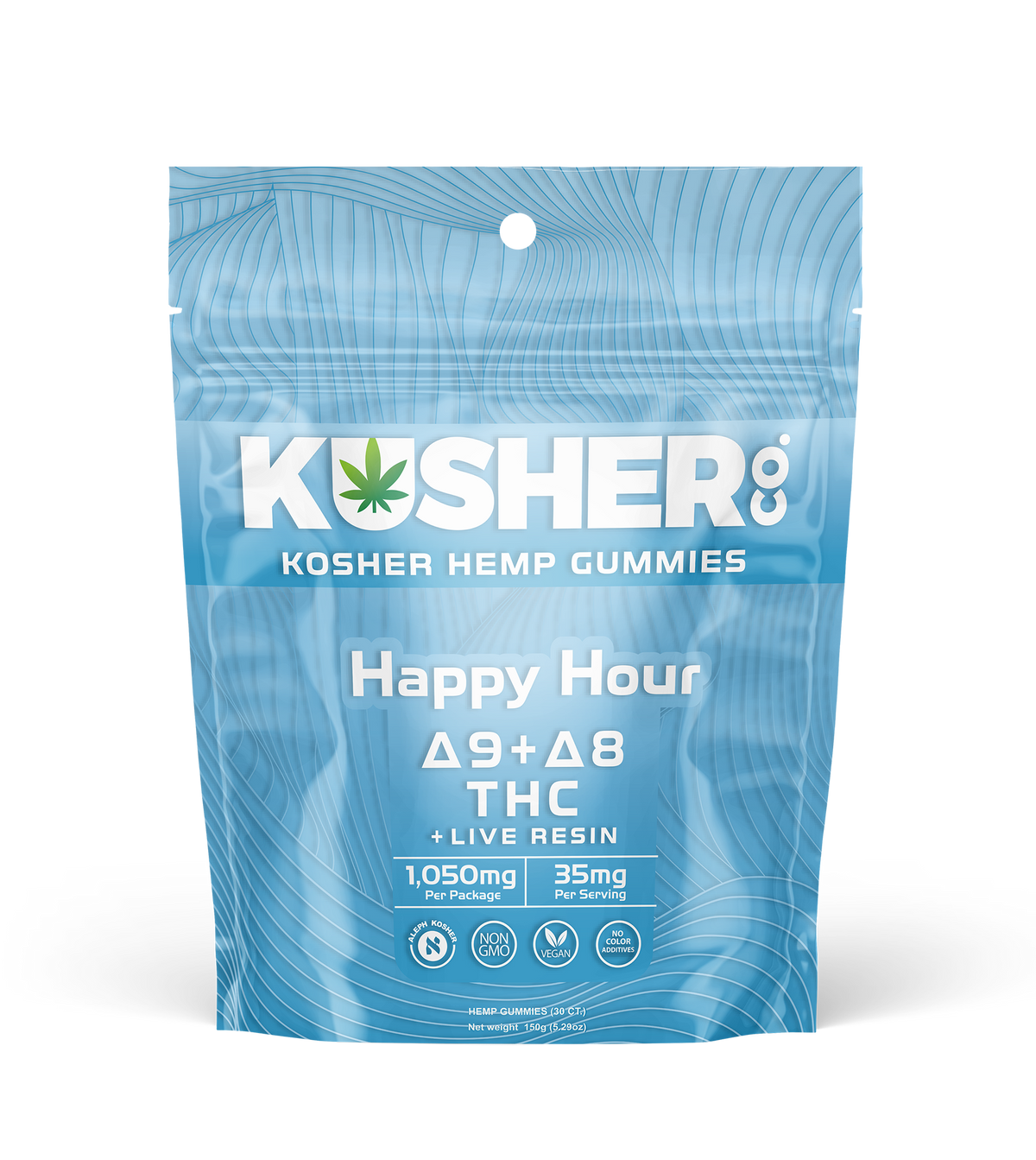
Live resin is a hemp extract made from flash-frozen fresh plant material rather than dried or cured flower, which preserves the full terpene profile, including volatile minor terpenes, that conventional extraction destroys. In the Happy Hour Kosher Hemp Gummies, live resin is paired with a dual-cannabinoid stack of Delta-8 and Delta-9 THC, so the jar carries a fuller set of plant compounds than single-cannabinoid distillate gummies and broad-spectrum isolates contain. The result is a product with botanical flavor integrity, no masking flavorants, and a formulation complexity that is a genuine technical barrier against commodity competitors.
That matters more than it sounds. Most hemp gummies on the market are built around distillate, which is cheap to produce, stable at room temperature, and easy to scale. They work, but they are stripped products. The extraction process that creates distillate runs at temperatures that volatilize and destroy the lighter, more delicate terpene compounds that were present in the living plant. What you get is high cannabinoid concentration with a flat, sometimes vaguely medicinal flavor that manufacturers cover with artificial fruit flavoring. Live resin skips all of that. The plant goes from harvest to freezer before any meaningful degradation can happen, and the extraction happens cold, so those volatile terpenes stay intact. That is not a marketing difference. It is a chemistry difference.
Why Stabilizing Live Resin with D8 and D9 Is Actually Hard
The mistake most people make is assuming that putting live resin in a gummy is just a matter of swapping one ingredient for another. It is not. Live resin is more chemically complex than distillate, and that complexity creates real formulation challenges when you are also working with two cannabinoids that behave differently from each other.
Delta-8 and Delta-9 THC are structurally distinct molecules, and they behave differently inside a food matrix, from how readily each one disperses to how each holds up against heat and time. Building a gummy around both of them at once, and then adding live resin on top of that, requires precise emulsification to keep the mix stable and evenly distributed. Get it wrong and you end up with inconsistent cannabinoid content between gummies in the same jar, or a product that degrades faster than it should.
Most single-cannabinoid gummy manufacturers do not attempt this. The formulation overhead is real. You need the technical knowledge to stabilize the live resin without cooking off the terpenes you paid to preserve in the first place, and you need the D8/D9 ratio held to spec so every gummy in the jar carries the same one. The Happy Hour gummies exist because we built that capability. It is not something you can shortcut.
You will see the phrase entourage effect stuck on products like this one. We are not going to tell you what a mixture of plant compounds does once you have eaten it, because that is not something we can stand behind and the people who say it loudest rarely can either. What we can describe is composition. A distillate gummy with a trace terpene blend stirred back in after the fact is not the same thing as a live resin product where those terpenes were never stripped out to begin with. The minor terpenes, the ones beyond the dominant limonene and myrcene that survive most extraction methods anyway, are exactly what broad-spectrum isolates and standard distillate products are missing. Live resin keeps them. That is a difference in what is in the jar, and it is the only version of that argument we are willing to make.
What Freezing Actually Saves
Terpenes are the aromatic compounds that give a hemp plant its smell. They are small, light molecules, and that lightness is exactly the problem. Compounds that evaporate readily at room temperature are the first things to leave a plant once it is cut and hung to dry, and drying is the standard first step in almost every hemp supply chain. A week in a drying room at ambient temperature, then a cure, then heat-driven extraction on top of that. By the time the oil reaches a formulator, a real share of what the standing plant was carrying has gone into the air of the barn.
Flash-freezing interrupts that sequence at the earliest point available. The plant is cut and frozen within hours, before a drying stage exists at all, and it stays frozen through extraction. Cold slows the movement of molecules, which is the whole reason a freezer keeps food from going off, and it slows the escape of volatile terpenes for the same reason. Nothing is added back later. The terpene profile in a live resin extract is the one the plant was carrying when it was alive, minus whatever the process loses along the way, rather than a reconstruction assembled after the fact from a flavor catalog.
The trade-off is cost, and it is not small. Freezing fresh biomass means freezer capacity at the farm, frozen transport, and a cold extraction line that runs slower and yields less than the hot process behind distillate. Wet frozen material also weighs several times what dried material weighs, so part of what you are paying to move is water. Every one of those costs lands in the price of the finished gummy. That is the honest reason most of this category runs on distillate and always has.
Flavor and Aroma Are Where You Notice It
Distillate is close to flavorless in the way refined sugar is close to flavorless. Stripping a plant oil down to one cannabinoid at high purity takes the plant out of it. What is left has a faint chemical edge that most manufacturers cover with an artificial fruit flavor system, which is why so many hemp gummies taste like a generic candy aisle rather than like anything that grew. The flavoring is not there to be nice. It is there to fill a gap.
A live resin gummy starts from the opposite position. The extract arrives carrying limonene, myrcene, pinene, linalool and a long tail of minor terpenes in whatever ratio that particular harvest produced, and those compounds have real smell and taste on their own. Limonene reads as citrus peel. Pinene reads like a pine bough. Myrcene is the earthy, slightly herbal note people recognize from the raw plant. Our job in formulation is to work with that rather than bury it, which means a lighter hand on added flavor and a finished gummy that tastes like hemp instead of like a candy pretending it is not.
That cuts both ways, and we would rather say so up front than let you find out at the register. Some people do not want to taste hemp. If your reference point is a distillate gummy in a bright artificial flavor, the first Happy Hour gummy will read as more botanical than you were expecting, and a few customers decide that is not for them. There is also natural variation. Terpene ratios shift between harvests the way a crop of tomatoes shifts between seasons, so a jar from one run is not a perfect flavor match for a jar from another. We could sand that off with heavier flavoring and never mention it. We would rather keep the variation and say so.
Aroma deserves its own word, because you meet it before you taste anything. Open a jar of the Happy Hour gummies and there is a smell. It is not strong and it is not unpleasant, but it is present in a way a distillate product simply is not, and it is the fastest informal check on whether a live resin claim on a label is real. A live resin product that smells like nothing at all has either lost its terpenes somewhere between the field and the jar or never had many to begin with.
Kosher Certification on a Live Resin Product Is Rare, and That Is the Point
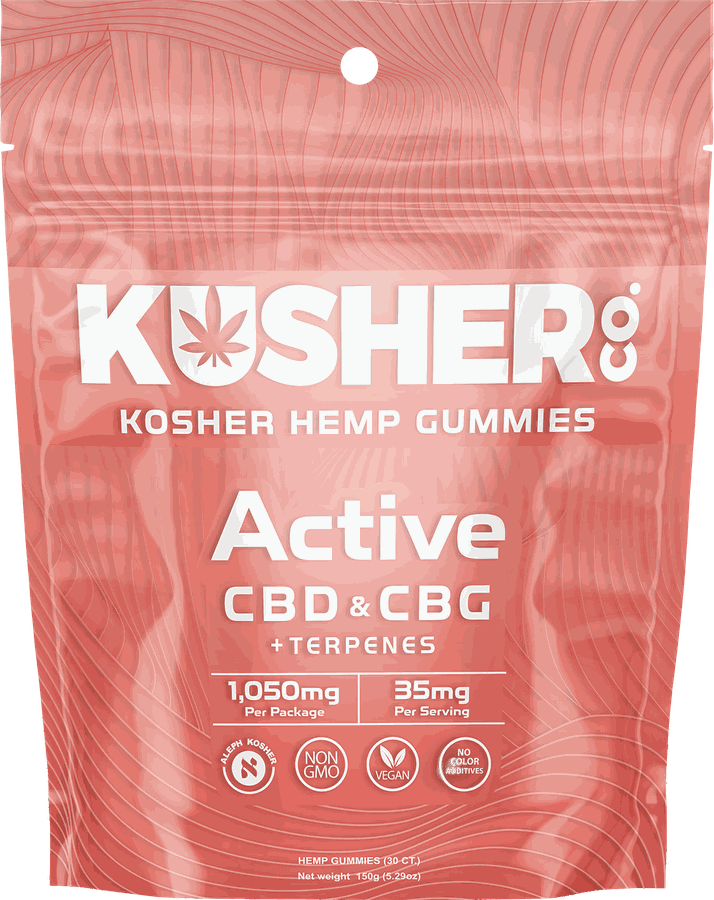
The Happy Hour gummies carry kosher certification. So do all of the core gummy SKUs in our lineup, including the Active Kosher Hemp Gummies, the Night Time gummies, the Wellness gummies, and the D8 gummies. The Full Spectrum Kosher Hemp Extract CBD Tincture is certified too.
Kosher certification on a live resin product is uncommon. Most live resin manufacturers skip the certification process entirely. The overhead is real: third-party audits, ingredient sourcing requirements, production facility standards, and ongoing compliance all add cost and complexity. For a product category that is already harder to produce than standard distillate gummies, most manufacturers conclude that certification is not worth pursuing.
We disagree, and the reason goes beyond serving observant customers. Kosher certification on any product is a quality-intentionality signal. The auditing process requires documentation and traceability across every ingredient and every stage of production. If you are willing to submit a live resin product to that level of scrutiny, it is because you are confident in what is in it and how it was made. It is much harder to cut corners in formulation when a third-party auditor is reviewing your process.
For customers who keep kosher, this matters in the obvious practical way. For customers who do not, it is still meaningful. Certification is a form of accountability that most hemp brands, especially in the premium live resin segment, have not taken on. We have taken it on across the entire core lineup, including the most complex product we make.
One honest note on this: we do not specify the certifying body or classify the gummies beyond kosher certification itself. If you have specific requirements around certifying organizations or sub-classifications, reach out before purchasing. What we can confirm is the certification exists on every product tagged with it in our catalog, and that includes the Happy Hour gummies.
Cold-Chain Requirements and Shelf Life Are Not a Warning. They Are a Transparency Signal.
Live resin requires cold-chain handling. The volatile terpenes that make it worth using are also what make it more sensitive to heat and time than distillate. At room temperature, the coating on a live resin product can go tacky, and over a longer storage window, the terpene profile degrades. That means the shelf life on a live resin gummy is shorter than a standard distillate product, and it means storage matters.
The short version: keep the Happy Hour gummies cool and out of direct light. A drawer, a cabinet away from the stove, or the refrigerator all work. Do not leave them in a hot car or on a windowsill. This is not a fragile product, but it is one that responds to its environment in a way a distillate gummy does not.
We are transparent about this because it is the honest trade-off of using live resin. A manufacturer who wanted to maximize margin would use distillate. It is cheaper, it ships more easily, it sits on a shelf longer, and most customers cannot tell the difference until they have had both. We chose live resin because the terpene profile it preserves is the actual mechanism behind what makes the Happy Hour gummies different from every other D8/D9 product on the market. Choosing a less demanding ingredient to make our logistics easier would defeat the point.
If you are looking for a gummy you can throw in a hot gym bag and forget about for three months, a standard distillate product will serve you better. The Happy Hour gummies are priced at $29.99, require a bit more care in storage, and are built for a buyer who wants the formulation difference to actually show up in what they smell and taste. That buyer exists, and this product is built for them. You need to be 21 or older to purchase.
The bottom line is simple. Live resin is not a buzzword on this label. It is the reason the terpene profile in the jar is close to what was in the standing plant, the reason the flavor is clean without artificial masking, and the reason these cost what they cost to make. If you already keep our topicals in your gym bag, the gummies are a different format out of the same catalog rather than a replacement for them. If you are new to live resin and used to distillate gummies, the difference in taste and smell is noticeable. It is worth trying once to find out whether it is worth making permanent.
Still have questions about the formulation or the handling? These are what people ask us most before they add the Happy Hour gummies to their cart.
Frequently Asked Questions
What makes live resin different from the distillate used in most hemp gummies?
Distillate is produced by heat-intensive extraction from dried, cured flower. That process drives off the lighter, more volatile terpenes the living plant was carrying. Live resin is extracted from flash-frozen fresh plant material, so those compounds stay in the extract instead of leaving during drying. The practical difference is composition and, from there, smell and taste. A live resin gummy carries a fuller terpene profile and needs less added flavoring to be palatable. Most hemp gummies on the market use distillate because it is cheaper, more stable on a shelf, and far easier to scale.
Why do the Happy Hour gummies list both Delta-8 and Delta-9 instead of one cannabinoid?
Delta-8 and Delta-9 THC are two distinct molecules that differ by the position of a single double bond on the ring. The Happy Hour gummies are formulated with both of them plus live resin, and total THC in the finished product stays under 0.3 percent. Most gummy manufacturers build around one cannabinoid because a dual-cannabinoid formulation is more demanding to keep consistent, especially when live resin is being stabilized in the same batch. If you want a single-cannabinoid product instead, the D8 Kosher Hemp Gummies carry Delta-8 on its own. You need to be 21 or older to buy either one.
How should I store the Happy Hour gummies to protect the live resin?
Keep them cool and out of direct light. A drawer, a cabinet away from the stove, or the refrigerator all work. Avoid leaving them in a hot car, next to a heat source, or on a windowsill. Live resin carries volatile terpenes that are sensitive to heat and to time. At warmer temperatures the gummy coating can go tacky and the terpene profile starts to thin out, which erases the composition difference you paid for. Shelf life is shorter than a standard distillate gummy, so buying quantities you will finish in a reasonable window is the practical approach.
What is in your topicals, and how are they applied?
The Cooling Pain Relief Gel ($25) carries 500mg of CBD with rosemary, thyme extract, tea tree and mint, and is applied by hand across a broad area. The Cooling Relief Stick ($20) carries 500mg of CBD with eucalyptus and mint in a coconut oil and shea butter base plus tea tree, and is applied by rolling the stick directly on the skin. The Heating Relief Stick ($20) uses the same 500mg CBD base with a warming build. The Joint and Muscle Roll on Relief ($20) carries 350mg of CBD with menthol, tea tree and aloe. The Pain Relief Gel Roll On ($20) carries 350mg of CBD.
What does kosher certification actually mean for a live resin product?
Kosher certification requires third-party auditing of ingredients, sourcing and production processes. For a live resin gummy that overhead is significant, which is why most live resin manufacturers skip it. Carrying the certification on the Happy Hour gummies means every ingredient and every production step has been reviewed and approved by a certifying authority. For customers who keep kosher, that is a practical requirement rather than a nice extra. For everyone else it signals a level of traceability that the uncertified live resin market does not consistently offer. All of our core gummy products carry it.
How do the Happy Hour gummies compare to the D8 Kosher Hemp Gummies?
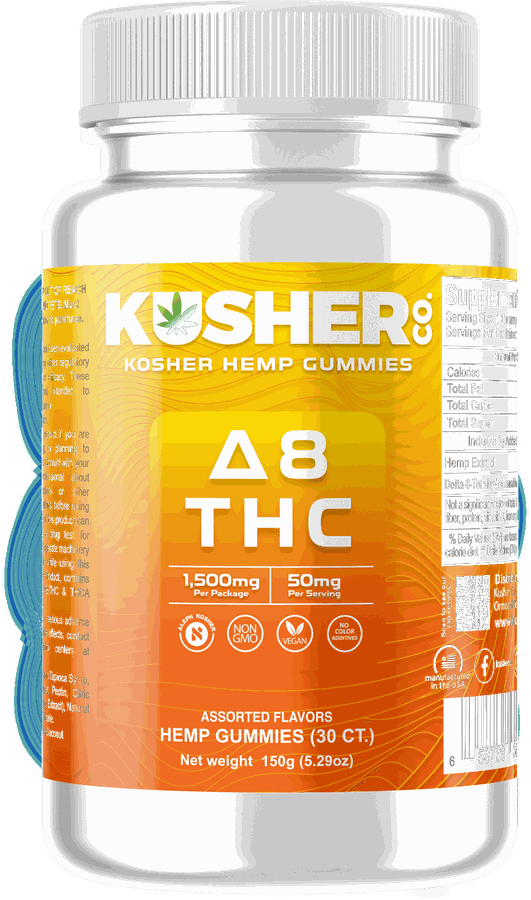
The D8 Kosher Hemp Gummies ($39.99) are a single-cannabinoid product built around Delta-8 in a jar format, with no live resin in them. The Happy Hour gummies ($29.99) list Delta-8 and Delta-9 together with live resin, and total THC stays under 0.3 percent. So the two products differ on two axes at once, the cannabinoid list and the extraction method behind the material. Buy the D8 jar if you want the shortest ingredient list we offer. Buy the Happy Hour gummies if you want the fullest plant extract we make. The price gap runs the other way from what people expect, and that is a manufacturing story rather than a strength rating.
Does live resin change how the gummy tastes?
Yes, and that is the part you can verify yourself without trusting anything on the label. Live resin gummies carry the plant terpenes into the finished product, so they taste and smell more botanical than a distillate gummy carrying an artificial fruit flavor system. Some people prefer that immediately. Some people find it stronger than they expected. Terpene ratios also vary between harvests, so jars from different runs will not match each other exactly on flavor. We call that variation a feature of an agricultural product rather than a defect to be papered over with more flavoring.
Ready to pick one? Browse Kosher Hemp Gummies.