News · 18 August 2026
Why Our Prices Run From $20 to $40 and What Changes Across That Range
Everything we sell falls between $20.00 and $40.00, and the spread has far less to do with how much CBD is in the package than most people assume. Four topicals sit at $20.00. One gel sits at $25.00. Four gummy formulas sit at $29.99. The Delta-8 jar sits at $39.99, and the tincture climbs from $20.00 to $40.00 across five strengths. Nothing on the site explains that range, so here it is in one place.
We would rather explain the spread than let it look arbitrary. Part of it is how many separate ingredients a formula carries. Part of it is what had to happen in a lab before a cannabinoid existed in usable quantity at all. A large part of it, honestly, has nothing to do with hemp: the bottle, the pump, the label, the carton, the batch testing, the certification paperwork. Those costs land on every single unit whether that unit holds 250mg of CBD or 3000mg. Once you can see that fixed layer sitting underneath the price, most of the range stops looking random.
The whole range, in one list
Here is the entire catalog by price, with nothing left out. It is a short list, which is deliberate. We would rather sell eleven things we can explain than forty we cannot.
- Cooling Relief Stick, Heating Relief Stick, Joint and Muscle Roll on Relief, and Pain Relief Gel Roll On: $20.00 each
- Cooling Pain Relief Gel: $25.00
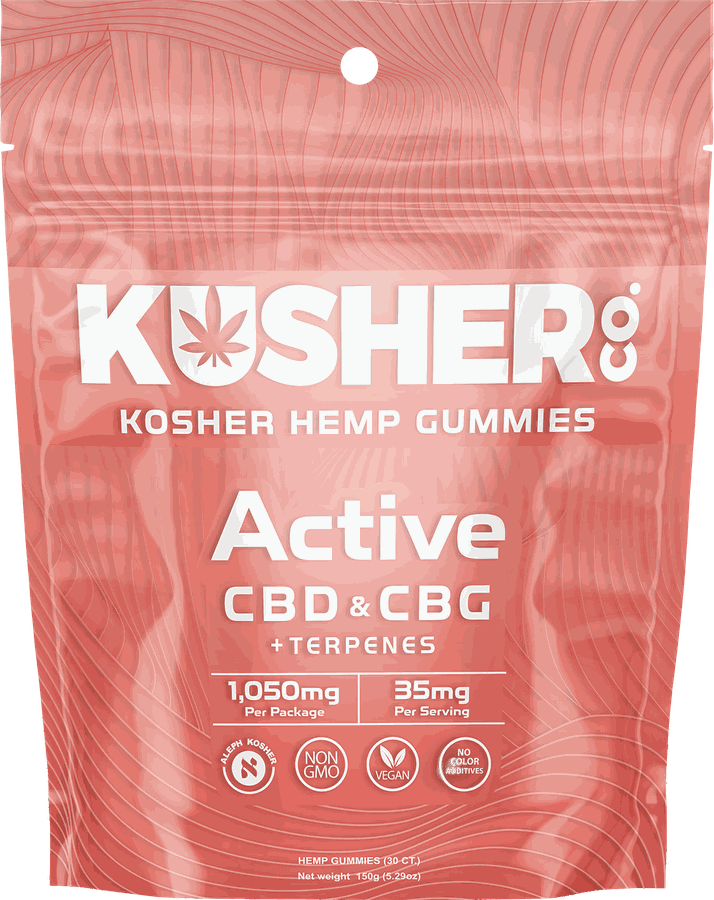
- Wellness, Active, Night Time and Happy Hour Kosher Hemp Gummies: $29.99 each
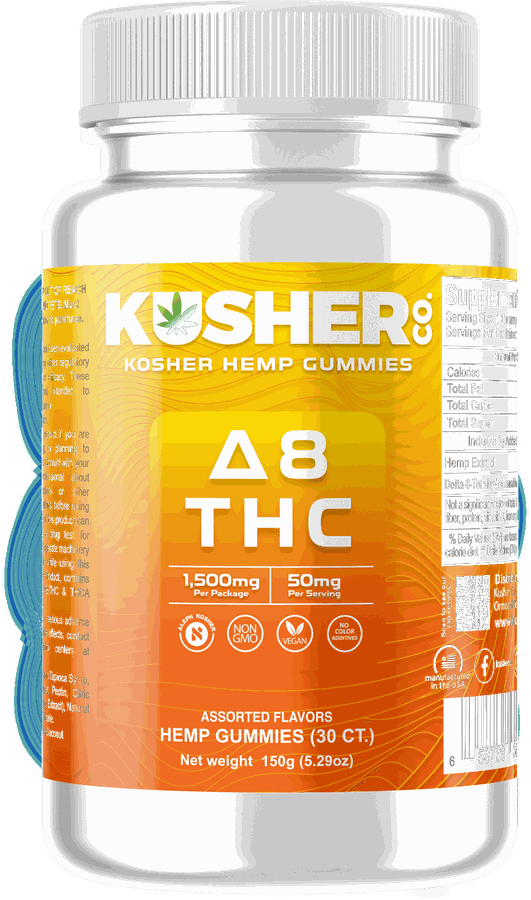
- D8 Kosher Hemp Gummies, the jar format: $39.99
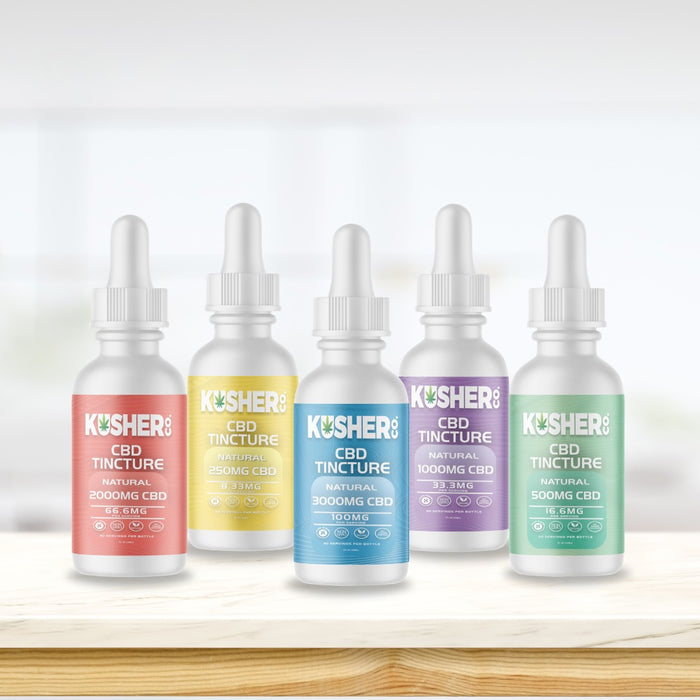
- Full Spectrum Kosher Hemp Extract CBD Tincture: $20.00 at 250mg, $25.00 at 500mg, $30.00 at 1000mg, $35.00 at 2000mg, $40.00 at 3000mg
Read down that list and one thing jumps out. The tincture alone runs the entire twenty dollar spread on its own, and the CBD inside the top bottle is twelve times what is inside the bottom one. Price and milligrams are only loosely related here, and anyone who tells you the two track neatly is selling you a simpler story than the one that is true.
What you are paying for that is not the extract
Take any product on the list and mentally remove the hemp from it. What remains still costs money. There is a container, and containers are priced per unit, not per milliliter of what goes in them. There is a label that had to be designed, printed, and checked against what the batch actually contains. There is a carton, a case, a pallet, a warehouse shelf, and a shipping box. There is a lab bill for the batch, and the lab charges by the batch rather than by the dose.
That fixed layer is the reason a 250mg tincture cannot be sold for an eighth of the price of a 2000mg one. The hemp extract inside a small bottle is a small share of what that bottle cost to put on a shelf. This is not unique to hemp. It is true of olive oil, of shampoo, of anything sold in a container. It just happens to surprise people more in a category where the milligram number is printed in large type on the front.
The practical consequence is worth holding onto as you read the rest of this. Every time you move up a strength, you are paying close to the marginal cost of more extract, because the fixed part of the bill was already paid at the bottom of the ladder. That is why the ladder gets better as it climbs.
The four topicals at $20.00
Cooling Relief Stick and Heating Relief Stick both carry 500mg of CBD. Joint and Muscle Roll on Relief and Pain Relief Gel Roll On both carry 350mg. All four are $20.00. A shopper looking only at the milligram figure would expect the 500mg items to cost more, and they do not.
The reason is the fixed layer again, plus format. A twist-up stick and a roll on ball are different pieces of hardware with different unit costs, and those differences roughly cancel out the difference in extract. The sticks also carry a heavier ingredient list. Both use coconut oil and shea butter as the base, plus mint, eucalyptus and tea tree. A balm base built from real butters costs more to make and more to fill than a thinner liquid, because it has to be heated, blended, poured and cooled.
So the two sticks are not underpriced and the two roll ons are not overpriced. They are two different builds that landed in the same place. If you want the most CBD per dollar in a topical, the sticks are the answer at 500mg for $20.00. If you want the applicator that puts a thin layer on a joint without touching it, the roll ons are worth the trade.
Why the gel is $25.00 when the sticks are $20.00
Cooling Pain Relief Gel is the only topical above the $20.00 line, and the extra five dollars buys ingredient count rather than cannabinoid count. It holds the same 500mg of CBD as the sticks. What it adds is rosemary and thyme extract on top of the tea tree and mint.
Botanical extracts are the expensive part of a formula sheet, far more than people expect. Each one is a separate raw material with its own supplier, its own certificate, its own incoming check, and its own line in the batch record. Two extra extracts means two more things to buy, two more things to test, and two more things that can hold up a production run. That is where five dollars goes.
Whether it is worth five dollars to you depends on whether you want that botanical profile or just want CBD on your skin. We will not pretend the gel is a different class of product. It is the same cannabinoid load in a richer formula and a different texture.
350mg or 500mg barely moves the price, and that is the tell
Across the topicals, a 43 percent difference in CBD content produces a zero dollar difference in price. If cannabinoid content were the main driver of what a topical costs, that could not happen. It happens because in a topical the extract is genuinely a minority of the cost, behind the base, the container and the batch work.
This is the single most useful thing to understand about topical pricing anywhere, including ours. When you see two topicals at similar prices with different milligram figures, the milligram figure is not what you are paying for. Look at the base, the applicator, and the rest of the ingredient list, because that is where the money went.
The tincture ladder is the clearest math on the site
Five strengths, five prices, five dollars apart each step. 250mg is $20.00. 500mg is $25.00. 1000mg is $30.00. 2000mg is $35.00. 3000mg is $40.00. Twelve times the CBD for twice the price, top to bottom.
That looks like a discount and it is not. It is what happens when a fixed cost sits under a variable one. The bottle, dropper, label, carton and batch test are effectively identical at every strength. What changes between two bottles on that ladder is the amount of full spectrum hemp extract dissolved into the same carrier, in the same glass, tested by the same panel. So each step up prices close to the extract alone, and the extract alone is not what made the first bottle cost twenty dollars.
We would rather say that plainly than dress the top of the ladder up as generosity. The 3000mg bottle is the best value on this site by a wide margin, and the reason is structural rather than promotional.
Cost per milligram, since that is the number that actually changes
Run the division and the ladder tells the whole story. At 250mg for $20.00 you are paying eight cents per milligram of CBD. At 500mg for $25.00 it is five cents. At 1000mg for $30.00 it is three cents. At 2000mg for $35.00 it is under two cents, and at 3000mg for $40.00 it is about one and a third cents.
That is a six fold improvement from the bottom of the ladder to the top, paid for with twenty extra dollars up front. The trade is real in both directions. Money now against money per dose later, plus the question of whether you will finish a large bottle before you would rather try something else.
Cost per milligram is also the right way to compare any two hemp products anywhere, ours included. It is arithmetic, it needs nothing but the price and the container total, and it cuts through packaging language faster than anything else you can do in ten seconds on a product page.
Which tincture strength is the honest buy
If you have never used a tincture, the 250mg bottle at $20.00 is the low risk way to find out whether you like the format, the taste and the routine of measuring a dose. You will pay the worst rate per milligram on the site for that answer. We think that is a fair trade for not committing forty dollars to something you may decide is not for you.
If you already know you use it regularly, the 3000mg bottle at $40.00 is the only strength that makes sense on the numbers, and buying anything in the middle is mostly a hedge. The middle strengths exist because plenty of people want a real supply without a large jump in either the amount they swallow per serving or the amount they spend at once. Both are legitimate reasons. Neither is the cheapest per milligram, and we are not going to imply otherwise.
Every gummy formula is $29.99, including the one with three actives
Wellness, Active, Night Time and Happy Hour all cost the same $29.99 despite carrying quite different formulas. Wellness is CBD with terpenes. Active adds CBG to the CBD. Night Time combines CBD with CBN and melatonin. Happy Hour is built on Delta-8 and Delta-9 with live resin, with total THC under 0.3 percent.
Holding one price across four formulas is a decision rather than an accident. Ingredient costs genuinely differ between them. CBG and CBN are minor cannabinoids and neither is cheap, live resin is a more involved input than a distillate, and melatonin is inexpensive by comparison. Averaged across the four, the price lands where it lands.
The alternative was pricing each formula to its own bill of materials, which would have produced a shelf where the sleep formula and the daytime formula differ by a couple of dollars for reasons no shopper can see or verify. We would rather people choose a gummy by what is in it and when they want to take it, not by a two dollar gap that tells them nothing.
The D8 jar at $39.99, and why converting costs more than extracting
D8 Kosher Hemp Gummies are the most expensive item we sell, and the reason is chemistry rather than quantity. Delta-8 THC occurs in hemp only in trace amounts. There is no practical way to extract it directly at any meaningful scale, because there is essentially nothing there to extract.
What producers do instead is start from CBD, which hemp makes in abundance, and convert it. That conversion is a real chemical process with reagents, reaction time, and a purification stage afterward to take out what the reaction leaves behind. Then the result has to be tested, both for how much Delta-8 you ended up with and for what else came along. CBD, by contrast, is pulled straight out of the plant and cleaned up. One of those routes has several extra steps and several extra places where a batch can fail.
Add the jar format on top. A jar holds more, costs more as a container than a pouch, and puts more product in the customer's hands per unit. Between the conversion route and the format, $39.99 is where it sits.
The odd part: the gentler cannabinoid is the expensive one
Delta-8 and Delta-9 differ by the position of one double bond in the molecule, and that small structural difference changes how tightly the molecule binds its receptor. Delta-8 binds less tightly, which is why it is usually described as the milder of the two isomers.
So the most expensive product on our site is the one built around the gentler compound, and the reason is entirely about how hard it is to make rather than how strong it is. This is genuinely counterintuitive, and it catches people out. Price in this category is not a strength ranking. It never has been.
If you assumed the $39.99 jar was the heavy hitter of the lineup because of the number on it, that is a reasonable assumption and it is wrong. Read the cannabinoid, not the price.
What kosher certification adds, and what it does not
Certification costs money and takes time. Ingredients have to be documented and approved, equipment and facilities are inspected, and production runs happen under supervision rather than whenever a schedule allows. That cost is real and it is on our bill.
What it is not is a per product surcharge. Certification applies to the operation and to the whole line at once, so it does not explain why one item on our shelf costs more than another. It sits inside every price on this page equally. A shopper choosing between the roll on and the gel is not choosing between more and less certification.
We think that is the right way to carry it. Certification is a condition of how we make things rather than an upgrade you buy. It affects where the whole range sits more than it affects the shape of the range.
Format and container do more work than people expect
Compare the four formats we sell and the hardware differences are substantial. A twist-up stick is a molded case with a screw mechanism. A roll on is a bottle plus a ball and housing that has to seal. A tincture is glass with a graduated dropper and a child resistant cap. A gummy jar is a jar with an induction seal, and a pouch is film.
Those components are bought at different prices and they fill at different speeds on a line. Fill speed matters more than it sounds, because a slower fill spreads more labor across fewer finished units. None of this is visible on a product page, which is exactly why it is worth saying out loud when someone asks why two products with similar contents do not cost the same.
Where the value sits, depending on what you want
Best rate per milligram anywhere in the range: the 3000mg tincture at $40.00, at roughly one and a third cents per milligram. Nothing else is close.
Best way to spend twenty dollars: either relief stick, at 500mg of CBD in a coconut oil and shea butter base with mint, eucalyptus and tea tree. It is the most formulated thing we sell at the bottom price.
Best way to find out whether a format suits you before committing: the 250mg tincture at $20.00, understanding that you are paying the worst rate on the site for a low stakes trial. And if what you want is the Delta-8 jar, know that you are paying for a conversion process rather than for volume, and decide with that in front of you.
Bottom line
Our range is driven by three things and none of them is a markup on strength. Ingredient count moves a topical five dollars. Chemistry moves the Delta-8 jar ten dollars above the gummy line. And a fixed cost per container, paid whether the container holds a little or a lot, is why twelve times the CBD in a tincture only doubles the price. If you buy on cost per milligram, the top of the tincture ladder wins and it is not close. If you buy on formulation, the gel and the sticks earn their prices in ingredients you can read on the label. What we will not do is let the number on the front of a package stand in for a reason.
Frequently Asked Questions
Why does twelve times the CBD only cost twice as much?
Because most of what a bottle costs has nothing to do with the extract inside it. The glass, the dropper, the cap, the label, the carton and the batch lab test are the same at 250mg as they are at 3000mg, and those costs are paid per container rather than per milligram. Once that fixed layer is covered at the bottom of the ladder, every step up prices close to the extract alone. That is why 250mg is $20.00 and 3000mg is $40.00 rather than $240.00.
Which product gives the most CBD per dollar?
The 3000mg Full Spectrum Kosher Hemp Extract CBD Tincture at $40.00, which works out to about one and a third cents per milligram. The 250mg bottle at $20.00 is eight cents per milligram, so the top of the ladder is roughly six times better on that measure. Among topicals, either relief stick gives you 500mg for $20.00, which beats the 350mg roll ons at the same price. Cost per milligram is simple division and it is the fastest honest comparison you can make on any product page.
Why is the Delta-8 jar the most expensive thing you sell?
Delta-8 exists in hemp only in trace amounts, so it is not extracted the way CBD is. It is converted from CBD through a chemical process that adds reagents, reaction time, a purification stage and extra testing on the other side. Every one of those steps costs money and adds a place where a batch can fail. The jar format adds container cost on top. The $39.99 price reflects how the cannabinoid is produced, not how strong it is.
Do both relief sticks and both roll ons really cost the same?
Yes, all four are $20.00. The Cooling Relief Stick and Heating Relief Stick each carry 500mg of CBD, and the Joint and Muscle Roll on Relief and Pain Relief Gel Roll On each carry 350mg. The sticks have the heavier ingredient list with a coconut oil and shea butter base, while the roll ons use different hardware that costs more per unit. Those differences roughly cancel, which is a good demonstration that milligrams are not what sets a topical price.
Why is the Cooling Pain Relief Gel five dollars more than the sticks?
Ingredient count, not cannabinoid count. The gel holds the same 500mg of CBD as the sticks and adds rosemary and thyme extract to the tea tree and mint. Botanical extracts are among the more expensive lines on a formula sheet, and each one adds a separate supplier, a separate incoming check and a separate entry in the batch record. The $25.00 price buys that longer ingredient list and a different texture, not more CBD.
Does kosher certification make your products cost more?
It adds cost to the operation, through ingredient approval, facility inspection and supervised production runs. What it does not do is explain the differences within our range, because certification applies to the whole line at once rather than to individual items. It is baked evenly into every price on this page. Choosing between the gel and the roll on is never a choice between more and less certification.
Why do four different gummy formulas all cost $29.99?
Their ingredient costs genuinely differ. CBG in the Active formula and CBN in the Night Time formula are minor cannabinoids and neither is cheap, live resin in Happy Hour is a more involved input than a distillate, and melatonin is inexpensive by comparison. Pricing each to its own bill of materials would have produced two dollar gaps that no shopper can verify or interpret. One price across the four means people pick a formula by what is in it and when they want to take it.