News · 18 August 2026
What Is the Entourage Effect and Do Any Kusher Co Products Actually Use It?
The entourage effect is the idea that cannabis compounds behave differently in combination than they do alone, and the mechanical half of that idea is solid. The plant produces cannabinoids and terpenes together, they arrive together in any extract that has not been stripped, and a mixture is chemically not the same thing as one purified compound. Where the idea gets oversold is precision, because nobody can currently tell you which combination produces which specific outcome.
Three of our products are built on whole plant thinking and two are deliberately not. We think the useful version of this article is the one that says which is which and stops short of the claims the science does not support.
What the claim actually says
Stripped of marketing, the entourage effect proposes that the compounds in cannabis interact, so the whole behaves differently from the sum of its isolated parts.
That is a claim about chemistry rather than about outcomes. It says a mixture is its own thing. It does not, in its careful form, say the mixture is better, and the slide from one to the other is where most of the trouble in this subject comes from.
The term itself came out of research on how cannabis compounds influence each other, and the original idea was narrower than the version that ended up on packaging. Somewhere between the paper and the product label, a hypothesis about interaction turned into a selling point about superiority. Those are not the same statement and only one of them is well supported.
The strong part: the plant makes these together
Here is what nobody argues about.
Hemp does not produce CBD in a vacuum. It produces CBD alongside CBG, CBN, dozens of minor cannabinoids and a large set of terpenes, all built from related precursors on the same biological pathway. That co-occurrence is not a coincidence of processing. It is how the plant works.
Which means any extract that has not been deliberately purified contains a mixture, and any isolate exists only because somebody spent effort removing everything else. The natural state of the material is the blend. The single compound is the manufactured version, not the other way around, and that ordering is worth keeping in mind when someone describes an isolate as the pure form of the plant.
A mixture is chemically not one compound
The second solid piece of the argument is almost too obvious to state, which is exactly why it gets skipped.
Put several compounds into a system together and they do not politely queue up to act one at a time. They compete for the same receptors, they influence how quickly each other is broken down, and some of them change how much of another ends up circulating at all. These are ordinary pharmacological facts that apply to almost any mixture of related compounds, not something special about this plant.
So the statement that a full spectrum extract behaves differently from an equivalent amount of isolated CBD is not a stretch. It is close to the default expectation. If someone told you a mixture of five related compounds acted exactly like one of them alone, that would be the surprising claim requiring evidence.
The oversold part: precision
Now the half that gets stated far more confidently than anyone has earned.
Knowing that compounds interact tells you nothing about which specific combination produces which specific result. The number of possible combinations across cannabinoids and terpenes is enormous, the amounts vary between plants and between batches, and the research that would map particular blends to particular outcomes in people mostly does not exist yet.
When a product description tells you that a certain terpene combined with a certain cannabinoid produces a certain feeling, that sentence is running well ahead of what has actually been established. Some of it comes from laboratory work on cells rather than people. Some of it comes from tradition dressed up in scientific vocabulary. Very little of it comes from studies in humans comparing one defined blend against another.
What nobody can honestly tell you
It is worth being specific about the gaps, because vagueness here is how overclaiming survives.
- Which terpene at which concentration changes which cannabinoid response, in a person, at the amounts present in a consumer product.
- Whether the interactions demonstrated in a laboratory dish occur at all after digestion and a pass through the liver.
- How much of any minor compound has to be present before it makes any difference, as opposed to being present in a quantity that shows on a test and nowhere else.
- Whether two batches of the same full spectrum extract, made from different harvests, are close enough to behave the same way.
None of those are answered. Any product page that implies otherwise is telling you something it does not know, and once you can spot that pattern you will see it everywhere in this category.
Our Full Spectrum tincture is the clearest case
If any product we make is built on the whole plant argument, it is this one, and the name says so.
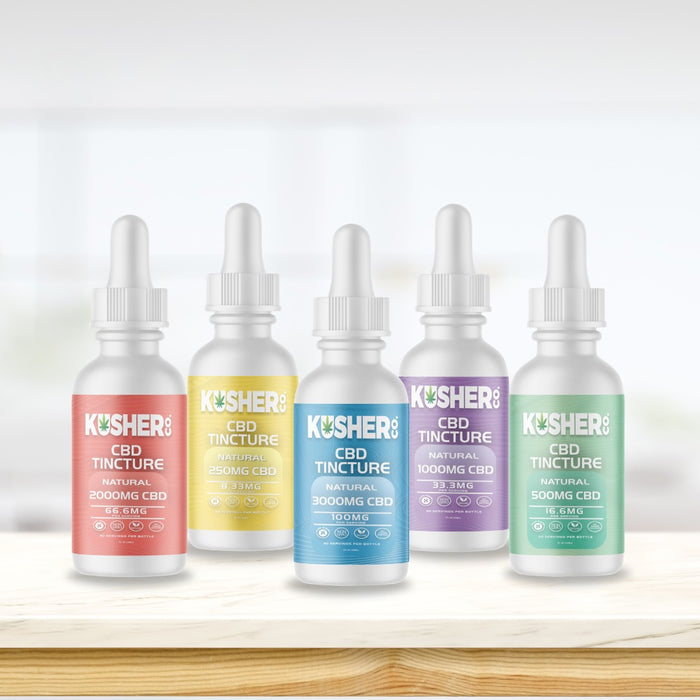
The Full Spectrum Kosher Hemp Extract CBD Tincture runs from $20.00 for 250mg through $25.00 for 500mg, $30.00 for 1000mg and $35.00 for 2000mg up to $40.00 for 3000mg. Full spectrum means the extract retains the range of compounds the plant produced rather than being refined down to CBD alone.
That is a formulation decision made on the reasoning above. Keep what the plant made together, because separating it is a choice that requires its own justification. What we are not going to do is attach a specific promise to that decision, because the specific promise is the part nobody can support. The honest version is that this is the product where we kept the mixture intact, and here is why we think keeping it intact is defensible.
The terpene carrying gummies
Two of our gummies list terpenes as part of the formula, and that is a deliberate choice rather than a leftover.
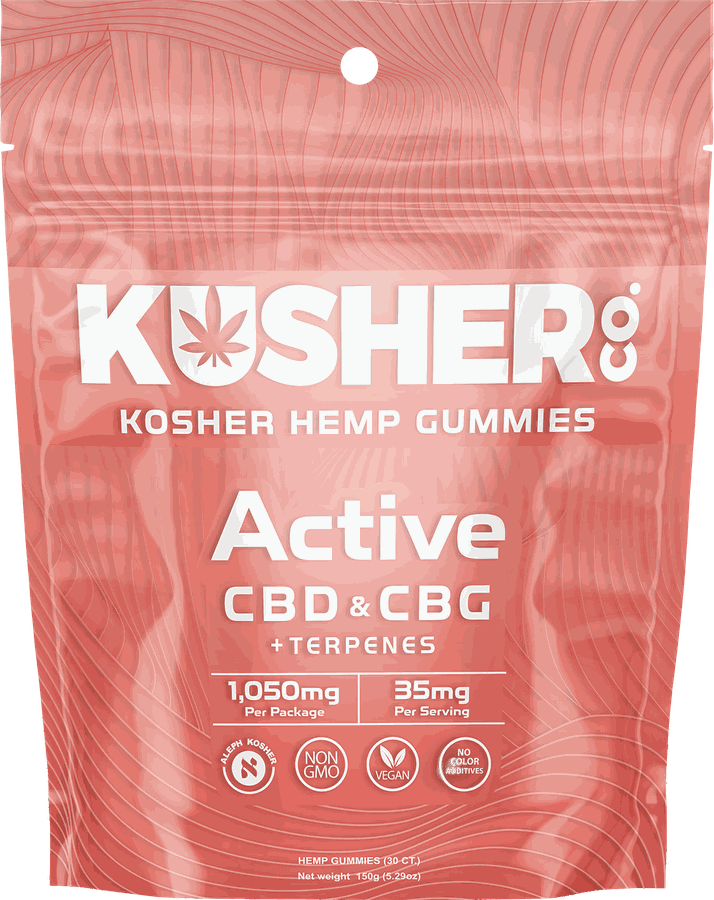
Wellness Kosher Hemp Gummies at $29.99 are CBD with terpenes. Active Kosher Hemp Gummies at the same $29.99 are CBD plus CBG plus terpenes, which puts a second cannabinoid alongside the first. In both cases the terpenes are there because removing them would have been an extra step taken for no good reason.
The Active gummy is the more interesting one for this discussion, because CBG is a distinct cannabinoid rather than a supporting aromatic compound. A product with two cannabinoids and a terpene fraction is a mixture in the sense the entourage argument cares about. Whether that mixture does something a CBD only version would not is precisely the question the evidence does not settle, and we are going to leave it unsettled rather than fill the gap with a sentence that sounds good.
Happy Hour and the live resin
The third whole plant product in our range is the one people least expect.
Happy Hour Kosher Hemp Gummies at $29.99 contain Delta-8 and Delta-9 with live resin, total THC under 0.3 percent. Live resin is the whole plant element. It comes from material that has not been through a conventional dry and cure, and that handling keeps more of the volatile compounds, terpenes in particular, that a normal dry drives off.
So the live resin is in there for exactly the reason this article has been circling. It carries more of what the plant contained than an isolate does. That is a statement about composition, which we can stand behind. Turning it into a statement about what you will experience is the step we are not taking.
Which of our products are not built this way
Two, and both by design.
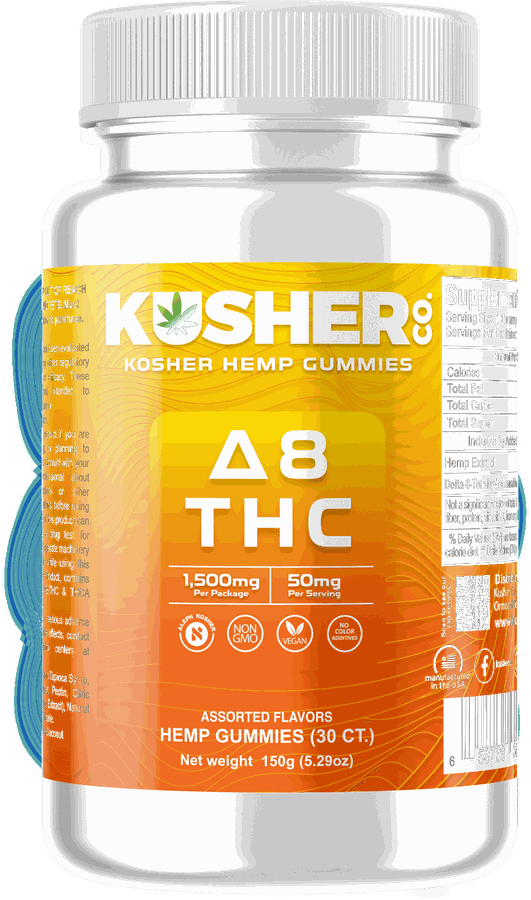
D8 Kosher Hemp Gummies at $39.99 are Delta-8 on its own in a jar format. That is the opposite of a whole plant product, and it is the right design for what it is. Somebody buying a single cannabinoid wants one variable, not a profile, and adding a supporting cast would defeat the purpose of the purchase.
Night Time Kosher Hemp Gummies at $29.99 are a mixed case. CBD and CBN are both cannabinoids, so there is a combination there, but melatonin is not a plant compound from hemp at all. It is a separate ingredient added on purpose. Calling that formula an entourage product would be stretching the term past where it applies.
Full spectrum, broad spectrum and isolate
Three words get used across this category and only one of them is well defined in ordinary conversation.
Full spectrum describes an extract that retains the range of compounds the plant produced. Broad spectrum usually describes an extract where one specific compound has been removed while the rest were kept. Isolate describes a single compound with everything else stripped away. Those are descriptions of processing, and the amount of processing runs upward as you move down the list.
The entourage argument only really applies to the first of the three. A broad spectrum extract is a mixture with a hole in it, and an isolate is not a mixture at all. Our tincture is full spectrum, which is the version the argument actually covers, and we use the term because it describes what is in the bottle rather than because it sounds better than the alternatives.
Why we will not publish a terpene chart
Almost every brand in this category eventually produces one. A grid of terpene names down one side, a set of outcomes across the top, and a tidy set of matches in the middle.
We are not going to make one, and the reason is that we would have to invent most of it. The charts that circulate are largely assembled from laboratory work on isolated compounds at concentrations that bear no relationship to what is in a consumer product, mixed with folklore about strains, then presented with the confidence of a periodic table.
What we would rather do is tell you which of our products contain a terpene fraction and why we left it in, which is the part we actually know. A chart would be more satisfying to read and it would be less true. Between those two, we would rather publish the less satisfying thing and be able to defend every line of it.
The topicals sit outside the argument
Our gel, sticks and roll ons are formulated around a different set of questions entirely.
The Cooling Pain Relief Gel at $25.00 carries 500mg of CBD along with rosemary and thyme extract, tea tree and mint. The Cooling Relief Stick and the Heating Relief Stick at $20.00 each carry 500mg with eucalyptus, mint, tea tree and a coconut oil and shea butter base. The Joint and Muscle Roll on Relief at $20.00 carries 350mg with menthol, tea tree and aloe, and the Pain Relief Gel Roll On at $20.00 carries 350mg.
Those botanical ingredients are not hemp compounds and the entourage argument does not cover them. They are there for their own reasons, chosen as ingredients in their own right. We would rather say that plainly than borrow a cannabis science term to describe a formulation choice it has nothing to do with.
How to shop with all this in mind
The useful conclusion is a way of reading labels rather than a rule about which to buy.
Treat full spectrum and live resin as descriptions of composition, which they are, and be suspicious of any product that turns them into a description of outcome. A brand telling you what is in the bottle is on solid ground. A brand telling you what a specific terpene profile will do for you has left the ground behind.
If the mixture argument appeals to you, our tincture and the two terpene carrying gummies are where it lives. If it leaves you cold and you would rather know exactly what you took, the single cannabinoid jar exists for that reason. Both are legitimate positions and we sell products for both, which is roughly the definition of not having an axe to grind here.
Bottom line
The entourage effect is real as chemistry and unproven as prediction. Compounds that occur together do interact, and a full spectrum extract is genuinely a different substance from purified CBD. What nobody can currently do is tell you which combination yields which result, and any product page that pretends otherwise is filling a gap in the science with confident writing.
Our Full Spectrum tincture, the Wellness and Active gummies with their terpene fraction, and the live resin in Happy Hour are all built on whole plant thinking. The D8 jar deliberately is not, and the topicals are answering a different question. That is the whole map, without the part where we tell you what any of it will feel like.
Frequently Asked Questions
Is the entourage effect real?
The mechanical part is. Hemp produces cannabinoids and terpenes together on the same biological pathway, so any extract that has not been deliberately purified contains a mixture, and a mixture of related compounds behaves differently from one purified compound. That much is close to the default expectation in chemistry rather than a bold claim. What is not established is precision. Nobody can currently tell you which specific combination of compounds produces which specific result in a person, and product pages that imply otherwise are running ahead of the evidence.
Which Kusher Co products are built on whole plant thinking?
Three. The Full Spectrum Kosher Hemp Extract CBD Tincture, priced from $20.00 for 250mg up to $40.00 for 3000mg, keeps the range of compounds the plant produced rather than refining down to CBD alone. The Wellness gummies at $29.99 carry CBD with terpenes and the Active gummies at $29.99 carry CBD plus CBG plus terpenes. Happy Hour at $29.99 contains live resin, which is the whole plant element in that formula. The D8 jar at $39.99 is deliberately the opposite, a single cannabinoid on its own.
Why does the D8 product not use a whole plant approach?
Because the point of it is the opposite. D8 Kosher Hemp Gummies at $39.99 contain Delta-8 alone in a jar format, and somebody buying a single cannabinoid is buying one variable rather than a profile. Adding a supporting cast of other compounds would defeat the reason for the purchase. It is not a lesser design, it is a different design answering a different request. If you want to understand your own response with as few unknowns as possible, a single compound is the better instrument.
What is live resin and why is it in Happy Hour?
Live resin is an extract made from plant material that has not been through a conventional dry and cure. Drying drives off volatile compounds, terpenes especially, so skipping that step keeps more of them in the finished extract. It is in Happy Hour because it carries more of what the plant actually contained than an isolated compound can. That is a statement about composition, which we can support. What it will feel like is a different kind of statement and we are not making it.
Do the terpenes in your gummies do anything specific?
We do not know, and neither does anyone else at the level of specificity most brands write with. The terpenes are in the Wellness and Active gummies because removing them would have been an extra processing step taken for no good reason, not because we can tell you which one produces which outcome. The honest position is that the mixture is chemically distinct from isolated CBD, and that the research mapping particular blends to particular results in people mostly does not exist yet.
Does the entourage effect apply to your topicals?
No, and we would rather say so than borrow the term. The Cooling Pain Relief Gel at $25.00 carries rosemary and thyme extract, tea tree and mint alongside its 500mg of CBD. The sticks at $20.00 carry eucalyptus, mint and tea tree in a coconut oil and shea butter base. Those botanicals are not hemp compounds, so the argument about cannabis compounds interacting does not cover them. They were chosen as ingredients in their own right, for their own reasons.