News · 18 August 2026
D8 Gummies vs Happy Hour D8 and D9 Gummies: What You Are Getting With Each
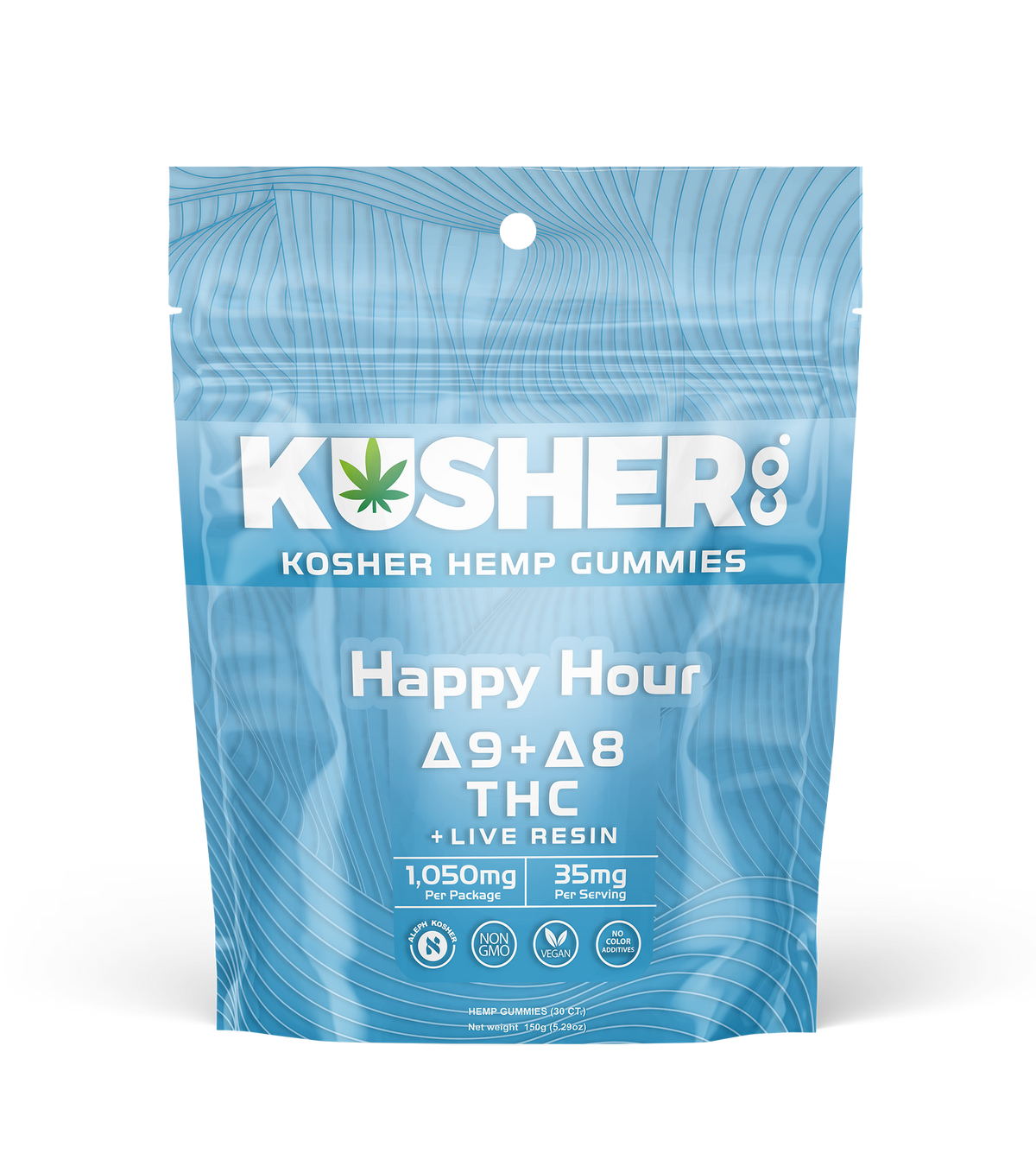
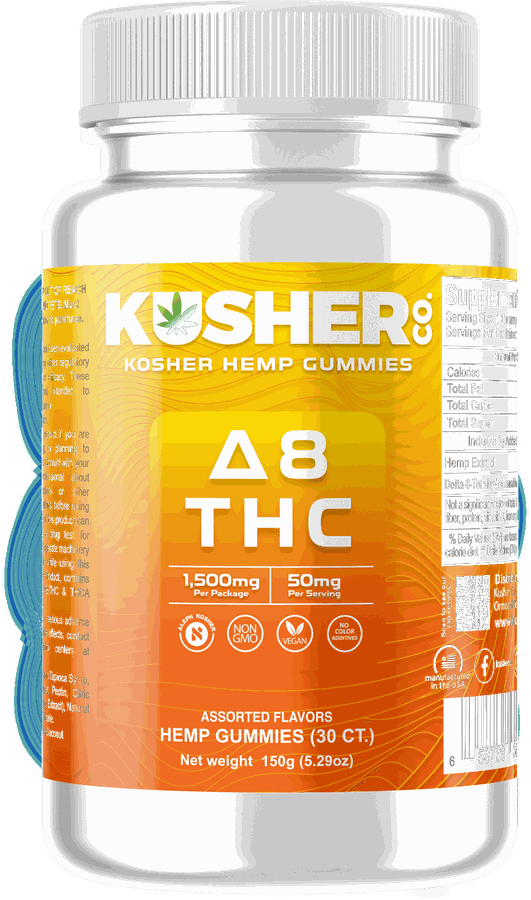
The D8 Kosher Hemp Gummies are $39.99 for a single cannabinoid in a jar. Happy Hour Kosher Hemp Gummies are $29.99 for Delta-8 plus Delta-9 plus live resin, with total THC under 0.3 percent. The cheaper product contains more distinct compounds, which reads backward until you understand where Delta-8 comes from and what a jar costs to fill.
Both of these get bought by people who want the same broad thing, and the two answers they get are genuinely different. This is our attempt to lay out what is in each one, why the pricing runs the direction it does, and which of the two we would point a given person toward.
What is actually in each one
Start with the contents, because half the confusion here comes from assuming the more expensive product must contain more.
D8 Kosher Hemp Gummies are Delta-8 and that is the design. One cannabinoid, no supporting cast, sold in a jar. If you want to know what you are taking, the answer fits in two words, and for a certain kind of buyer that is the entire appeal.
Happy Hour Kosher Hemp Gummies are Delta-8 plus Delta-9 plus live resin, with total THC held under 0.3 percent. That is three components rather than one, and the third of them is a whole plant extract rather than an isolated compound, which means it brings along whatever the plant put in it. More moving parts, less precision about the exact makeup, and a broader profile.
The price runs backward, and here is why
A product with one ingredient costing ten dollars more than a product with three sounds like a mistake. It is not.
The reason is that Delta-8 is barely present in the hemp plant. It exists in trace amounts, far too small to extract at any sensible cost, which means every gram of Delta-8 on the market got there by being converted from something else. That something else is usually CBD, and the conversion is a real manufacturing step with real inputs, real equipment, real time and real testing attached to it.
Delta-9 by contrast is what the plant makes. It does not need converting because it is already there. So the product built around the compound that requires an extra industrial process ends up carrying that process in its price, and the product that includes a compound the plant handed over directly does not.
What conversion actually involves
We think this is worth explaining rather than waving at, because it is the load bearing fact behind the whole price question.
Converting CBD into Delta-8 is a chemical process. It takes CBD as the starting material, runs a reaction on it, and then requires cleanup and separation to isolate the result from everything else the reaction produced. None of those steps are free, and the last one matters most, because a poorly separated product carries residue from its own manufacture.
Testing sits on top of all of it. You cannot sell a converted cannabinoid responsibly without confirming what came out the other end, and that confirmation costs money on every batch. So the $39.99 on the D8 jar is not paying for a rarer plant. It is paying for a process, and processes have invoices.
Format is the other half of the gap
The second reason for the difference has nothing to do with chemistry.
The D8 product comes in a jar, and a jar is a larger format. More product in the container, more material in the container itself, more weight to ship. A larger format costs more to fill and more to send, and that shows up at the till the same way it does for anything else sold by the container.
Which means the honest way to read $39.99 against $29.99 is not as a straight quality comparison. Part of the gap is the conversion step and part of it is simply that you are buying a bigger package. Those are two separate reasons pointing the same direction, and lumping them together as one reason produces a wrong conclusion about value.
What a single cannabinoid buys you
Control. That is the short version, and it is not a small thing.
When a product contains one active compound, everything you experience from it belongs to that compound. There is no question of which part of a blend was responsible, because there is no blend. Adjust the amount and you are adjusting one variable. Stop taking it and you have removed one variable.
For anyone who wants to understand their own response rather than just have one, that clarity is worth paying for. It is also the right choice for someone who has already tried a blended product, formed no clear view of what was happening, and wants to strip the question back to a single input. The D8 jar is the version of this category with the fewest unknowns in it.
What the combination buys you
A fuller picture of the plant, and less precision about which part of it is doing what.
Happy Hour brings Delta-8 and Delta-9 together and then adds live resin on top, which is an extract that carries the compounds the plant produced alongside its cannabinoids rather than stripping them out. The result is closer to what the plant contains than any isolated compound can be.
The trade you are making is legibility. You cannot attribute anything you notice to a specific component, because several are present and they arrived together. If that bothers you, buy the single cannabinoid. If what you want is the fuller profile and you do not need a breakdown of which element contributed what, the combination is the more interesting product and it happens to be the cheaper one.
Live resin, and why it is in there
Live resin is the ingredient people ask about least and it is arguably the most distinctive thing in the Happy Hour formula.
The name describes the handling. Rather than drying and curing plant material before extraction, the process works from material that has not been through that drying step, which keeps more of the volatile compounds that drying drives off. Terpenes are the obvious example. They evaporate readily, and a lot of what a plant smells like disappears during a conventional dry.
So live resin is in the product because it carries plant compounds that a stripped isolate does not have. Whether that changes your experience is a question we are not going to answer with a claim we cannot support. What we can say is what it is and why it was chosen, which is that it keeps more of the original material in the finished product.
The 0.3 percent figure, and what it does not mean
Total THC under 0.3 percent is the line that separates hemp from everything else in federal terms, and Happy Hour sits under it.
What that number describes is a proportion of total product weight, not a statement about the size of the effect. A percentage of a gummy is a different thing from a percentage of a flower, and people who transfer their intuitions from one to the other get it wrong in both directions.
The reason we mention it is compliance, not marketing. It tells you the product is what it says it is under the definition that governs the category. It does not tell you the product is mild, and we are not going to imply that it does.
What a jar changes about how you use it
Packaging shapes behavior more than most people credit, and the difference between a jar and a pack is not only a shipping cost.
A jar sits somewhere. It lives in a cupboard or on a shelf, it does not travel well, and it invites you to take from it rather than to work through it. A larger container also lasts longer, which changes the buying rhythm from a frequent small purchase into an occasional larger one.
Whether that suits you is a question about habit rather than product quality. Somebody who uses this kind of thing rarely and wants a supply on hand is well served by the jar. Somebody who wants to try a category without committing to a large container is not, and the $29.99 pack is the smaller and more sensible first step.
Reading a lab report on a converted cannabinoid
If the conversion step is the reason for the price, it follows that the testing is where the value lands.
What you want confirmed on any converted product is twofold. First, that the target compound is present at the level claimed. Second, that the byproducts of the reaction and the solvents used in the cleanup are not present at levels that should worry anybody. The second half is the one people skip, and it is the half that only exists because of the manufacturing step.
A product that came straight from the plant has a shorter chain to verify. A converted one has a longer chain, which is more work for whoever is verifying it. That is a real difference in what the price is buying, and it is worth understanding before concluding that two similar looking jars on two different shelves are the same purchase.
Both are intoxicating, and we say so
Neither of these belongs in the same conversation as our CBD products, and the packaging similarity between them can hide that.
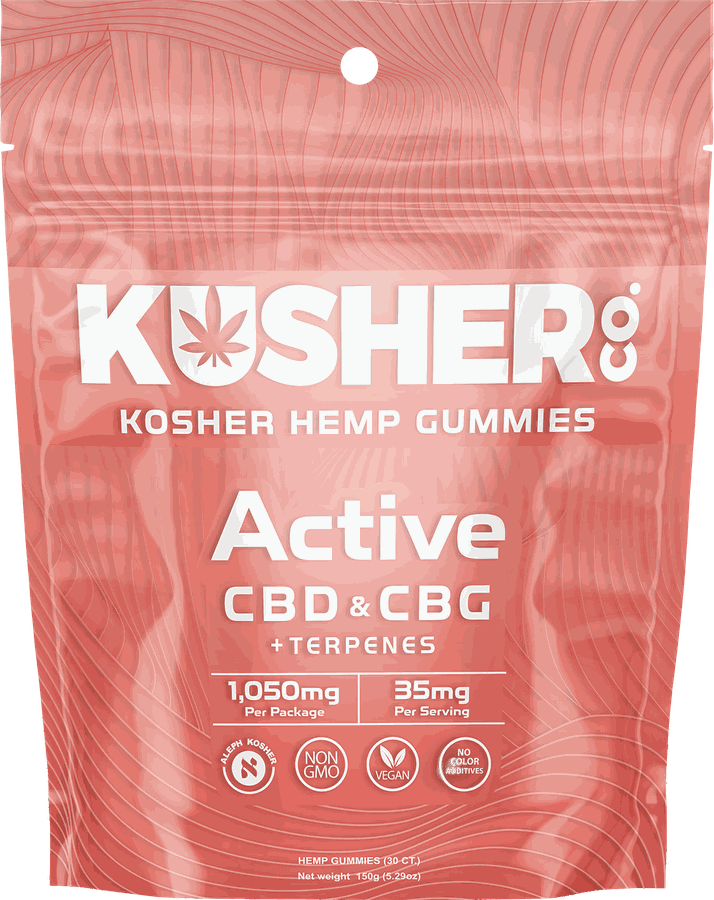
Wellness, Active and Night Time at $29.99 are CBD based products. Happy Hour and D8 contain THC and behave accordingly. Somebody who has used the CBD range and is stepping across to either of these should treat it as a first time with a new category rather than a variation on something familiar.
The pricing makes this worse rather than better, because Happy Hour costs the same $29.99 as the CBD gummies. Same price, very different product. Read the ingredient line rather than the price tag.
Onset is slow on both, and that causes the classic mistake
Anything eaten has to get through digestion before it circulates, and that takes a while regardless of what is in it.
The predictable consequence is the person who takes one, waits what feels like a reasonable stretch, concludes nothing is happening, takes another, and then meets both arrivals at the same time. This is the single most common error in the whole edible category and it has nothing to do with which of our two products you picked.
The counter to it is boring and effective. Take one thing, wait considerably longer than you think you need to, and make no decisions about a second in the meantime. Neither the jar nor the pack changes that advice.
Do not run them together
We get asked whether you can combine the two, and our answer is that we would not.
Both are systemic, both contain THC, and both arrive on the same slow schedule. Two products doing the same job in the same place at the same time genuinely do combine, unlike a topical and a gummy, which do not. There is no clever reason to run both and there is an obvious reason not to.
Pick one. Treat the other as an alternative you might try on a different occasion rather than an addition to what you already took.
Kosher certification on both
Both products carry the same certification, which is the reason a lot of our customers are here at all.
Certification means an outside authority inspected the ingredients and the production process against a standard. For a converted cannabinoid that inspection has more to look at, since there is an extra manufacturing stage in the chain, and the certification does not skip it because it is inconvenient.
Very few products in this category carry it. That is the plain situation, and it is why people who need it end up shopping somewhere narrow rather than somewhere broad.
Which one we would point you toward
If you have not used a THC product before, Happy Hour at $29.99 is the one we would suggest, partly because it is the more complete expression of the plant and partly because it is the smaller commitment in both price and format.
If you have used Delta-8 specifically, know it agrees with you, and want a supply of exactly that rather than a blend, the D8 jar at $39.99 is the right purchase and the larger format is the point rather than a drawback.
And if what you actually want is to understand your own response with as few unknowns as possible, the single cannabinoid is the better instrument no matter what it costs. You are buying clarity, and clarity is the thing the conversion step is paying for.
Bottom line
The D8 jar costs more because Delta-8 has to be manufactured out of CBD rather than pulled from the plant, and because a jar holds and ships more than a pack does. Neither of those is a quality signal. They are cost facts, and they explain an inversion that otherwise looks like a pricing error.
Buy the single cannabinoid when you want to know exactly what you are taking and want one variable to adjust. Buy Happy Hour when you want the fuller plant profile with live resin in it and can live with not knowing which component contributed what. Do not buy both and take them together.
Frequently Asked Questions
Why do the D8 gummies cost more than Happy Hour when they contain less?
Two reasons, and neither is about quality. Delta-8 does not occur in the hemp plant in useful quantity, so it has to be converted from CBD, and that conversion is a real manufacturing step with reaction, cleanup, separation and batch testing attached to it. Delta-9 by contrast is what the plant already makes. The second reason is format. The D8 product comes in a jar, which is a larger container that costs more to fill and more to ship. The $39.99 covers a process and a package, not a rarer plant.
What is in Happy Hour Kosher Hemp Gummies?
Delta-8 and Delta-9 together with live resin, at $29.99, with total THC under 0.3 percent. The live resin is the part people ask about least and it is the most distinctive element in the formula. It comes from material that has not been through a conventional dry, which keeps more of the volatile plant compounds that drying drives off. So the product carries more of what the plant contained than an isolated compound can, at the cost of being harder to attribute any single element to.
What does total THC under 0.3 percent actually tell me?
That the product meets the definition that governs the hemp category in federal terms. It is a proportion of total product weight and nothing more. It is not a statement about how strong the product is, and anyone reading it as a mildness signal is transferring an intuition from a different kind of product where the same percentage means something else. We quote the figure for compliance reasons rather than marketing ones, and we are not going to imply it means less than it does.
Can I take the D8 gummies and Happy Hour together?
We would not. Both are systemic, both contain THC, and both arrive on the same slow digestive schedule, which means they genuinely combine in a way that a topical and a gummy never do. There is no benefit to running both and there is an obvious reason not to. Pick one, learn what it does for you, and treat the other as an alternative for a different occasion rather than something you add on top of what you have already taken.
Which should I buy if I have never used a THC product before?
Happy Hour at $29.99, on balance. It is the smaller commitment in both price and format, and it gives you the fuller plant profile rather than a single isolated compound. Whatever you pick, the thing that matters most is patience on the first attempt. Anything eaten has to clear digestion before it circulates, and the most common mistake in this whole category is taking a second one because the first has not shown up yet, then meeting both arrivals at once.
Are these the same as your CBD gummies with a different flavor?
No, and the packaging similarity makes that easy to miss. Wellness, Active and Night Time are CBD based products at $29.99. Happy Hour and D8 contain THC and are intoxicating in a way the CBD range is not. The price makes the confusion worse, since Happy Hour costs the same $29.99 as the CBD gummies do. Read the ingredient line rather than the price tag, and treat a move from the CBD range to either THC product as a first time with a new category.