News · 18 August 2026
What Is CBN and Why Is It Paired With Melatonin in the Night Time Gummies?
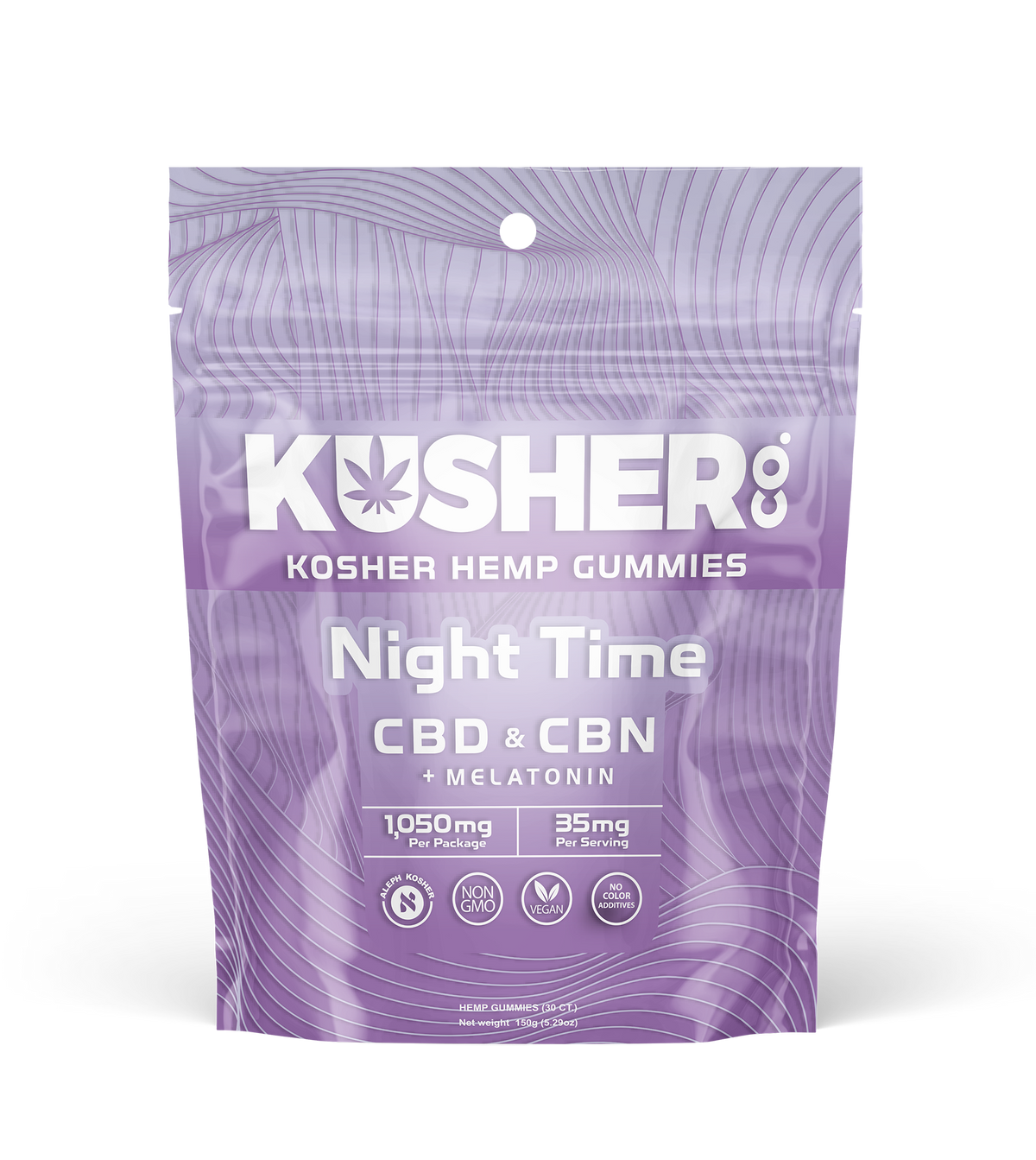
CBN (cannabinol) is a minor cannabinoid that forms naturally as THC degrades over time in aged cannabis and hemp. It is not something the plant produces directly in any quantity, which is the single fact that explains why it costs what it costs and why so few products carry a verified amount of it. It sits alongside melatonin in our Night Time Kosher Hemp Gummies for a formulation reason rather than a physiological one. Melatonin is the ingredient shoppers already recognize from the night-time shelf. CBN is the one they came to hemp looking for. Putting both into one $29.99 kosher-certified gummy means one ingredient list, one certificate of analysis and one item in the routine instead of two.
That is a plainer answer than most product pages give, and the rest of this is the part nobody explains properly. Where CBN actually comes from, why verifying it is harder than verifying CBD, what kosher certification covers in a gummy, and how to store a cannabinoid that does not sit still.
Where CBN Comes From, and Why That Makes It Rare
Hemp does not make CBN. It makes CBDA and THCA and a handful of other acidic precursors, and those convert into the cannabinoids people know by name. CBN arrives later, as a product of age. When THC is exposed to oxygen, heat and light over a long enough period, it oxidizes, and cannabinol is what that oxidation leaves behind. Old flower left in a warm room is the classic illustration. Time is the reagent.
That origin story has two consequences for anyone buying a CBN product. The first is supply. You cannot plant a field and harvest CBN the way you can harvest a CBD-dominant crop, so the material either comes from deliberately aged and processed feedstock or from a conversion and purification process run in a laboratory setting. Either route costs more per milligram than CBD, and neither scales the way a straightforward extraction does.
The second is variability. Aged material is not uniform. How long it sat, at what temperature, and in what container all change what comes out the other end. This is why the isolation and purification step matters so much for CBN specifically, and why a finished ingredient with a clean, single-compound assay behind it is worth more than a vaguely described distillate. When we talk about CBN sourcing being harder than CBD sourcing, this is the concrete version of that statement rather than a marketing flourish.
What Melatonin Is, and What It Is Not
Melatonin is not a cannabinoid. It does not come from hemp, it is not extracted alongside CBD, and it arrives in a formula as its own separately sourced ingredient with its own supplier, its own documentation and its own certificate. In the United States it has been sold as a dietary supplement ingredient for decades, which makes it one of the most familiar names on any night-time shelf.
Commercial melatonin is manufactured rather than harvested. That matters for kosher certification, because a synthesized ingredient carries a documentation trail about its production inputs, and that trail has to be reviewed like any other. It is one of the reasons a kosher-certified combination product takes longer to bring to market than a single-ingredient one.
What we will not do here is describe what melatonin does once you have taken it. There is a large body of published research on the compound and there is an even larger body of confident internet writing about it, and the gap between the two is wide. Doses on the shelf range from fractions of a milligram to ten milligrams and higher, which tells you something about how unsettled the retail conventions are. Read the amount on the label, treat any product that does not print it as unfinished, and take questions about your own use to a clinician rather than to a store.
Why the Two Are In One Gummy Rather Than Two Products
The formulation argument for a combination product is mostly about what a buyer has to manage. Two separate products mean two ingredient lists, two certificates, two prices, two expiration windows and two containers. One product means one of each. For a shopper who is already reading labels carefully, that consolidation is worth something concrete.
There is a second reason that is specific to us. Every ingredient in a kosher-certified formula has to clear the certification, so a combination product concentrates that work into a single audited formula rather than leaving a buyer to check two separate supply chains for themselves. The certification does the filtering upstream, before anything reaches a product page.
The trade-off is real and we will name it. A combination product removes your ability to change one input without changing the other. If you want a different amount of one ingredient and the same amount of the other, a fixed-formula gummy cannot do that, and a two-product routine can. We think the convenience wins for most people. It does not win for everybody, and anyone who wants that control should buy separates rather than a blend.
The Supply-Chain Problem That Nobody Talks About
Here is where it gets practical, and where a lot of buyers get quietly burned without realizing it.
CBD has years of third-party testing infrastructure behind it. Labs know how to measure it accurately, certificate formats for CBD are standardized across most vendors, and consumers have learned to ask for them. CBN is a different story. Third-party potency verification for CBN is still rarer across the market than for CBD, which means a product can make a CBN claim on its label without the same verification burden that CBD products typically carry. Some brands are doing the testing. Many are not.
This creates a real problem for buyers who are comparison-shopping on price or cannabinoid count without looking at the documentation. CBN concentrations in commercial gummies often run lower than CBD in the same product, yet pricing is frequently equivalent. A common range in night-time gummies is somewhere between 2 mg and 10 mg of CBN per piece, while CBD in the same product might be 15 mg or more. That disparity matters because the low end of that range is a token inclusion. It puts a word on the front of the package without putting much of the ingredient in the piece, and you are paying a premium for the word. The only way to know what you are actually getting is a certificate of analysis that shows verified CBN potency, not just CBD.
What to Look For on a CBN Certificate of Analysis
When you look at the certificate for any CBN product, you want to see a few things. First, CBN potency listed as a separate line item, not bundled into a broad cannabinoid panel that makes individual concentrations hard to isolate. Second, testing by an accredited third-party lab, not an in-house test. Third, batch-specific results, because formulations vary between production runs and a blanket certificate from six months ago may not reflect what is in the jar you are buying today.
Two more things are worth checking that most buyers never think to ask about. One is the unit. A potency panel can report milligrams per piece or milligrams per gram of material, and those are very different numbers on the same document. If the certificate reports per gram and the label reports per piece, you need the piece weight to reconcile them, and a seller who cannot supply it has an incomplete file.
The other is the date relative to the manufacture run. A certificate issued before a formula changed is a description of the old formula. We would rather a buyer ask us an awkward question about a document date than assume a posted certificate covers everything we have ever made.
What Kosher Certification Actually Covers Here
Our Night Time Kosher Hemp Gummies carry kosher certification, and that certification does a lot of filtering work before a certificate of analysis even enters the picture. Kosher-certified gummy formulations exclude a wide range of common additives that show up in conventional night-time products, because every input has to be traceable to a supplier whose own process has been reviewed. The sourcing and processing standards that kosher certification requires are stricter than most supplement manufacturing standards, which means the ingredient list is cleaner by default. That is not a marketing claim. It is a structural feature of what kosher certification actually requires.
The part that surprises people is how far up the chain it goes. It is not a review of the finished gummy alone. It covers the ingredient inputs, the facility, the equipment those inputs run through and the changeover procedures between production runs. A supplier who cannot document their own inputs cannot be used, regardless of how good their material is.
For consumers who care about what is not in their gummy as much as what is, this matters more than most product pages acknowledge.
CBN Stability and Why Storage Is Not Optional
CBN is less stable in a gummy matrix than CBD. Heat and light degrade it faster, which means the gap between labeled potency and actual potency can widen significantly if the product is stored poorly. This is not a quirk unique to our formulation. It is a property of the cannabinoid itself, and it applies across every CBN product on the market. There is a certain irony in it, since CBN is itself what degradation produces, and it does not stop changing once it has been made.
In practice, this means a few things. Keep the gummies in a cool, dark place, because warmth accelerates the degradation that pulls the CBN in a piece below the figure printed on the label. A bathroom cabinet with temperature swings from shower steam is the wrong spot. A nightstand drawer away from direct light is better. A pantry or medicine cabinet that stays reasonably cool is better still.
It also means buying in quantities that match your actual consumption rate. A large supply that sits for months at room temperature is not the same product you started with by the time you reach the bottom of the jar. For a cannabinoid as potency-sensitive as CBN, freshness is what keeps the contents close to the label.
There is also a less obvious degradation risk that most buyers do not think about, which is the period between manufacturing and purchase. A gummy that was produced four months ago, shipped in summer heat, and sat in a warehouse before arriving at your door may already have lost potency before the seal is broken. This is another reason batch-specific certificates matter. A certificate dated close to the production run, combined with a reasonable purchase timeline, gives you more confidence that the labeled amount is still accurate. A certificate from a year ago tells you what the product was, not what it is.
Gelatin, Pectin and the Rest of the Ingredient List
A gummy is mostly not cannabinoid. By weight it is a gelling agent, a sweetener, an acid, a color and a coating, and the cannabinoid is a small fraction of the piece. Anyone comparing gummies only on milligram figures is comparing the smallest part of the product.
The gelling agent is the line worth reading first. Gelatin is animal-derived and pectin is plant-derived, and the two behave differently in the mouth and on the shelf. For a kosher-certified product, that single ingredient carries a large share of the certification work, because the sourcing behind it has to be documented rather than assumed. This is one of the places where certification and formulation stop being separate subjects.
After that, look at the coating and the color. Night-time products are a category where synthetic colorants show up frequently for no reason other than shelf appearance. A short ingredient list is not automatically better than a long one, but a long one full of additives that exist to make a product look a particular shade is a fair thing to ask about.
Price Per Milligram Is the Only Fair Comparison
Two night-time gummies at the same shelf price can be very different purchases. The comparison that tells you something is price divided by verified milligrams of the ingredient you actually came for, per piece, multiplied by the number of pieces in the container.
Run that arithmetic across a few products and the pattern in this category becomes obvious quickly. Products carrying a large CBD figure and a small CBN figure price themselves as CBN products. The word on the front is doing the work that the formula is not. This is not fraud and it is not unusual. It is simply what happens when an ingredient is expensive and the marketing value of naming it is high.
Our Night Time gummies are $29.99, the same price as the Active and Wellness formulas, and they are sold to buyers 21 and over. We would rather you did that arithmetic on us and on everyone else than take a front-of-package claim at face value from anybody, including us.
When This Is Not the Product You Want
Most product pages do not include this section, which is one reason they read like product pages.
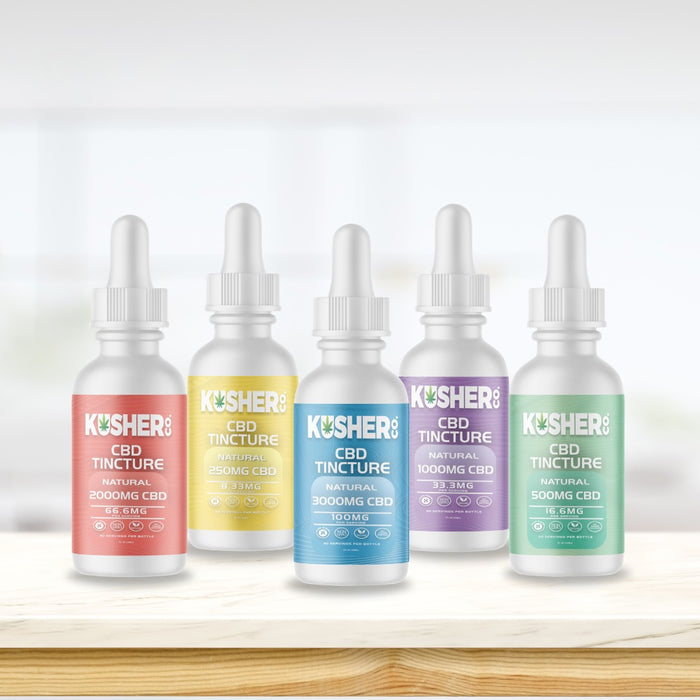
If you want to control each ingredient independently, a fixed-formula combination gummy is the wrong shape of product for you, and buying separates is the better call. If you do not want melatonin in your cabinet at all, this is not the formula to buy, and our Wellness Kosher Hemp Gummies at $29.99 are CBD with terpenes and nothing else added. If you prefer a liquid format where you can measure an amount by dropper rather than by piece, the Full Spectrum Kosher Hemp Extract CBD Tincture runs $20.00 for 250mg through $40.00 for 3000mg.
If you are pregnant or nursing, taking prescription medication, or under 21, this is not a product for you. Questions about your own use belong with a clinician, not with a store, and we are not going to blur that line to move a jar.
How the Night Time Gummies Fit the Rest of the Line
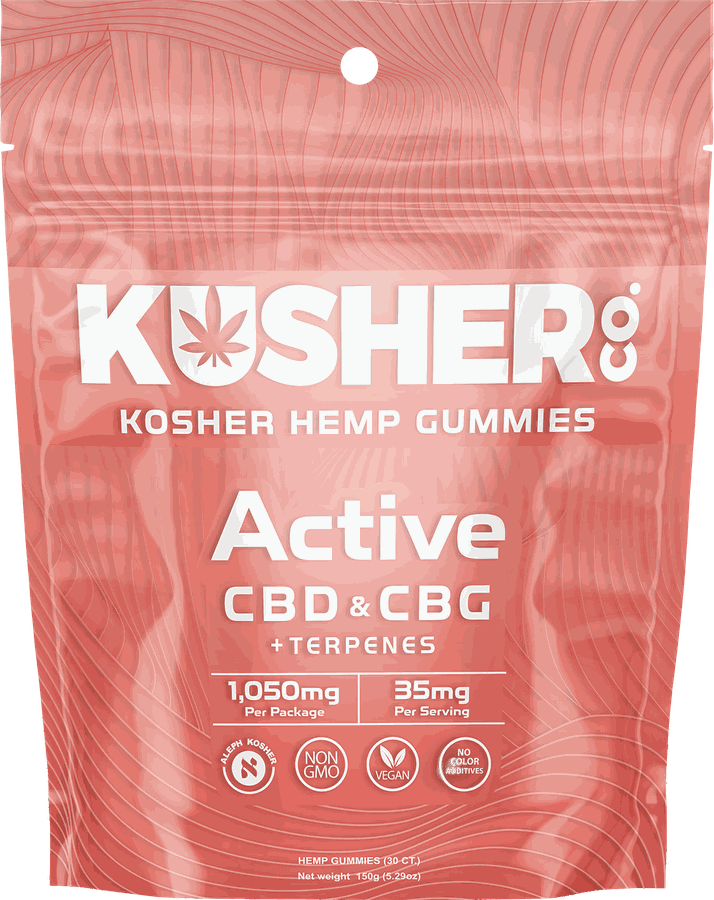
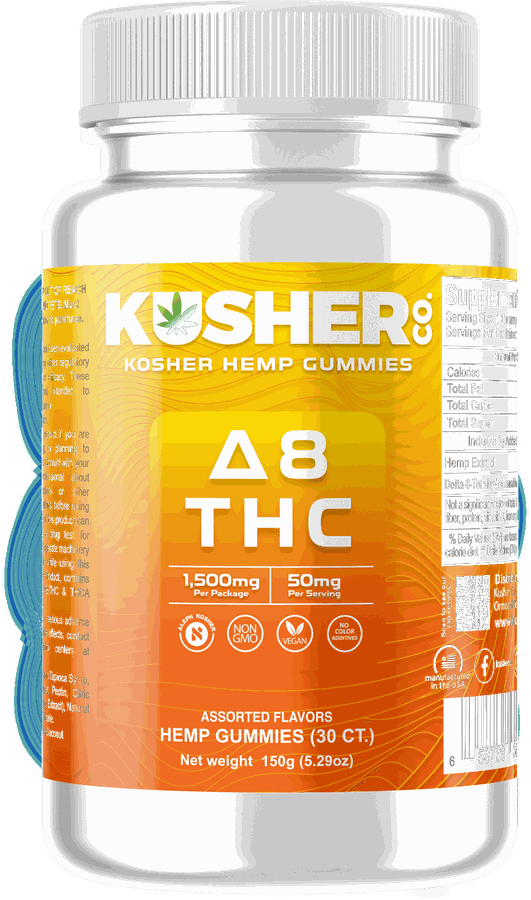
The Night Time Kosher Hemp Gummies are $29.99 and contain CBD, CBN and melatonin. That price point puts them alongside our other kosher hemp gummy lines. The Active formula at $29.99 contains CBD, CBG and terpenes. The Wellness gummies at $29.99 are CBD with terpenes. The Happy Hour gummies at $29.99 contain Delta-8, Delta-9 and live resin with total THC under 0.3 percent, and the D8 Kosher Hemp Gummies are $39.99 in a jar format.
Outside the gummies, the tincture covers the same certification standard in liquid form, and the topical range is applied to skin rather than eaten. The Cooling Pain Relief Gel is $25.00 with 500mg CBD, rosemary and thyme extract, tea tree and mint. The Cooling Relief Stick and the Heating Relief Stick are $20.00 each with 500mg CBD. The Joint and Muscle Roll on Relief and the Pain Relief Gel Roll On are $20.00 each with 350mg CBD.
The through line is the certification rather than the ingredient. Every one of those carries the same documentation standard, which is the part of this business that is genuinely difficult and the part almost nobody else in hemp has done.
How We Would Buy Any CBN Product
- Find the CBN figure per piece, not per package, and not folded into a total cannabinoid number.
- Ask for the certificate for that batch, and check the date against the manufacture date.
- Check that the lab is accredited and independent of the seller.
- Reconcile the units on the certificate with the units on the label.
- Read the gelling agent, the coating and the colorant, not just the cannabinoid line.
- Divide the price by the verified milligrams to compare products honestly.
- Buy a quantity you will finish, and store it cool and dark.
Bottom line
CBN is cannabinol, a cannabinoid that time makes rather than the plant, which is why it is scarce, expensive and inconsistently verified across this category. It appears next to melatonin in our Night Time gummies because that pairing puts a familiar night-time ingredient and a rare hemp one into a single kosher-certified formula with one document trail behind it.
Buy on the certificate rather than the front of the package, do the price-per-milligram arithmetic, read the gelling agent, and store the jar somewhere cool and dark. If you would rather control each ingredient separately, buy separates. We would rather tell you that than sell you a formula that is the wrong shape for how you want to buy.
Before you go, a few things come up consistently when customers are deciding whether the Night Time gummies are right for them. Here are the honest answers.
Frequently Asked Questions
Is CBN the same as CBD, just for night time?
No, and treating them as interchangeable is the mistake most people make. CBD and CBN are distinct cannabinoids with different structures and different origins. CBD is produced in abundance by the hemp plant directly, which is why it is comparatively cheap and easy to verify. CBN is not made by the plant in any quantity. It forms when THC oxidizes over time, so the material behind it comes from aged feedstock or a laboratory conversion and purification process. Different compound, different supply chain, different price per milligram. They are not one thing with two names.
Why does the Night Time formula include both CBN and CBD instead of just CBN?
Because CBN is scarce and expensive, and a formula built only on it would be a far narrower and far costlier product. CBD is the cannabinoid the plant produces in quantity, it is the best verified compound in the category, and it is the backbone of every gummy we make. Putting both into one piece gives the formula two separately measured cannabinoid line items on the certificate rather than one. Read them as two numbers, because a single merged cannabinoid total on any label is hiding the ratio between them.
How do I verify that the CBN amount on the label is accurate?
Ask for the certificate of analysis for the specific batch you are purchasing. It should list CBN as a separate, named line item with a potency reading from an accredited third-party lab. If CBN is bundled into a general cannabinoid total without its own figure, that is not sufficient verification. Check the units too, since a panel reporting milligrams per gram is not directly comparable to a label reporting milligrams per piece. Batch-specific certificates are more reliable than blanket ones because formulations vary between runs. A seller who cannot produce one has told you something important.
What does kosher certification actually change about the gummy formula?
Kosher certification imposes sourcing and processing standards that go well beyond standard supplement manufacturing. Every input has to trace to a supplier whose own process has been reviewed, which covers the facility, the equipment and the changeover procedures between runs, not just the finished gummy. In gummy form it puts particular weight on the gelling agent, since gelatin is animal-derived and pectin is plant-derived and the sourcing behind that one line has to be documented rather than assumed. The ingredient list ends up cleaner because of the certification requirements, not as a branding add-on.
Can the CBN potency in these gummies degrade if I store them wrong?
Yes, and it is underappreciated. CBN degrades faster than CBD under heat and light. A gummy that sits in a warm bathroom cabinet or on a sunlit counter can drift below its labeled figure over time even if the amount was right on the day it was made. Store them in a cool, dark location and buy in quantities that match your actual pace so you are not working through old stock months later. The window between manufacture and purchase counts too, which is another reason to check the certificate date against the production date.
How is CBN made if the plant does not produce it?
Time and oxygen produce it. THC exposed to air, warmth and light over a long enough period oxidizes, and cannabinol is what that reaction leaves behind. Old plant material stored in a warm room is the textbook example. Commercially, that means CBN comes either from deliberately aged and processed feedstock or from a controlled conversion and purification process, and both routes cost more per milligram than a straightforward CBD extraction. Aged material is also inconsistent, so the purification and assay steps behind the finished ingredient carry more weight for CBN than they do for CBD.
Who should not buy the CBN and melatonin combination?
Anyone who wants to control each ingredient independently, since a fixed-formula gummy cannot change one input without changing the other. Anyone who does not want melatonin in the cabinet at all, in which case the Wellness Kosher Hemp Gummies at $29.99 are CBD with terpenes and nothing else added. Anyone who prefers measuring by dropper rather than by piece, which is what the Full Spectrum Kosher Hemp Extract CBD Tincture is for at $20.00 through $40.00. And anyone under 21, pregnant, nursing or taking prescription medication, where the conversation belongs with a clinician rather than a store.
Ready to pick one? Browse Kosher Hemp Gummies.