News · 24 July 2026
CBD vs CBG vs D8: Which Hemp Gummy Matches Your Fitness Goals
CBD, CBG, CBN and Delta-8 are four different molecules, and the only comparison we can honestly draw between our gummies is which of those molecules is in the jar and what is in there alongside it. Four of our five gummy products cost $29.99. The Delta-8 jar costs $39.99. Every one of them is kosher certified. What actually separates them is composition, so this piece walks through that composition one molecule at a time, in enough detail that you can read the back of any hemp label without needing a store to interpret it for you.
We should be blunt about what this article is not. It is not a guide to which gummy produces which outcome in a body. We are not permitted to make claims like that, we do not think this category has the evidence to back up most of the ones you see made anyway, and the sellers who make them loudest are usually the ones with the least to say about their own formulation. Chemistry, sourcing, cost, format and who tends to buy what is what we can put in writing. It turns out to be enough to choose with.
CBD is the molecule most of this catalog is built on
Cannabidiol is the most abundant non-intoxicating cannabinoid in hemp, and it is the ingredient the modern hemp industry was built around. The plant produces it in quantity, which means it can be extracted directly out of harvested material without any conversion step in between. That single fact drives almost everything downstream, including price. A directly extracted compound costs what farming and extraction cost. A converted compound costs that plus a chemistry operation.
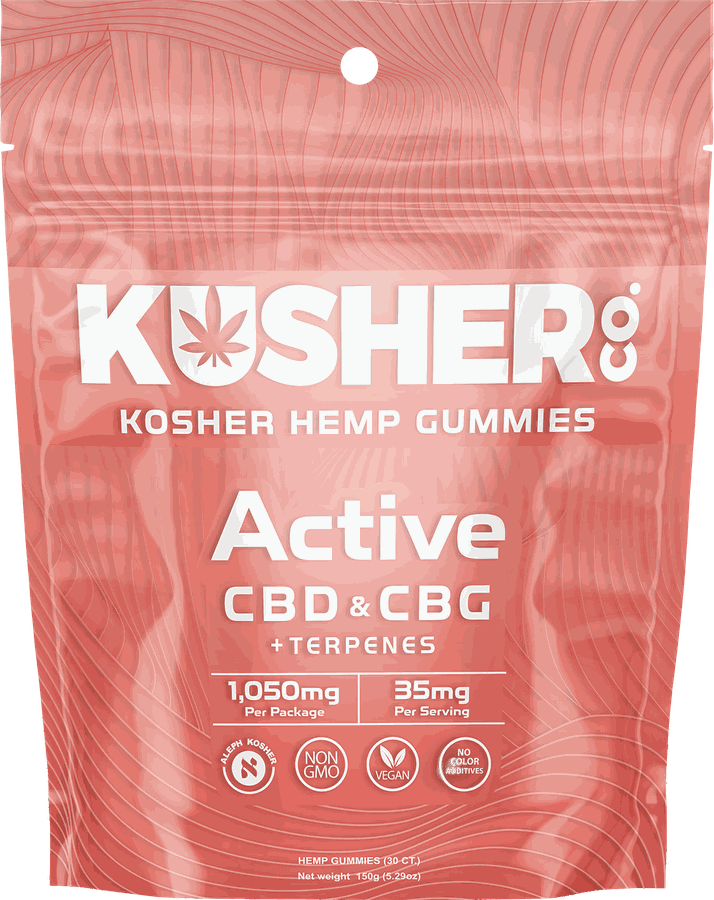
In our line, CBD is the base of the Wellness Kosher Hemp Gummies ($29.99), the Active Kosher Hemp Gummies ($29.99) and the Night Time Kosher Hemp Gummies ($29.99). It is also the only cannabinoid in the Full Spectrum Kosher Hemp Extract CBD Tincture ($20.00 to $40.00 depending on strength) and in all five topicals. If you strip our catalog down to its most common ingredient, CBD is it by a wide margin.
The Wellness gummies are the cleanest illustration of what CBD on its own looks like as a product. CBD, terpenes, and nothing else in the cannabinoid column. No second cannabinoid, no melatonin, no live resin. When people ask us where to start, the answer is usually the one with the fewest moving parts, because a product with one variable in it is a product you can actually learn something from.
CBG is scarce because the plant spends it early
Cannabigerol is the interesting one chemically, and the scarcity has a specific cause rather than a marketing one. In a growing hemp plant, the acid form CBGA is the parent compound. Plant enzymes convert most of it into the acid forms that later become THC and CBD as the plant matures. CBG is not rare because it is hard to find. It is rare because the plant uses it up making everything else.
That leaves growers two options. Harvest early, while CBGA is still present in useful amounts, and give up the rest of the yield the plant had not produced yet. Or grow cultivars specifically bred to hold onto CBG through maturity, which means dedicated seed stock and dedicated acreage. Either route costs more per finished milligram than CBD does, and that cost is why you see CBG listed as a headline ingredient far less often than CBD.
In our catalog CBG appears in exactly one product, the Active Kosher Hemp Gummies, where it sits alongside CBD and terpenes. It is not in the Wellness gummies, not in Night Time, and not in either Delta-8 product. If CBG is the reason you are shopping, Active is the only jar on this list that has any.
CBN is what time and air do to THC
Cannabinol is a degradation product, and we mean that as a description rather than an insult. The hemp plant does not produce meaningful amounts of CBN directly. It forms when THC is exposed to oxygen, light and time, which is why aged, badly stored flower tests higher for CBN than fresh material from the same harvest does. Every cannabinoid profile is a snapshot with a date on it.
Manufacturers who want CBN in a product do not wait around for stock to go stale. It is produced deliberately under controlled oxidation, so the input, the conditions and the endpoint are all specified rather than accidental. That is a real manufacturing step with real cost attached, and it is the reason CBN products are less common on a shelf than CBD products.
CBN appears in one jar here, the Night Time Kosher Hemp Gummies, where it is listed with CBD and melatonin. Three named ingredients, two of them cannabinoids and one of them not. We will get to the melatonin, because a non-cannabinoid ingredient in a cannabinoid product is exactly the sort of thing a label should make obvious.
Delta-8 and Delta-9 differ by the position of one double bond
Both are tetrahydrocannabinol. The number in the name points at which carbon in the ring structure carries a particular double bond, the eighth position or the ninth. That is the entire structural difference between them, and it is enough to make them two distinct molecules with separate names, separate legal status and completely different manufacturing routes.
Delta-9 is the form the plant produces in quantity, so it is obtained the same way CBD is, by extraction from harvested material. Delta-8 occurs naturally only in trace amounts, far too little to isolate at any sane cost, which means every Delta-8 product on the market is made rather than simply extracted. That distinction is not a knock on Delta-8. It is just an honest description of where the molecule in the jar came from.
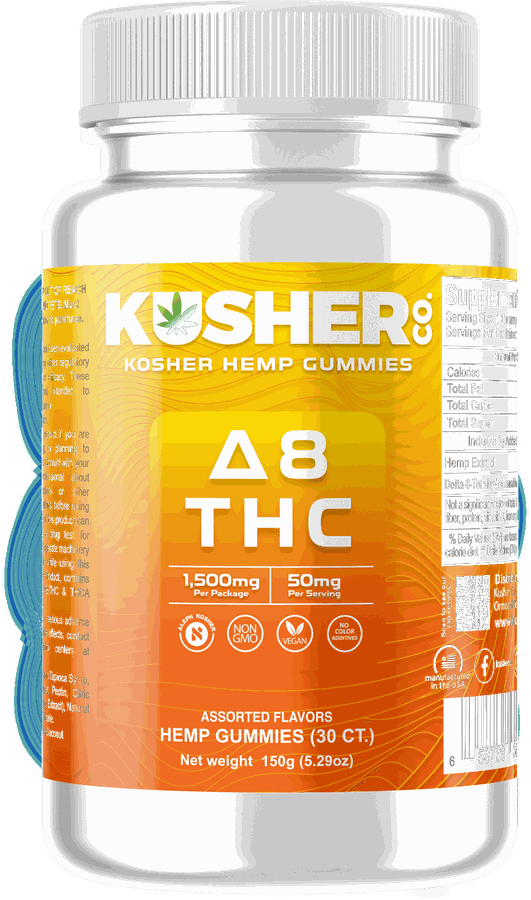
Our Happy Hour Kosher Hemp Gummies ($29.99) list Delta-8 and Delta-9 together with live resin, and total THC in the finished gummy stays under 0.3 percent. The D8 Kosher Hemp Gummies ($39.99) carry Delta-8 alone in a jar format. Both products are restricted to buyers 21 and over.
Why the Delta-8 jar costs ten dollars more
The D8 gummies have the shortest ingredient list of anything in the gummy line and the highest price on it. That looks backwards until you know how Delta-8 is obtained. Because the plant makes almost none of it, Delta-8 is produced by converting CBD through an acid-catalyzed isomerization step. Chemically that is a rearrangement of a molecule you already have rather than a new extraction.
The cost sits in everything wrapped around that rearrangement. Reagents. Reaction time on equipment that could otherwise be running something else. Neutralization and cleanup afterward. Purification of the product stream. Then analytical testing to confirm what actually came out the other end, which is a heavier testing burden than a directly extracted cannabinoid carries, because a conversion step can leave byproducts and confirming they are absent costs the same whether they are there or not.
So the ten dollar gap is a manufacturing story. It reflects the route the molecule took to get into the jar and the lab work required to verify the result. It is not a strength rating, it is not a quality ranking against the $29.99 jars, and it is not a hierarchy. Cannabinoids are not ranked by price any more than spices are.
Terpenes are aromatic compounds, and they are not cannabinoids at all
Terpenes are the compounds that give plants their smell. Limonene is the one in citrus peel. Pinene is the one in pine needles. Linalool turns up in lavender, and myrcene shows up in hops and in mango. None of these are unique to hemp, and none of them are cannabinoids. They belong to a completely separate chemical family that happens to be present in the same plant material.
They are also fragile. Terpenes are volatile, meaning they evaporate readily at ordinary temperatures, so drying a plant and running a hot extraction on it drives a large share of them off. That is why so many hemp products list cannabinoids in precise milligrams and say nothing at all about terpenes. There is often not much left to talk about.
Terpenes are listed as an ingredient in the Wellness gummies and the Active gummies. In the Happy Hour gummies they arrive through the live resin rather than as a separate addition. When you see terpenes on a label, the question worth asking is whether they survived the process or were added back afterward out of a bottle, because those are two very different products wearing the same word.
Live resin is an extraction method, not an ingredient category
Live resin describes how material was handled, not what was in it. Plant matter is flash-frozen within hours of harvest instead of being dried and cured, and it stays frozen through a cold extraction. Skipping the drying stage means skipping the point in the process where volatile terpenes escape, so the extract carries a terpene profile much closer to what the living plant held.
None of that is free. Live resin needs freezer capacity at the farm, frozen transport, and an extraction line that runs slower and yields less than the hot process behind conventional distillate. Fresh frozen biomass also weighs several times what dried material weighs, so part of the freight bill is water. The finished product has a shorter shelf life and wants cool storage, which is a genuine downside rather than a footnote.
Happy Hour is the only gummy in our line built on live resin. The other four are conventional. That is a formulation decision with a cost attached on both sides, and we would rather explain it than let the phrase sit on a label doing decorative work.
Melatonin is in exactly one jar, and it does not come from hemp
Melatonin is not a cannabinoid and it is not extracted from the hemp plant. It is a compound the human body produces on its own, and it has been sold as a standalone supplement in ordinary drugstores for decades, which is where most people have run into it before. It appears in one product of ours, the Night Time Kosher Hemp Gummies, listed alongside CBD and CBN.
We call it out separately for a reason. A cannabinoid product with a non-cannabinoid active ingredient in it is a different kind of product from one without, and anybody comparing labels deserves to see that at a glance rather than working it out from an ingredient panel in six-point type. If you are trying to keep your intake to hemp-derived compounds only, Night Time is the jar to know about.
It also matters for certification. Melatonin sold as a supplement can be produced by more than one route, and an ingredient with multiple possible sources is exactly the kind of thing a kosher audit examines rather than assumes. The certification on the Night Time gummies covers the finished product, melatonin included.
The five gummy jars, side by side
- Wellness Kosher Hemp Gummies, $29.99. CBD and terpenes. One cannabinoid, no additions.
- Active Kosher Hemp Gummies, $29.99. CBD plus CBG plus terpenes. The only CBG product in the line.
- Night Time Kosher Hemp Gummies, $29.99. CBD plus CBN plus melatonin. The only jar with a non-cannabinoid active.
- Happy Hour Kosher Hemp Gummies, $29.99. Delta-8 plus Delta-9 plus live resin, total THC under 0.3 percent. The only live resin product. 21 and over.
- D8 Kosher Hemp Gummies, $39.99. Delta-8 alone, jar format. Shortest ingredient list, highest price. 21 and over.
Read that list as a spreadsheet rather than a ladder. Four different cannabinoid combinations at one price, one at a higher price for a reason that lives in the factory. Nothing in the ordering implies that a jar further down is stronger, better or more advanced than a jar further up.
Single cannabinoid versus a combination is a real choice
A single-cannabinoid product is legible. There is one active molecule in it, so you know exactly what you bought and exactly what changed if you switch products later. The Wellness gummies come closest to that in the CBD range, and the D8 jar is the cleanest version of it in the THC range. If you want to know what one molecule is like on its own terms, buy the jar with one molecule in it.
Combination products trade that legibility for a fuller extract. The Active gummies carry CBD and CBG together, and there is no way to separate them by inspection once they are in the same gummy. If you keep notes on what you buy, and plenty of people do, notes on Active are notes on the combination rather than on either cannabinoid by itself. That is a real cost, and anyone telling you otherwise is selling.
Our position is that neither approach wins in general. Combination formulations are harder to make consistently and cost more to test, so they are a reasonable thing to charge for. Single-cannabinoid products are easier to reason about and easier to compare across sellers. Which of those two things you care about more is a genuine preference and not something a store should decide for you.
What the numbers on our labels actually cover
We publish CBD content in milligrams where we have it stated on the product. The Cooling Pain Relief Gel ($25.00) carries 500mg of CBD with rosemary, thyme extract, tea tree and mint. The Cooling Relief Stick ($20.00) carries 500mg with eucalyptus, mint, coconut oil, shea butter and tea tree. The Heating Relief Stick ($20.00) carries 500mg in a warming build. The Joint and Muscle Roll on Relief ($20.00) carries 350mg with menthol, tea tree and aloe, and the Pain Relief Gel Roll On ($20.00) carries 350mg.
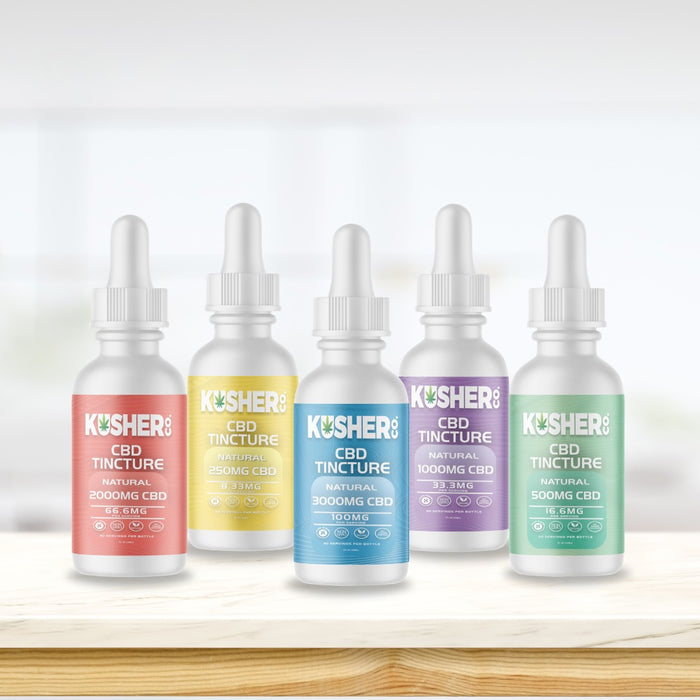
The tincture is sold by strength, which is the most transparent format we offer. Two hundred and fifty milligrams for $20.00, 500mg for $25.00, 1000mg for $30.00, 2000mg for $35.00 and 3000mg for $40.00. Same extract throughout, five concentrations, and the price per milligram falls steeply as the number goes up. That is worth knowing before you buy the smallest bottle twice.
For the gummies, read the current jar. Cannabinoid content per piece is the number that should drive a purchase, it belongs on the package and on the certificate of analysis for that batch, and we would rather point you at the live label than print a figure on a blog post that could go stale between harvests. Any hemp seller should be able to hand you a certificate of analysis for the batch you are holding. Ask for it, from us or from anyone.
Who tends to reach for what
This is an observation about buying patterns, not a statement about what anything does. People who describe themselves as active most often pick the Active gummies or the Happy Hour gummies. Night Time gets bought by people who already buy melatonin separately and would rather carry one product than two. The Wellness gummies get picked by people new to the category who want the simplest possible starting point.
The D8 jar is different. The people who buy it usually arrive already knowing they want Delta-8 specifically, which is why the format is a jar rather than a smaller pack, and why the shorter ingredient list is a selling point rather than a limitation. It is a product for someone who has already made the decision.
Say all of that out loud and the shape of the catalog makes sense. Five jars, four cannabinoid combinations, one price for most of them, and a set of buyers who know roughly what they came for. What we are not going to do is turn those patterns into a recommendation engine that quietly implies an outcome. Who buys a thing and what a thing does are separate questions, and only one of them is ours to answer.
Total THC under 0.3 percent is a legal line
The 0.3 percent figure attached to the Happy Hour gummies is a regulatory threshold that defines hemp in federal law rather than a measure of how much product is in the jar. Formulating to stay under it is a compliance requirement, and it constrains what a hemp product can be regardless of what a formulator might otherwise want to do.
Read it as a boundary, not a rating. A product sitting under that line is a hemp product. It says nothing about milligrams per piece, nothing about cannabinoid ratios, and nothing about quality. Sellers who wave the percentage around as if it were a performance number are relying on you not knowing what it measures.
The age restriction is separate from the percentage and applies on its own terms. The Happy Hour gummies and the D8 gummies are both 21 and over. That is not us being cautious. It is the rule.
Kosher certification runs across the whole line
Every gummy product listed here carries kosher certification, and so does the Full Spectrum Kosher Hemp Extract CBD Tincture. In a category where certification is close to absent, that is the single hardest thing about our catalog to copy quickly, because it is not a formulation choice that can be made in a lab in a week.
Certification means an outside auditor has reviewed ingredients, suppliers, equipment and process. It requires documentation and traceability at every stage, and it constrains what you can put in a product and where it can come from. For customers who keep kosher that is the entire purchase decision. For customers who do not, it is a form of outside accountability that most hemp brands have never submitted to.
One honest limitation, the same one we state everywhere. We do not specify the certifying body or any sub-classification on our pages. If you have particular requirements about which organization certifies what you buy, contact us before you order rather than after. We would rather answer that question up front than have you find out the answer does not suit you once the box has arrived.
How to read a hemp label without taking anyone's word for it
Start with the cannabinoid list and count the entries. One name means a single-cannabinoid product. Two or three names means a combination, and the order they appear in usually tracks how much of each is present. Then look for anything in the list that is not a cannabinoid at all, the way melatonin is not, because that is the ingredient most likely to be doing something a shopper did not sign up for.
Next, check whether terpenes are named and how. Terpenes listed as an ingredient means they were added or preserved deliberately. No mention of terpenes at all usually means a distillate base where they were lost during processing. A live resin or fresh frozen claim tells you about handling before extraction, which is the stage that decides whether the terpenes were ever there to keep.
Finally, look at what the label does not say. A product that talks at length about the experience it promises and says almost nothing about what is in it has made a choice about which of those two things it wants you to focus on. We would rather be the other kind of label, even when the other kind is harder to write.
Bottom line
Buy on composition. If you want the simplest CBD product we make, the Wellness gummies at $29.99 are CBD and terpenes with nothing else in the cannabinoid column. If you specifically want CBG, the Active gummies at $29.99 are the only jar in the line that contains any. If you want CBN and melatonin together, that is Night Time, also $29.99. If you want the fullest plant extract we produce, the Happy Hour gummies at $29.99 are the only live resin product and the only one carrying Delta-8 and Delta-9 together. If you want Delta-8 by itself in a jar, that is the D8 gummies at $39.99, and the extra ten dollars pays for a conversion and testing step rather than for a stronger product.
Four of the five cost exactly the same, which means price is not the deciding variable anywhere except the D8 jar. What is left to decide on is which molecules you want in the jar and whether you want them alone or in company. That is a real question with a real answer, and it is the one we can actually help with.
Frequently Asked Questions
Are CBD, CBG, CBN and Delta-8 all cannabinoids?
Yes, all four belong to the cannabinoid family, which is a group of related compounds associated with the hemp plant. They are not interchangeable with each other. CBD is the one hemp produces in the largest quantity. CBG is the parent compound the plant converts into others as it matures, which is why mature hemp holds so little of it. CBN forms when THC is exposed to oxygen, light and time. Delta-8 is a form of THC that occurs naturally in only trace amounts. Terpenes and melatonin, which also appear on our labels, are not cannabinoids at all.
Which of your gummies contains CBG?
The Active Kosher Hemp Gummies ($29.99) are the only product in our line that contains CBG. They list CBD, CBG and terpenes. The Wellness gummies carry CBD and terpenes with no CBG. Night Time carries CBD, CBN and melatonin. The Happy Hour gummies carry Delta-8, Delta-9 and live resin. The D8 jar carries Delta-8 alone. If CBG is what you are shopping for, Active is the one jar on the list that has any in it.
Why do the D8 gummies cost $39.99 when your other gummies cost $29.99?
Because of how Delta-8 is obtained. The hemp plant produces only trace amounts of it, far too little to isolate economically, so Delta-8 is made by converting CBD through an acid-catalyzed isomerization step. That means reagents, reaction time, neutralization, purification and a heavier analytical testing load to confirm what came out of the process. All of that cost sits behind a very short ingredient list. The price gap reflects the manufacturing route the molecule took rather than a strength rating or a quality ranking against the $29.99 jars.
What is the difference between live resin and regular hemp extract?
Live resin is a handling method. The plant material is flash-frozen within hours of harvest and stays frozen through a cold extraction, which skips the drying and curing stage where volatile terpenes escape. Conventional extract comes from dried, cured material processed with heat, so much of the original terpene content is gone by the time the oil exists. Live resin costs more to produce because it needs freezer capacity, frozen freight and a slower extraction line. It also has a shorter shelf life. The Happy Hour gummies are the only live resin product we make.
Are terpenes the same thing as cannabinoids?
No. Terpenes are aromatic compounds found across the plant kingdom, and they are what you smell when you open a jar or peel an orange. Limonene is in citrus peel, pinene is in pine needles, linalool is in lavender and myrcene turns up in hops and mango. Cannabinoids are a separate chemical family. Both are present in hemp, which is why both appear on hemp labels, but they are not versions of each other. Terpenes are also volatile, which is why processing method decides how many of them survive into a finished product.
Is melatonin in all of your gummies?
No. Melatonin appears in exactly one product, the Night Time Kosher Hemp Gummies ($29.99), where it is listed alongside CBD and CBN. It is not a cannabinoid and it does not come from the hemp plant. It is a compound the human body produces on its own and it has been sold as a standalone supplement for decades. None of the other four gummy products contain it. If you want to keep a purchase to hemp-derived ingredients only, Night Time is the jar to be aware of.
Are all of these products kosher certified?
Yes. All five gummy products carry kosher certification, and so does the Full Spectrum Kosher Hemp Extract CBD Tincture ($20.00 to $40.00). Certification means an outside auditor has reviewed the ingredients, the suppliers, the equipment and the production process, with documentation and traceability required at each stage. Very few sellers in the hemp category carry it. We do not specify the certifying body or a sub-classification on our product pages, so if you have particular requirements about which organization certifies what you buy, contact us before ordering.
Which gummy should I buy if I am new to hemp products?
Start with the product that has the fewest variables in it, which is the Wellness Kosher Hemp Gummies at $29.99. They carry CBD and terpenes with no second cannabinoid, no melatonin and no live resin. A product with one active molecule is one you can actually learn something from, because if you try something else later you will know exactly what changed. The two Delta-8 products are restricted to buyers 21 and over and are a different category of purchase, so they are not where we would suggest anyone begins.
Ready to pick one? Browse Kosher Hemp Gummies.