News · 19 August 2026
What Goes Into a Gummy Besides the Cannabinoid
A cannabinoid is a small fraction of a gummy by weight, and almost everything else in the piece is doing structural work. There is a gelling agent that decides the texture and, in our case, decides whether the product can be certified kosher at all. There are sweeteners, which are also bulk and also a preservative system. There is acid, flavoring and color. And there is a carrier, because a cannabinoid is an oil-soluble compound being asked to distribute evenly through a mostly water-based sugar slurry, which it does not want to do on its own.
We think this is the least discussed and most informative part of the product. The cannabinoid gets the headline number and the rest of the jar gets ignored, even though the rest of the jar determines whether every piece contains the same amount of that headline number. Even distribution is a manufacturing achievement rather than a default state, and understanding why explains most of what separates a well-made gummy from a badly made one.
By weight, the cannabinoid is almost nothing
Start with proportion. A gummy weighs somewhere in the region of a few grams. The cannabinoid content is measured in milligrams. That means the active ingredient is a fraction of a percent of the total mass, and everything you can see, feel, taste and chew is the other 99 point something percent.
This is not a criticism, it is a manufacturing reality shared with most supplements and most medicines. When a tiny quantity of one thing has to be delivered accurately inside a large quantity of another thing, the large quantity is where all the engineering goes. A gummy is mostly a delivery format, and the format has requirements of its own.
The gelling agent decides the most
Every gummy is a gel: a liquid trapped inside a solid network. What builds that network is the single most consequential formulation choice in the product, ahead of flavor, ahead of color, arguably ahead of the cannabinoid itself in terms of how many other decisions it forces.
Two candidates dominate. Gelatin, which is animal-derived protein. Pectin, which is plant-derived polysaccharide. They build networks by different mechanisms, produce different textures, set under different conditions, and have completely different implications for certification. Everything downstream in the formula is adjusted around whichever one is chosen.
Gelatin: what it is and where it comes from
Gelatin is collagen that has been partially broken down, usually from the skin and bones of cattle or pigs. Dissolved in hot water and cooled, its protein chains form a network that traps liquid. Reheat it and the network melts again, which is why gelatin gummies soften in a warm room and why they have the particular springy, melting chew people associate with the classic candy texture.
From a sourcing point of view, gelatin is an animal product with a specific species origin, and that origin is exactly the question a kosher certification has to answer. There is no way to be vague about it. Either the source is acceptable and documented or the product cannot carry the certification.
Pectin: what it is and where it comes from
Pectin is a structural polysaccharide found in plant cell walls, commercially extracted mainly from citrus peel and apple pomace. It gels by a different mechanism, needing sugar and acid at the right levels, or calcium depending on the type of pectin, to form its network.
The texture is different in a way most people can feel immediately. Pectin gels are shorter and cleaner in the bite, less springy, and they do not melt back to liquid at body temperature the way gelatin does. They also hold up better in heat, which is a real advantage for anything that might sit in a warm delivery van. The trade-off is that pectin is fussier to work with, since its set depends on a narrower window of acidity and sugar content.
Why the gelling agent decides the kosher question
Here is where the choice stops being about texture. Kosher certification examines the origin of every ingredient, and gelatin is the ingredient in a gummy most likely to be a problem, because it is animal-derived by definition. Pork-derived gelatin is straightforwardly out. Bovine gelatin brings in questions about the slaughter and processing of the source animal that require documentation from further up the supply chain than most ingredient suppliers routinely provide.
Pectin sidesteps the entire question, since it is plant matter and pareve, which means it carries no meat or dairy status at all. That is why plant-based gelling agents are common in certified products. Any kosher certified gummy has resolved this question one way or the other, either by using a plant-based gelling agent or by sourcing gelatin from a certified supply with paperwork behind it. The certification is evidence that the question was answered, which is the part we think is worth paying for.
Sweeteners are structural, not just sweet
Sugar in a gummy is bulk, texture and shelf stability before it is flavor. The typical system pairs a crystallizing sugar such as sucrose with a non-crystallizing syrup such as glucose syrup, and the ratio between them controls whether the surface stays smooth or turns grainy over weeks.
Sugar also lowers water activity, which is the amount of water in a food that is chemically available rather than bound up. Low water activity is what stops molds and bacteria growing in a product that sits at room temperature for a year without refrigeration. A gummy is preserved largely by being very sweet. Sugar-free versions built on sugar alcohols such as maltitol or on high-intensity sweeteners have to solve both the bulk problem and the water activity problem some other way, which is why they are harder to formulate rather than simply a substitution.
Acid does more than make it sour
Citric, malic and tartaric acids appear in most gummies. The obvious job is tartness. The less obvious jobs matter more. Acid level controls pectin gelling directly, since pectin needs a specific pH window to set. Acid also contributes to shelf stability, because most spoilage organisms do not thrive in an acidic environment.
The sour coating on the outside of some gummies is a separate layer, usually acid mixed with sugar, applied after depositing. It is worth knowing that a coating is a surface treatment rather than part of the gel, because coatings can absorb moisture and go tacky in a way the gel underneath does not.
Flavoring, and why hemp extract needs it
Full spectrum hemp extract has a strong, green, bitter, resinous taste that does not disappear at the concentrations used in a gummy. Flavoring is not decoration here, it is covering something specific.
Natural flavor and artificial flavor are regulatory categories about the origin of the flavor molecules, not about safety or quality. A natural flavor is derived from a plant or animal source. An artificial one is synthesized. The molecules are frequently identical. Fruit flavors dominate in this category because acid and fruit read as a matched pair on the palate, and because bright fruit notes do a better job of masking a bitter herbal base than delicate ones do.
Color, and what it does not tell you
Color comes either from synthetic dyes or from plant sources such as black carrot, purple sweet potato, turmeric or paprika extract. Plant-derived colors are less stable, shifting with pH and fading with light exposure over time, which is why naturally colored gummies often look duller after a few months.
The important point is negative. Color tells you nothing about cannabinoid content. A darker gummy is not a stronger gummy. In a full spectrum product the extract itself carries some color and can tint the base, but that tint is not a dose indicator and reading it as one is a mistake.
The carrier: what the cannabinoid arrives in
A cannabinoid is oil-soluble and a gummy slurry is mostly water and sugar. Adding a hydrophobic oil to a water-based mixture produces exactly what you would expect: it separates. So the cannabinoid does not go in neat. It arrives already dispersed in a carrier and usually already emulsified.
The carrier is commonly a neutral oil such as MCT, which is a fraction of coconut oil chosen because it stays liquid and has little flavor of its own. Emulsification then breaks that oil into very small droplets and stabilizes them with an emulsifier such as lecithin or a food-grade surfactant, so that the droplets stay suspended rather than floating to the top. The finer and more stable the emulsion, the more evenly the cannabinoid can be spread through the batch. This is the step where consistency is won or lost.
Even distribution is an achievement, not a given
Imagine trying to spread half a teaspoon of oil evenly through a bathtub of warm syrup, then dividing that bathtub into thousands of identical portions, each of which must contain the same fraction of that half teaspoon. That is the actual problem.
Several things have to go right at once. The emulsion has to be stable enough not to separate while the batch sits in a heated hopper. The slurry has to be viscous enough to hold the droplets in suspension and fluid enough to deposit accurately into molds. Mixing has to be thorough without whipping in air. Temperature has to stay in a narrow band, because too hot degrades ingredients and too cool sets the gel early. And depositing has to be volumetrically accurate piece after piece for the length of the run.
- Emulsion stability keeps the cannabinoid suspended instead of rising.
- Viscosity control stops droplets migrating between mixing and setting.
- Mixing time has to be long enough for uniformity and short enough to avoid heat damage.
- Deposit accuracy decides whether piece one thousand matches piece one.
- Cooling and drying set the final water content, which affects weight per piece.
How uneven distribution shows up
When distribution fails, the failure is invisible. Every gummy looks identical. The variation is in what is inside them, and the only way to see it is to test individual pieces rather than a blended composite.
That last distinction is worth holding onto. A potency test run on several gummies ground together produces a batch average, and a batch average can look perfect while the pieces underneath it vary widely. Averages hide spread by design. This is why manufacturing controls matter as much as testing does, because testing an average never catches a distribution problem no matter how many times you repeat it.
The order of the ingredient list is information
Ingredient lists on food products are printed in descending order by weight, which turns the list into a rough map of the formula even when no percentages are given. Read one from the top and you are reading the structure of the piece: the bulk sweetener system first, then the gelling agent, then water, then the smaller functional additions.
The cannabinoid usually appears near the bottom, and people occasionally read that position as a bad sign. It is not. It is arithmetic. A few milligrams inside a few grams of gummy cannot be anywhere else in a list ordered by weight, and a formula where the cannabinoid appeared near the top would be a very different product from the one anybody is selling. What the tail of the list does tell you is which minor ingredients were chosen, and that is where the emulsifier, the acid and the coloring show up.
What this looks like across our own gummies
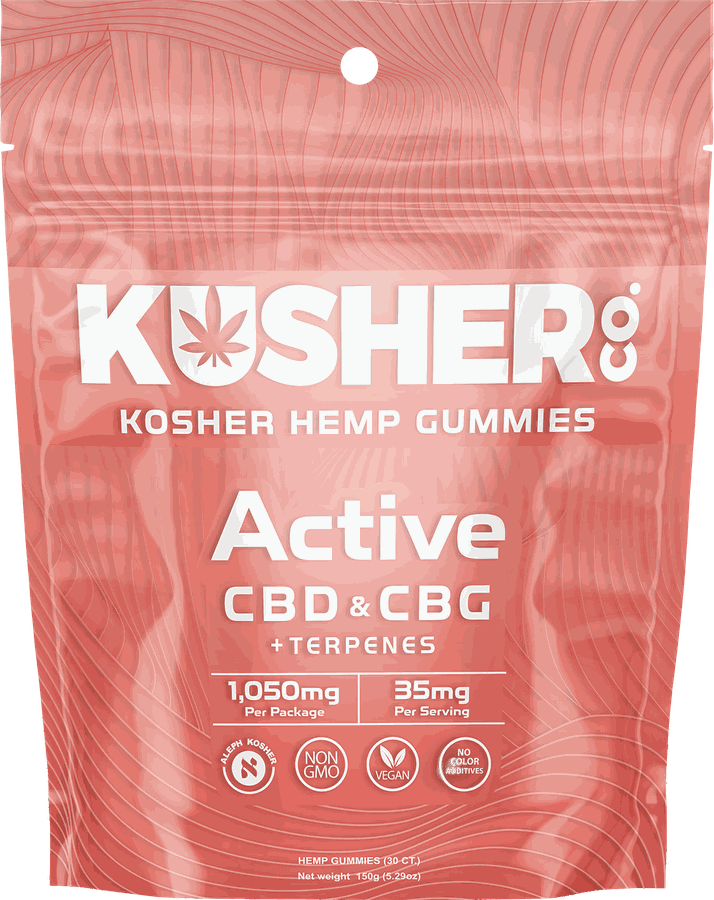
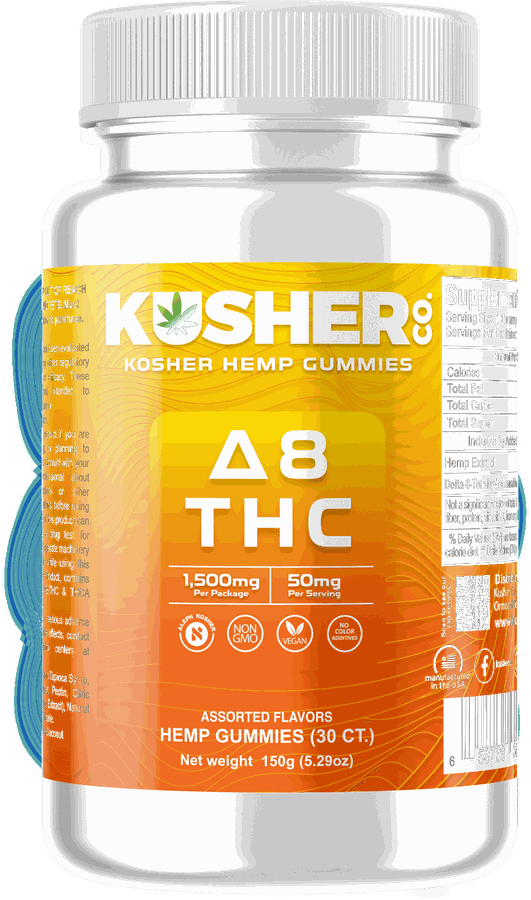
We make five gummies and each one puts a different load on the formulation. The Wellness Kosher Hemp Gummies carry CBD and terpenes. The Active Kosher Hemp Gummies add CBG, which means two cannabinoids have to distribute evenly rather than one. The Night Time Kosher Hemp Gummies carry CBD, CBN and melatonin, and melatonin behaves differently in a slurry from an oil-soluble cannabinoid, so that formula has two distribution problems running in parallel. The Happy Hour Kosher Hemp Gummies contain delta-8, delta-9 and live resin with total THC under 0.3 percent, which puts an accuracy requirement on the formulation because that ceiling is not a target to approach casually. The D8 Kosher Hemp Gummies are delta-8 in a jar format at $39.99, while the other four sit at $29.99.
Every one of those formulas sits inside the same gelling, sweetening and emulsifying framework described above. The cannabinoid line on the label is the part that differs. The other 99 percent of the piece is where the work is.
Bottom line
Judge a gummy by the parts nobody advertises. The gelling agent decides texture, heat behavior and whether kosher certification is even possible, and that single choice constrains sweetener levels, acidity and setting conditions downstream. Sugar is a preservation system as much as a taste. Flavor exists because hemp extract is genuinely bitter. And the carrier and emulsion are where consistency between pieces is decided, which is the property that actually matters and the one a batch-average lab test can never confirm. A brand that can explain its gelling agent and its emulsion knows how its own product is made.
Frequently Asked Questions
Is pectin or gelatin better in a gummy?
They are different rather than ranked, and the choice drives the rest of the formula. Gelatin is animal-derived collagen that gives the springy, melting chew people associate with classic candy, and it softens in heat. Pectin is a plant polysaccharide from citrus peel or apple pomace, giving a shorter, cleaner bite that holds up better when warm. Pectin is fussier to work with because its set depends on a narrow sugar and acidity window. For kosher certification, pectin removes an entire category of sourcing questions.
Why does the gelling agent matter for kosher certification?
Because gelatin is animal-derived by definition, and certification examines the origin of every ingredient. Pork-derived gelatin is out. Bovine gelatin raises questions about the slaughter and processing of the source animal that need documentation from further up the supply chain than most ingredient suppliers routinely supply. Pectin avoids the question entirely, since it is plant matter and pareve, carrying no meat or dairy status. Any certified gummy has answered this question one way or the other, and the certification is the evidence that it was answered.
Why is there so much sugar in a gummy?
Sugar is doing three jobs and only one of them is taste. It provides bulk, since the cannabinoid is a fraction of a percent of the mass and something has to be the rest. It controls texture, because the ratio of crystallizing sugar to non-crystallizing syrup decides whether the surface stays smooth or turns grainy over time. And it lowers water activity, which is the free water available to microbes. A gummy sits at room temperature without spoiling largely because it is very sweet.
What is the carrier oil in a gummy for?
Cannabinoids are oil-soluble and a gummy slurry is mostly water and sugar, so the two do not mix on their own. The cannabinoid arrives already dissolved in a neutral carrier, commonly MCT oil, and is then emulsified into very small droplets stabilized by an emulsifier such as lecithin. That emulsion is what allows the cannabinoid to spread evenly through the batch instead of floating to the top of the mixing tank. It is the step where consistency between pieces is decided.
Does a darker gummy contain more cannabinoid?
No. Color comes from added dyes or from plant sources such as black carrot, purple sweet potato or turmeric, and it is chosen for appearance rather than dose. Plant-derived colors also shift with acidity and fade with light exposure, so the same product can look different after a few months without anything else having changed. Full spectrum extract does carry some color of its own and can tint a base, but that tint is not a dose indicator and reading it as one will mislead you.
How can two gummies from the same jar contain different amounts?
Because the cannabinoid has to be distributed evenly through a large batch of slurry before it is deposited into thousands of molds, and that depends on emulsion stability, viscosity, mixing, temperature control and deposit accuracy holding steady for the whole run. If any of those drift, pieces vary while looking identical. The catch is that potency testing on several pieces blended together produces a batch average, and an average can look perfect while the spread underneath it is wide. Manufacturing control is what prevents this, not testing.