News · 19 August 2026
Hemp Seed Oil and Hemp Extract Are Not the Same Thing
Hemp seed oil and hemp extract come from different parts of the same plant and contain almost entirely different material. Seed oil is pressed from the seeds, which hold fats and protein and essentially no cannabinoids. Extract is taken from the flower and the leaf, which is where the cannabinoids are. A product whose ingredient list says hemp seed oil and nothing else is not a CBD product, no matter what the front of the box implies.
We sell a Full Spectrum Kosher Hemp Extract CBD Tincture, so we have an obvious stake in people understanding this. We would still write it the same way if we sold neither. This is the correction that saves shoppers the most money in this category, because the two ingredients read almost identically on a label, cost very different amounts to produce, and are routinely sold at similar prices.
The plant makes them in two different places
A hemp plant is not uniform. The cannabinoids are produced in trichomes, the sticky resin glands that sit mostly on the flower and on the small leaves closest to it. That resin is where CBD, CBG, CBN and the THC molecules live. It is a surface feature of the upper part of the plant, and it is concentrated in a small fraction of the total biomass.
The seed is a different organ with a different job. It is a storage vessel for the next generation of plant, packed with fatty acids and protein because that is what a seedling needs before it can photosynthesize. It does not manufacture cannabinoids and it does not store them. Whatever trace amount shows up in a seed pressing is contamination from resin on the outside of the hull, not content.
So the difference is not a matter of grade or quality or how carefully somebody worked. It is anatomy. You can press seeds perfectly and still end up with a bottle that has no meaningful cannabinoid content in it, because the compound you wanted was never in the input material.
What comes out of a seed press
Cold pressed hemp seed oil is a culinary and cosmetic oil. It is greenish, it has a nutty taste, and it is high in polyunsaturated fats. People cook with it, put it on salads, and formulate it into skin products. It is a perfectly good ingredient. Nothing in this article is an argument against hemp seed oil as an oil.
The manufacturing is simple compared with extraction. Seeds go into a press, oil comes out, the solids get filtered. There is no solvent, no distillation column, no winterization step, no chromatography. That simplicity is exactly why the finished oil costs a fraction of what an equivalent volume of cannabinoid extract costs to make.
You can usually see the difference in how these products are sold. Hemp seed oil is often priced by volume, in ounces or milliliters, and marketed on its fatty acid profile. Cannabinoid products are priced by milligram of cannabinoid, because the volume of the bottle is close to irrelevant and the milligram figure is the thing being bought.
What comes out of a flower extraction
Extraction is a separation process run on flower and leaf material. Solvent, whether that is carbon dioxide under pressure, ethanol, or a hydrocarbon, pulls the resin off the plant. What comes out first is a crude mixture of cannabinoids, terpenes, chlorophyll, waxes and plant lipids. Everything after that first pull is cleanup.
Those cleanup steps are where the cost sits. Winterization drops out the waxes. Filtration takes the chlorophyll down. Distillation separates fractions by their boiling points. Each step needs equipment, energy, time, and a loss of yield, and each step is a place where a kosher certification either held or did not.
The output is measured in cannabinoid content, usually as a percentage by weight, and that number is what a finished product's milligram figure is calculated from. When we say our tincture is 250mg or 3000mg, that number traces back to an assay of the extract that went into it. There is no equivalent number for a seed oil, because there is nothing to assay.
Why the two get confused on a label
Both ingredients are legally and accurately called hemp. That is the root of it. A bottle of seed oil can say hemp on the front in large type and be telling the truth. It can say hemp oil, which is a phrase with no fixed meaning in this category and is used for both things by different sellers.
The visual language of the two categories has converged as well. Green packaging, a leaf illustration, an amber dropper bottle, a wellness typeface. None of those are regulated and none of them tell you what is inside. A shopper who has learned to recognize the look of a CBD product has learned to recognize the look of a marketing decision.
Some of the confusion is deliberate and some of it is not. A small brand formulating a skin oil may genuinely think of hemp seed oil as their hemp ingredient, because it is. The shopper reading the box is thinking about cannabinoids. Both parties are using the same word for different things, and the label does not force either of them to be more precise.
Read the ingredient list, not the front panel
The front of a package is where the marketing lives. The ingredient list is where the composition lives, and it is the only part of the packaging that is obliged to be complete. Turn the box over before you decide anything.
What you are looking for is the exact phrase used for the hemp material. Cannabis sativa seed oil is seed oil. Hemp seed oil is seed oil. Cannabis sativa L. seed oil is seed oil. If seed appears in the ingredient name, you are looking at a pressing from seeds, and that is the end of the inquiry regardless of what the front said.
Extract shows up under different words. Hemp extract, full spectrum hemp extract, cannabis sativa flower extract, aerial parts extract, or a named isolate such as cannabidiol. Those phrases point at the flower and leaf. Ours reads as Full Spectrum Kosher Hemp Extract, and the word extract in that name is doing real work rather than decorating it.
A cannabinoid milligram figure is the fastest tell
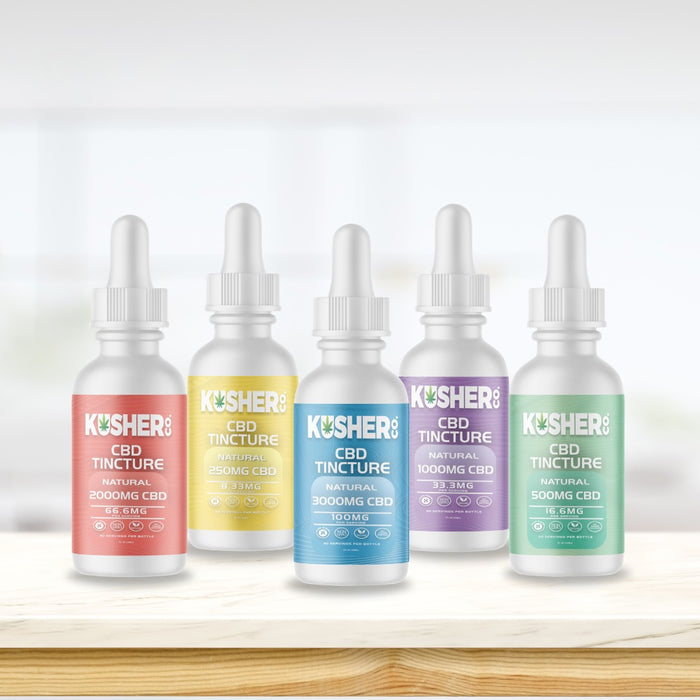
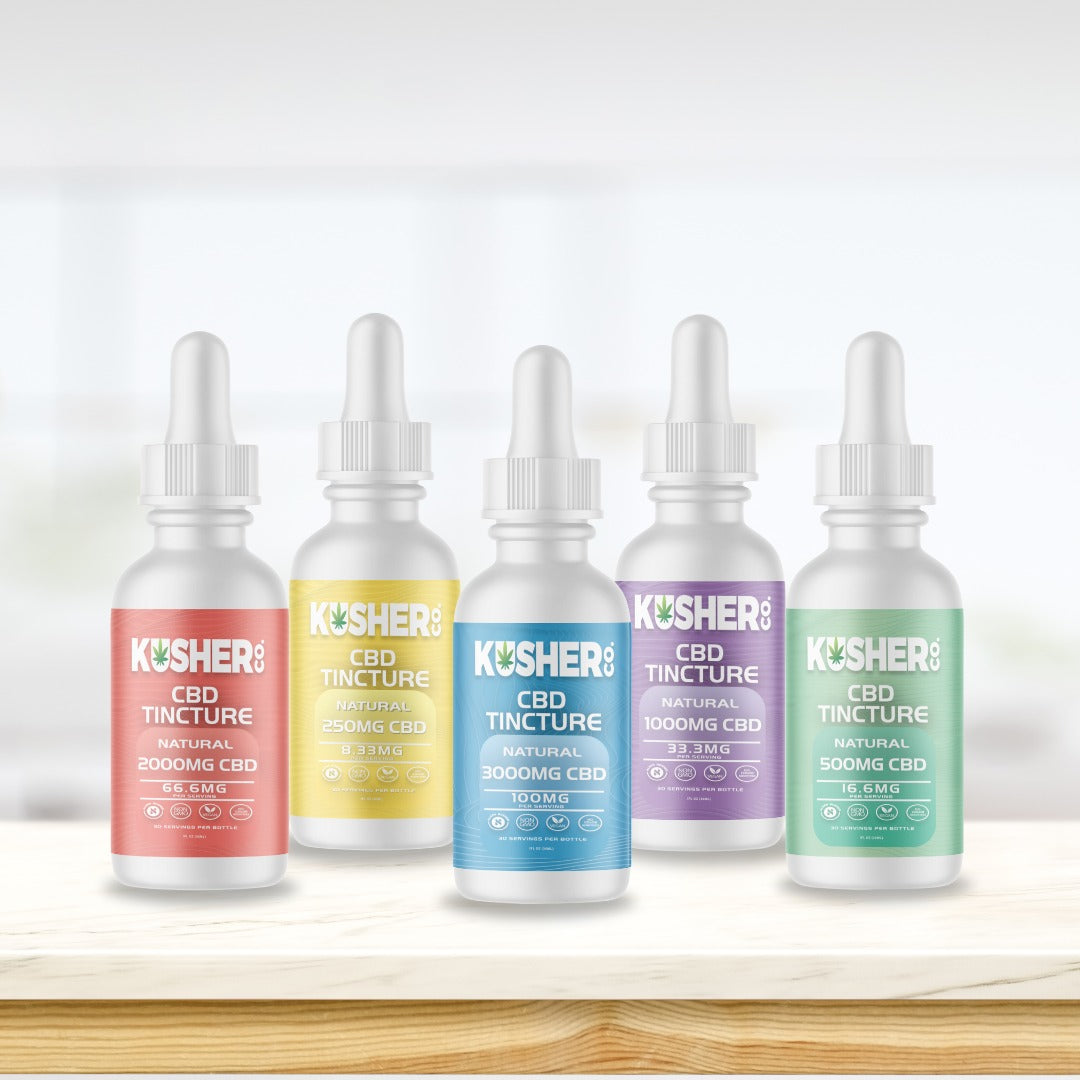
If you only have ten seconds, look for a milligram number attached to a named cannabinoid. A real cannabinoid product tells you how much CBD is in the container, because that figure is the product. Our tincture runs 250mg at $20.00, 500mg at $25.00, 1000mg at $30.00, 2000mg at $35.00 and 3000mg at $40.00, and every one of those bottles is named by that number.
A seed oil product will usually give you a volume and no cannabinoid figure, because there is no honest figure to give. Sometimes it will give you a large milligram number that refers to the total weight of hemp seed oil in the bottle rather than to any cannabinoid. That is the trap. A bottle advertising 1000mg of hemp oil where the ingredient list says seed oil is telling you how much oil it holds, not how much cannabinoid.
The test that resolves it is to ask what the milligrams are milligrams of. If the answer is CBD, CBG, CBN or total cannabinoids, the number means something. If the answer is hemp oil, hemp extract with no assay behind it, or nothing at all, you have a volume dressed up as a potency.
The words that mean extract and the words that do not
It helps to keep two short lists in your head. These are the phrasings that point at cannabinoid containing material, and the phrasings that do not, and once you have seen them a few times the sorting takes no effort at all.
- Points at cannabinoids: hemp extract, full spectrum hemp extract, broad spectrum hemp extract, cannabidiol, CBD isolate, cannabis sativa flower extract, aerial parts extract, phytocannabinoid rich hemp oil.
- Points at seed pressing: hemp seed oil, cannabis sativa seed oil, hemp oil with no other qualifier, cold pressed hemp oil, hemp seed extract.
- Means nothing on its own: hemp, hemp derived, made with hemp, hemp infused, contains hemp.
That third list is the one that catches people. Hemp infused is a phrase with no defined content behind it. A gummy infused with hemp seed oil has been infused with hemp. The claim is accurate and the product has no cannabinoids in it.
Hemp seed extract is a phrase worth pausing on
Hemp seed extract sounds like it should belong on the cannabinoid list, because it contains the word extract. It does not. The extraction being described is extraction from seeds, and seeds have no cannabinoids in them to extract. The word that matters in an ingredient name is the plant part, not the process.
This is the single most effective piece of label wordplay in the category, and it is not always intentional. A supplier sells hemp seed extract as a cosmetic ingredient, a formulator lists it accurately, and a shopper reads the second word and stops. Nobody lied at any point and the shopper still got the wrong idea.
Train yourself to read the plant part first. Seed, or flower, or aerial parts, or leaf. Everything else in the ingredient name is secondary, and if the plant part is seed then the process does not rescue it.
The certificate of analysis settles the argument
A certificate of analysis is a third party lab report on a specific batch, and it is the only document that can prove a cannabinoid figure rather than assert it. Any seller making a milligram claim should be able to hand you one, and the batch number on the report should correspond to the batch number on the product you are holding.
What you are looking at on that report is the cannabinoid panel. A real extract based product produces a panel with numbers in it, showing CBD and whatever minor cannabinoids the process left behind, plus a THC figure that has to sit under the legal limit. The percentages will be meaningful figures rather than trace readings.
Run the same test on a seed oil product and the cannabinoid panel comes back at or near the detection limit across the board. That is not a failed batch. That is the correct result for a material that never contained the compounds being tested for. If a seller cannot produce a certificate at all, you are being asked to take the front of the box on faith.
Price is a signal, not proof
Extraction is expensive and pressing is cheap, so there is a floor under what a real cannabinoid product can cost to make. When a large bottle of hemp oil is priced well below anything with a verified cannabinoid figure, the price is usually telling you which of the two you are looking at.
The inverse does not hold. A high price proves nothing at all. Seed oil sold in a nice bottle with wellness language on it can carry a premium price for reasons that have nothing to do with what is inside, and plenty of shoppers have paid extract money for a pressing.
Use price as a prompt to check the ingredient list rather than as an answer in itself. A suspiciously cheap product is worth turning over. So is an expensive one. The ingredient list costs nothing to read and it ends the question in both directions.
Hemp seed oil has a real job, it is just not that one
We are not here to run down an ingredient. Hemp seed oil appears in perfectly honest formulations as a carrier, which is to say the oil that a cannabinoid extract gets dissolved into and diluted with. In that role it is doing something useful and nobody is being misled.
You can tell a carrier from an active by where it sits and what sits beside it. If an ingredient list names hemp seed oil alongside a separate cannabinoid entry, the seed oil is the vehicle and the extract is the payload. If hemp seed oil is the only hemp ingredient in the list, it is not carrying anything.
The same logic applies to any other carrier oil in the category. What matters is whether a cannabinoid containing material is named somewhere in the list as its own line item. One hemp word in an ingredient panel is not enough information. Two hemp words, one of them a plant part and one of them a cannabinoid, is a different picture entirely.
What is actually in our tincture
Our tincture is a full spectrum hemp extract, which means the cannabinoid material came from flower and leaf and was not reduced to a single isolated compound. Full spectrum in that name is a description of the extract, and the word extract is the part of the name that answers the question this article is about.
The strength ladder tells you the rest. 250mg, 500mg, 1000mg, 2000mg and 3000mg are cannabinoid figures, not bottle volumes, which is why the price moves with the number rather than with the size of the glass. A seed oil product cannot offer a ladder like that, because there is no dimension to move along.
Every one of those bottles is kosher certified, and that certification covers the extraction and blending steps rather than just the final fill. In a category where the manufacturing chain has this many stages, a certification that only looked at the last one would not be worth much.
A sixty second check before you buy
Here is the whole method, compressed. It works on any product in this category, including ours, and it does not require you to know any chemistry.
- Turn the package over and find the ingredient list.
- Find the hemp ingredient and read the plant part. Seed means seed oil. Extract, flower or aerial parts means cannabinoid material.
- Find a milligram figure and ask what it is a figure of. If it is not attached to a named cannabinoid, treat it as a volume.
- Ask for the certificate of analysis and look at the cannabinoid panel.
- If the answers do not line up with the front of the box, believe the ingredient list.
Nothing on that list requires trusting the seller, including us. It is all verifiable from the package and one document, which is why we would rather teach it than ask anyone to take our word for anything.
Where the labeling rules leave you
Ingredient naming in this category is governed by cosmetic and food labeling conventions that were not designed with cannabinoids in mind. That is why hemp seed oil and hemp extract can both be described accurately in ways that sound the same to a shopper. The rules are working. They were just written for a different problem.
Until that changes, the burden of distinguishing the two sits with the buyer, which is not fair but is the actual situation. The compensating fact is that the distinction is easy to make once you know where to look, and it takes less time than reading the marketing copy you were going to read anyway.
We would rather a shopper walk away from our tincture having learned this than buy it without knowing why the word extract is on the label. A customer who can read a panel is a customer who can tell what they are paying for, and that is a better long term outcome for a store that has nothing to hide in its ingredient list.
Bottom line
Hemp seed oil is a fat pressed from seeds and it contains essentially no cannabinoids. Hemp extract is resin taken from flower and leaf and it is where every cannabinoid figure comes from. If the ingredient list says seed, you are buying oil. If it says extract, flower or a named cannabinoid, you are buying cannabinoid material, and only then does a milligram number mean anything.
Our tincture is a Full Spectrum Kosher Hemp Extract, priced from $20.00 to $40.00 across a 250mg to 3000mg ladder, and the word extract in that name is the load bearing one. Check ours the same way you would check anyone else's. Ingredient list, plant part, milligram figure, certificate of analysis. Four things, one minute, and the confusion goes away for good.
Frequently Asked Questions
Is hemp oil the same as CBD oil?
Not reliably. Hemp oil is a loose phrase that different sellers use for two different materials. Some use it to mean hemp seed oil, which is pressed from seeds and contains essentially no cannabinoids. Others use it to mean a cannabinoid extract taken from flower and leaf. Because the phrase has no fixed meaning, it cannot answer the question on its own. Look at the ingredient list instead and read the plant part. If the ingredient names seed, it is a pressing. If it names extract, flower, aerial parts or a specific cannabinoid such as cannabidiol, it is extract based material.
Why does hemp seed oil have no cannabinoids in it?
Because the plant does not make cannabinoids in its seeds. Cannabinoids are produced in trichomes, the resin glands that sit on the flower and the small surrounding leaves. Seeds are storage organs full of fatty acids and protein, built to feed a seedling. They neither produce nor store cannabinoid compounds. Any trace amount that turns up in a lab test of seed oil comes from resin that was on the outside of the hull during harvest, not from the seed itself. This is anatomy rather than a question of processing quality, so a carefully made seed oil still has no meaningful cannabinoid content.
What does a 1000mg figure on a hemp oil bottle mean?
It depends entirely on what the milligrams are milligrams of, and that is the question to ask. On our tincture, 1000mg is a cannabinoid figure that traces back to a lab assay of the extract that went into the bottle. On some seed oil products, a large milligram number refers to the total weight of hemp seed oil in the container rather than to any cannabinoid at all. That is a volume presented as a potency. If the number is not attached to a named cannabinoid on the label or on a certificate of analysis, treat it as a statement about how much oil is in the bottle.
Is hemp seed oil a bad ingredient?
No. It is a good oil doing an honest job in plenty of formulations. Cold pressed hemp seed oil is used in cooking and in skin products, and it appears legitimately in cannabinoid products as a carrier, which is the oil that an extract gets dissolved into and diluted with. The problem is not the ingredient, it is the labeling. A product where hemp seed oil is the carrier and a cannabinoid extract is named separately is clear about what it is. A product where seed oil is the only hemp ingredient but the marketing implies cannabinoids is where a shopper gets the wrong idea.
How do I check whether a certificate of analysis backs up the label?
Look at the cannabinoid panel and match the batch number. A certificate of analysis is a third party lab report on one specific batch, so the batch identifier on the report should correspond to the batch on the package in your hand. On the panel itself, an extract based product produces real percentages for CBD and whatever minor cannabinoids the process left in, plus a THC figure under the legal limit. A seed oil product tested the same way returns readings at or near the detection limit across the board, which is the correct result for a material that never contained those compounds.
What kind of hemp material is in your tincture?
Our Full Spectrum Kosher Hemp Extract CBD Tincture is built on extract taken from flower and leaf, not on seed oil. Full spectrum means the cannabinoid material was not reduced down to a single isolated compound. The strength ladder runs 250mg at $20.00, 500mg at $25.00, 1000mg at $30.00, 2000mg at $35.00 and 3000mg at $40.00, and those figures are cannabinoid content rather than bottle volume, which is why the price tracks the number instead of the size of the glass. Every strength on that ladder is kosher certified across the production steps, not only at the final fill.