News · 18 August 2026
Delta-8 vs Delta-9 THC: What the Science Actually Says About the Difference
Delta-8 and Delta-9 THC are the same molecule with one double bond sitting in a different place, and that single structural difference is the whole reason they behave differently in the body. Delta-9 carries its double bond on the ninth carbon of the chain. Delta-8 carries it on the eighth. Everything people describe as a difference in feel, in intensity and in legal treatment traces back to that one shift, because where that bond sits changes how tightly the molecule locks into the receptors it acts on.
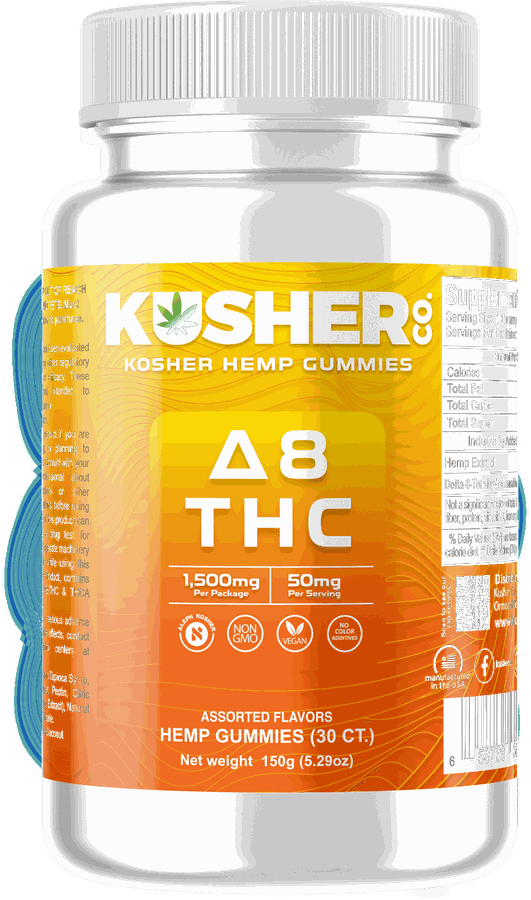
We sell both, and we sell them in two different products. Our Happy Hour Kosher Hemp Gummies at $29.99 combine Delta-8 and Delta-9 with live resin, and the total THC content is under 0.3 percent. Our Delta-8 Kosher Hemp Gummies come in a jar at $39.99. If you are trying to work out which of those makes sense for you, the structural story below is the part worth understanding first, because the marketing language in this category skips it almost every time.
The one-carbon difference, and why it changes anything at all
THC works by fitting into receptors that belong to a signaling system the body already runs on its own. The useful way to picture a receptor is as a lock with a very particular shape. A molecule that matches that shape closely engages it strongly. A molecule that is slightly off engages it less.
Delta-9 fits tightly. Delta-8, with its double bond one position further along the carbon chain, sits at a marginally different angle and binds less tightly to the same receptor. Binding affinity is the technical name for how firmly a molecule holds on, and a lower affinity produces a smaller response from the same amount of material.
That is the mechanism behind almost everything else people report about the two. When someone says Delta-8 is milder, they are describing the downstream consequence of a shape mismatch. It is not a softened way of saying the material is weaker in the sense of being diluted or lower grade. A gram of pure Delta-8 and a gram of pure Delta-9 are both fully potent examples of what they are. They simply do different amounts of work at the receptor.
Our own product description for Happy Hour puts the practical difference plainly. Delta-8 gives a clear headed, mellow experience. Delta-9 gives the more traditional one. Those two descriptions differ because of bond position, not because one ingredient is better than the other.
Why Delta-8 is nearly always made rather than extracted
Hemp plants produce CBD in quantity and Delta-9 THC in small amounts. What they do not produce in any useful quantity is Delta-8. It exists in the plant in traces so small that extracting it directly makes no economic sense at any scale a real business operates at.
So the Delta-8 on the market is generally converted from CBD through a chemical reaction. This is the single most important fact about the category and it is the one least often said out loud. Conversion is ordinary chemistry and there is nothing sinister about it, but it does mean that the Delta-8 in any finished product is the output of a process, and the quality of that output depends entirely on how carefully the reaction was run and how thoroughly the result was cleaned up afterward.
A reaction that is pushed too hard, or not purified properly, leaves behind material that was never meant to be in the finished product. The buyer has no way to see any of this. You cannot look at a gummy and know how the molecule inside it was made.
That is exactly where an outside certification changes the picture. Our gummies are kosher certified, which means the ingredients and the processing were reviewed by a body with no stake in selling them. A certifier looking at a converted cannabinoid is looking at the inputs and at what happened to them. In a category where the central question is what took place during manufacturing, an outside party with the standing to inspect is worth considerably more than any sentence we could print on a label about our own care and dedication.
The 0.3 percent figure, and what it actually governs
Hemp is legally separated from other cannabis by total Delta-9 THC content measured on a dry weight basis, with 0.3 percent as the dividing line. Our Happy Hour gummies state total THC under 0.3 percent, and that number is doing real work rather than sitting on the label as decoration.
Two things follow from it that buyers get wrong constantly.
- The threshold is a concentration, not a dose. A percentage tells you what fraction of the product's weight is THC. It tells you nothing on its own about how many milligrams you are taking, because that depends entirely on how much the product weighs. A very large product at a low percentage can carry more total THC than a small product at a higher one.
- The line was drawn around Delta-9 specifically. Delta-8 sits in a different regulatory position precisely because the original rule named one isomer, and Delta-8 is a different isomer. That is an artifact of how the rule was written. It is not a statement that one is inherently gentler or safer than the other, and reading it that way is a mistake.
Anyone selling in this category who cannot tell you their total THC figure is asking you to take the most consequential number in the product entirely on trust. We put ours on the product because a buyer who cannot see that number cannot make an informed decision about anything else.
What live resin adds, and why we put it in that formula
Happy Hour is not only the two cannabinoids. It also carries live resin, and that is a deliberate formulation decision rather than a word added for shelf appeal.
Most hemp extract is made from plant material that has been dried and cured first. Drying is convenient, it makes material easier to store and transport, and it is also lossy. Many of the aromatic compounds in the plant are volatile, which means they evaporate readily, and a good share of them simply leave during the drying process. What reaches the extractor is a reduced version of what the plant originally made.
Live resin is made from plant material frozen fresh instead of dried. Freezing holds those volatile compounds in place through handling and into extraction. What survives is the terpene fraction, the family of compounds responsible for aroma and for the character of an experience rather than its raw intensity.
A product built with live resin carries more of the original plant profile than one built from dried material. Whether that matters to you depends on what you want out of the product. If you are after a specific cannabinoid and nothing else, it is beside the point. If you want something that reads as fuller and more like the plant it came from, it is the reason to pick one formula over another. It is a genuine difference in what is in the jar rather than a difference in wording.
Two products, two different questions
Choosing between what we sell is easier once you stop asking which is better and start asking which question you are answering.
If you want the more familiar experience with the plant's aromatic profile intact, Happy Hour at $29.99 is the one. The presence of Delta-9 alongside Delta-8 is what makes it read as complete rather than flat, and the live resin is what gives it character beyond raw effect. It is the product for someone who wants the whole thing rather than one isolated piece of it.
If you specifically want Delta-8 without Delta-9 in the mix, the Delta-8 jar at $39.99 is built for exactly that. It is the more expensive of the two, which surprises people who assume the milder option should be the cheaper one. It is not, for two straightforward reasons. The conversion process behind Delta-8 is a real manufacturing step with real cost attached, and a jar holds more than a retail pack does.
The honest trade-off runs like this. The combination product gives you less control, because you are taking two cannabinoids together and cannot separate their contributions. The single cannabinoid jar gives you more control and asks you to pay for it. Neither one is the better product in the abstract, and we would rather sell you the right one than the dearer one.
Four things people believe about Delta-8 that are not true
This category generates confident misinformation faster than almost any other we know, and most of it comes from people repeating a half remembered version of something that was roughly true once.
That Delta-8 is synthetic and Delta-9 is natural. Both occur in the plant. Delta-9 occurs in usable amounts and Delta-8 does not, which is why one is extracted and the other is converted. The starting material for that conversion is CBD, which came out of the same plant. Calling one natural and the other artificial describes the manufacturing route rather than the molecule, and the molecule is the same either way.
That a lower percentage means a smaller effect. A percentage is a ratio between the THC and the total weight. Two products at the same percentage can deliver very different amounts depending on how much they weigh. If you want to know what you are actually taking, you need the milligram figure per serving, and the percentage will not give it to you.
That Delta-8 cannot be too much. Milder per milligram is not the same as mild. Lower binding affinity means you need more of it to reach a given effect, and it is entirely possible to take more of it. People who assume the ceiling is lower tend to be more casual about the amount, which is how the milder option produces the worse evening.
That the color of an extract tells you about its quality. Color varies with the starting material, the extraction method and how much filtering was done afterward. A pale extract has been processed more, which is not automatically better and sometimes means more of the supporting compounds were stripped along the way. You cannot read purity off a photograph.
How to start if you have never taken either
Start with one product, not two. Take the smallest amount that does anything noticeable, and wait long enough to know what it does before deciding whether to adjust.
Edibles are slower than most people expect because they have to pass through digestion before anything reaches circulation. The gap between taking one and knowing how it landed is measured in a good while rather than a few minutes. Almost every bad experience in this category comes from the same mistake, which is taking more because the first amount did not seem to be working yet.
Give it time. Write down what you took and when. Adjust in one direction at a time. That is unexciting advice and it is the advice that actually works.
Two more habits are worth building early. Eat something first, because cannabinoids are fat soluble and absorb better alongside food containing some fat, and an empty stomach makes the onset both faster and harder to predict. And do not judge a product on a single occasion. Sleep, food, hydration and the state you were in before you took anything all move the result around more than most people expect, so a fair assessment takes a few separate occasions rather than one.
Bottom line
Delta-8 and Delta-9 differ by the position of one double bond, and that difference makes Delta-8 bind less tightly and land lighter at the same amount. Delta-8 is almost always converted from CBD rather than pulled from the plant, which makes the integrity of the manufacturing process the thing that genuinely matters and makes outside certification worth more here than in most categories. If you want the fuller, more traditional experience with the plant's aromatics preserved, take the Happy Hour gummies at $29.99. If you want Delta-8 on its own and you want to control exactly what you are taking, take the Delta-8 jar at $39.99 and understand you are paying more for a sound manufacturing reason rather than a marketing one.
Frequently Asked Questions
Is Delta-8 just a weaker version of Delta-9?
Not exactly. It is a different isomer that binds less tightly to the same receptors, so at an equal amount it lands lighter. Calling it weaker is a fair shorthand for the effect but it misses the cause, which is molecular shape rather than reduced purity or a lower grade of material. The two are closely related compounds that do different amounts of work at the receptor, and a product built on one will not behave like a product built on the other even at matched milligrams.
Why does the Delta-8 jar cost more than the Happy Hour gummies?
The Delta-8 jar is $39.99 and Happy Hour is $29.99. Two things drive that. Delta-8 does not occur in useful quantity in the plant, so it has to be converted from CBD, and that conversion is a genuine manufacturing step with cost attached. The jar is also a larger format than the retail pack. Price in this category does not track intensity, which is why the milder sounding option is the more expensive one here.
What does total THC under 0.3 percent actually mean?
It is a concentration by weight rather than a dose. It tells you THC makes up less than three tenths of one percent of the product's weight, which is the threshold that legally separates hemp from other cannabis. It does not by itself tell you how many milligrams are in a serving, because that depends on what the serving weighs. Both numbers matter and they answer completely different questions.
Does live resin make the gummies stronger?
No. Live resin is about breadth rather than strength. It is made from plant material frozen fresh instead of dried, which preserves far more of the volatile aromatic compounds that ordinary drying drives off. The result carries more of the original plant profile, so it changes the character of the experience rather than its raw intensity. That is why we use it in Happy Hour specifically rather than across everything.
Does kosher certification tell me anything about the Delta-8 itself?
It tells you an outside body reviewed the ingredients and the processing rather than taking our word for it. That carries more weight in this category than in most, because Delta-8 is converted rather than extracted, so the central question is what happened during manufacturing. A certifier reviewing that process is reviewing precisely the thing a buyer has no way to see from the outside.
Can I take both products at the same time?
We would not start there. Both contain THC, so stacking them means taking a combined amount that is much harder to judge than either one alone. Start with a single product, at the smallest amount that does anything noticeable, and give it long enough to come on fully before deciding whether to change anything. Taking a little more of one product is far easier to reason about than combining two.
How long should I wait before deciding it is not working?
Longer than feels natural. Anything you swallow has to pass through digestion before it reaches circulation, so the gap between taking a gummy and knowing how it landed is a good while rather than a few minutes. Most poor experiences in this category come from taking a second one because the first did not seem to be doing anything yet. Wait it out, note what you took, and change one thing at a time.