News · 18 August 2026
What Is CBG and How Is It Different From CBD in the Active Gummies?
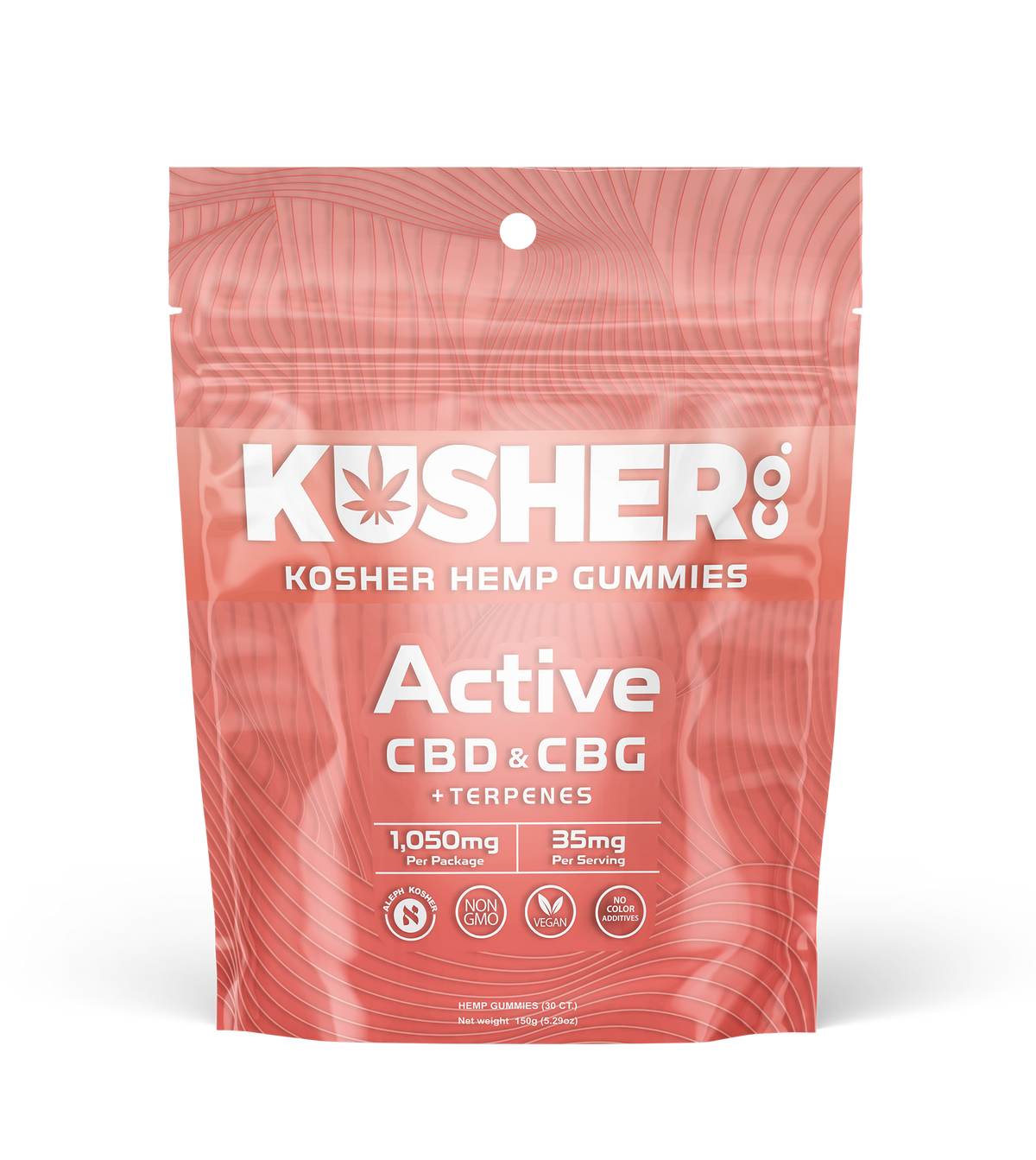
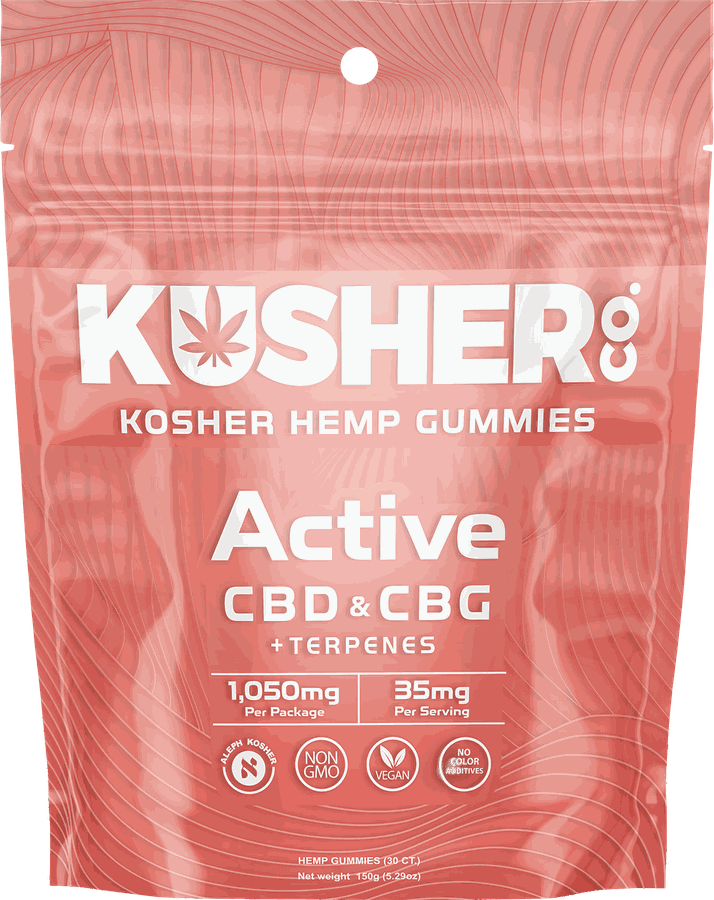
CBG and CBD are not two versions of the same thing. They work through distinct biological pathways, and the reason our Active Kosher Hemp Gummies ($29.99) combine both is precisely because neither one does what the other does. That is the whole story, and everything else in this article is the evidence.
GABA vs. Serotonin: Why These Two Cannabinoids Are Not Interchangeable
CBG (cannabigerol) modulates GABA receptors. GABA is the brain's primary inhibitory neurotransmitter, the one that dials down neural overactivity. When CBG engages GABA pathways, the result tends toward increased mental clarity and focused calm. Not sedation. Not the loose-limbed relaxation people associate with winding down. The kind of clarity you want before a workout or a long shift on your feet.
CBD (cannabidiol) works differently. It engages serotonin pathways, which play a larger role in mood regulation and baseline relaxation. The experience is less about sharpening focus and more about softening the edges of a stressful day. That is genuinely useful, but it is not what CBG produces, and it is not a replacement for it.
The mistake most people make is treating these as a dose-dependent choice, as if you could just take more CBD and get the same mental clarity that CBG provides. You cannot. The mechanisms are different at the receptor level. Doubling your CBD intake does not convert a serotonin pathway effect into a GABA modulation effect. These are not two dials on the same knob.
It is also worth being specific about what "focused calm" actually means in practice, because that phrase gets thrown around loosely. CBG's GABA modulation does not produce a stimulant effect. It is not an energy compound. What it does is reduce the background noise of anxious or scattered thinking, which is a different thing from giving you more energy. Someone who struggles to settle into a training session because their head is still full of the morning's stress is a better candidate for CBG than someone who just needs a pre-workout energy boost. The compound helps clear the mental static, not charge the battery. That distinction matters when you are deciding whether the Active gummies are actually the right fit for your situation.
This is why we formulated the Active gummies the way we did. CBG handles the focus-and-clarity side of the equation. CBD handles the baseline relaxation side. Run them together and you get a daytime experience that is alert without being wired and relaxed without being heavy. That is a specific functional outcome, and it required both cannabinoids to achieve it.
The Product Architecture Is the Proof
Here is the most direct evidence that CBG and CBD are not interchangeable: look at what is in the Night Time Kosher Hemp Gummies ($29.99) and what is not.
The Night Time formula contains CBD, CBN, and melatonin. CBG is absent. That is not an accident and it is not a cost decision. CBG's stimulating, GABA-modulating profile makes it actively unsuitable for an evening formulation. If you are trying to help someone fall asleep, the last ingredient you want is one that promotes mental clarity and focus. CBN pairs with CBD and melatonin precisely because CBN reinforces the sedating direction that CBD and melatonin are already pointing toward.
CBN deserves a moment of explanation here, because it is the lesser-known of the three compounds in the Night Time formula and people often ask why it is in there at all. CBN (cannabinol) forms as THC oxidizes over time, and its interaction profile leans sedating in a way that neither CBD nor melatonin achieves alone. The working theory is that CBN amplifies the sleepiness signal rather than introducing an entirely separate one, which makes it a logical complement to both CBD's relaxing effect and melatonin's circadian influence. Together, all three are pointing in the same direction. CBG, by contrast, would be pulling against them. That is the architectural logic in plain terms.
CBG points the other way. It belongs in the daytime formula because it functions as a daytime cannabinoid. The Active gummies carry CBG. The Night Time gummies deliberately do not. That product separation is the clearest expression of what we know about these two compounds.
For the active person reading this, the practical implication is straightforward. If you want support for a morning run, a long training session, or a workday where you need to stay sharp, the Active gummies are built for that window. If you want to recover and sleep well after all of that, the Night Time formula takes over. They are not competing products. They cover different parts of the day by design.
Terpenes, Bioavailability, and the Gummy Format Specifically
The Active gummies include terpenes alongside CBG and CBD, and that choice matters more than it might look at first glance. Terpenes are not a marketing flourish in this context. In a full-spectrum or terpene-forward formulation, they interact with cannabinoids in ways that influence how those cannabinoids are absorbed and how they function. This is what the entourage effect actually refers to, not a vague synergy but a specific enhancement of cannabinoid activity that terpene co-formulation provides.
An isolate-only gummy, one stripped down to a single purified cannabinoid compound, loses this. The CBG or CBD in that product works in isolation, without the terpene environment that a full-spectrum or co-formulated product provides. Our Active gummies keep that environment intact, which is why we include terpenes as a named formulation component rather than a trace incidental.
The specific terpenes present in a formulation are not all equivalent, and this is where the subject gets genuinely technical. Terpenes like beta-caryophyllene interact directly with the endocannabinoid system through CB2 receptor binding, which makes them functionally closer to minor cannabinoids than to simple flavor compounds. Others, like myrcene, influence how readily cannabinoids cross into the central nervous system. The point is not to memorize the list but to understand that terpene selection in a well-built product is a formulation decision, not a flavoring decision. A co-formulation that includes these compounds is doing something that an isolate product cannot replicate even at a higher milligram dose of the primary cannabinoid.
On onset timing: gummies as a format sit in a specific window. The Active gummies typically begin working somewhere between 30 and 90 minutes after eating them, which is slower than inhalation methods but generally faster than oil tinctures absorbed without sublingual use. The gelling agents in a gummy format affect how the cannabinoids move through the digestive process. This matters for planning. If you want the Active gummies to carry you through a morning session, taking them 45 to 60 minutes beforehand is a reasonable starting point rather than eating them the moment you walk into the gym.
One honest note on cost: CBG carries a higher cost-per-milligram than equivalent CBD. The extraction and isolation process for CBG is more complex, and that complexity translates to price. At $29.99 for the Active gummies, you are paying for a co-formulated stack that includes a genuinely harder-to-produce cannabinoid. That is worth knowing upfront. If your only goal is general relaxation and a single-cannabinoid CBD product would serve you well, our Wellness Kosher Hemp Gummies (also $29.99) do exactly that. The Active formula is not the budget-conscious option. It is the mechanistically specific one.
Kosher certification on the Active gummies adds another layer of formulation requirement that most hemp products skip entirely. Sourcing verification, processing compliance, and ingredient traceability all go through additional review steps that standard formulations are not required to complete. If kosher dietary practice matters to you, that certification reflects real operational work, not a label choice.
Stacking the Active Gummies With Topical Relief Products
A significant portion of our customers using the Active gummies are also managing real physical discomfort. Muscle soreness, joint aches, the kind of wear that accumulates over an active lifestyle. Many of them are also using our topical products alongside the gummies, and CBG's interaction profile makes that combination worth thinking about clearly.
Take someone who is managing joint pain and regularly uses our Joint and Muscle Roll-On Relief ($20), which contains 350mg of CBD oil with cooling menthol and is applied directly to the affected area. That person is already getting CBD topically. Adding the Active gummies on top brings CBG into the stack alongside additional CBD. CBG shows a minimal interaction risk with common pain-relief compounds, which matters if you are someone layering multiple approaches. The GABA-modulating, focus-supporting role that CBG plays does not conflict with the topical CBD's localized anti-inflammatory work. These are different delivery methods acting on different targets.
High-dose CBD taken systemically is where interaction profiles become worth monitoring more carefully, particularly if someone is also on other compounds. CBG does not carry the same concern at the levels present in a gummy formulation. For a fitness-oriented person building a supplement stack, that distinction is relevant. CBG adds a layer without requiring you to second-guess your existing topical routine.
Here is a real scenario: someone training five days a week uses the Joint and Muscle Roll-On on their knees after runs and takes the Active gummies before morning sessions for mental focus and pre-workout calm. That is a coherent, non-redundant stack. The gummies are working systemically, targeting focus and baseline tension through CBG and CBD respectively. The roll-on is working locally, targeting inflamed tissue directly. There is no meaningful overlap and no conflict worth worrying about at these formulation levels.
What would not make sense is swapping the Active gummies for the Night Time formula to use during the day, figuring that CBD is CBD. The Night Time formula also contains melatonin. Taking melatonin at 7am before a workout is not a formulation choice anyone wants to make twice. The formulas are built for specific windows and specific mechanisms. Treating them as interchangeable is where people run into problems.
How to Know Which Formula Is Actually Right for You
The question we hear most often from first-time buyers is some version of: "I want to feel better during the day and sleep better at night, so should I just take both?" The answer is yes, but the timing matters as much as the products themselves, and it is worth laying out clearly.
The Active gummies are a daytime tool. They work best when you have a defined window ahead of you, a training block, a long work session, a period where you need to be functional and present. They are not a morning-to-night supplement. CBG's GABA-modulating effect is not the kind of thing you want running in the background at 10pm when you are trying to wind down. If you take the Active gummies in the afternoon and feel alert later than expected, that is the CBG doing exactly what it is supposed to do at the wrong time of day. Build your timing around the 30-to-90-minute onset window and the functional window you actually need covered.
The Night Time formula, by contrast, is better suited for consistency than for precision timing. You do not need to engineer the perfect moment to take it. Taking the Night Time gummies roughly an hour before you want to be asleep gives the melatonin and CBN time to work, but there is more flexibility there than with a pre-workout daytime formula where being 30 minutes off can mean the effect peaks at the wrong time.
Where the two formulas do work together well is in a deliberate split-day routine. Active gummies in the morning, Night Time gummies in the evening, with a clean gap of several hours between them. The compounds are not accumulating against each other in a harmful way when you do this, but running them too close together defeats the purpose of each. The Active gummies are calibrated to sharpen your day. The Night Time gummies are calibrated to close it. Give each one the window it was designed for, and they do not compete at all.
The bottom line is this: the Active Kosher Hemp Gummies exist because CBG and CBD are not alternatives to each other. They are mechanistically distinct cannabinoids that target different receptor pathways, produce different functional outcomes, and serve different roles in a well-built daytime formula. If you want focus and clarity alongside baseline relaxation, you need both. If you want sleep support, you need neither CBG nor this product. That clarity in design is what makes the Active gummies worth the price for the right customer, and it is also what makes them the wrong choice if your goal is simply winding down.
A short human note before the questions below: these come up constantly, and the answers matter for making a confident buying decision.
Frequently Asked Questions
Can I take the Active gummies at night if I find CBD relaxing?
We would not recommend it, and the reason is CBG, not CBD. CBG's GABA-modulating profile produces mental clarity and focus, which is the opposite of what you want before sleep. The Night Time Kosher Hemp Gummies ($29.99) are specifically built for the evening window with CBD, CBN, and melatonin. CBG is deliberately absent from that formula because its stimulating profile conflicts with the sleep objective. If you want evening wind-down support, the Night Time gummies are the right product. The Active gummies are a daytime formula by mechanism, not just by name.
Why do the Active gummies cost the same as the Night Time gummies if CBG is more expensive to produce?
CBG does carry a higher cost-per-milligram than CBD due to extraction and isolation complexity. The Active gummies at $29.99 reflect a co-formulated stack that includes CBG, CBD, and terpenes. The pricing is positioned to make the formula accessible while covering the formulation cost. If you are comparing the Active gummies to a single-cannabinoid CBD product and wondering whether the price is justified, the answer depends on what you need. General relaxation: our Wellness Kosher Hemp Gummies handle that at the same price point. Daytime focus paired with baseline calm: the Active formula is the mechanistically specific option.
How long before a workout should I take the Active gummies?
The Active gummies typically begin working somewhere between 30 and 90 minutes after eating them. This is the standard gummy format window: slower than inhalation, generally faster than an oil tincture taken without sublingual absorption. For a morning workout, taking them 45 to 60 minutes before you start is a reasonable starting point. Individual onset can vary based on your metabolism and whether you have eaten beforehand. Taking them on a completely empty stomach may accelerate onset slightly. On a full stomach, allow closer to the 90-minute end of the range before expecting the full effect.
Can I use the Active gummies alongside the Joint and Muscle Roll-On Relief?
Yes, and this is actually a common combination for active customers managing physical discomfort. The Joint and Muscle Roll-On ($20) contains 350mg of CBD oil applied topically to a targeted area. The Active gummies work systemically through digestion. These are different delivery methods acting on different targets, so there is no meaningful overlap. CBG specifically shows minimal interaction risk with common pain-relief compounds, which makes it a practical choice for stacked use. The two products address different dimensions of the same problem: local tissue discomfort handled topically, systemic focus and tension managed through the gummy formula.
What does the kosher certification on the Active gummies actually require?
Kosher certification on the Active Kosher Hemp Gummies requires additional verification in sourcing and processing that standard hemp formulations are not required to complete. That includes ingredient traceability and processing compliance reviewed against kosher standards. It is not a label that any manufacturer can self-apply. For customers who keep kosher dietary practice, this certification reflects real operational steps taken at the formulation and sourcing level. The certification applies to the Active gummies, along with other products in our lineup that carry the kosher designation, including the Night Time, Wellness, D8, and Happy Hour gummies and the Full Spectrum Tincture.
Is CBG safe if I'm already taking CBD regularly?
CBG and CBD work through different receptor pathways, so combining them is the point of the Active gummies formula, not a risk to manage. The formulation is built around co-administration. What is worth tracking is the total CBD load if you are using other CBD products alongside the gummies, such as a topical roll-on or the Full Spectrum Tincture. CBG at gummy formulation levels shows a low interaction risk profile with common compounds. If you are on pharmaceutical medications, particularly those with known interactions with cannabinoids, that is a conversation worth having with a healthcare provider before starting any cannabinoid product, CBG or otherwise.
Why do the Active gummies include terpenes when many other gummies do not?
Terpenes are included in the Active gummies because they interact with CBG and CBD in ways that affect how those cannabinoids perform. A co-formulated, terpene-forward product supports the entourage effect, meaning the cannabinoids work in the context of the plant compounds that naturally accompany them rather than in isolation. An isolate-only gummy strips that environment away. Full-spectrum or terpene-enhanced formulations retain it. We include terpenes as a named formulation component because they are doing functional work in the product, not because they look good on a label. If focus amplification and bioavailability matter to you, the terpene co-formulation is a meaningful part of why the Active gummies are built the way they are.
Ready to pick one? Browse Kosher Hemp Gummies.