News · 18 August 2026
Why the Heating Relief Stick Uses Coconut Oil and Shea Butter
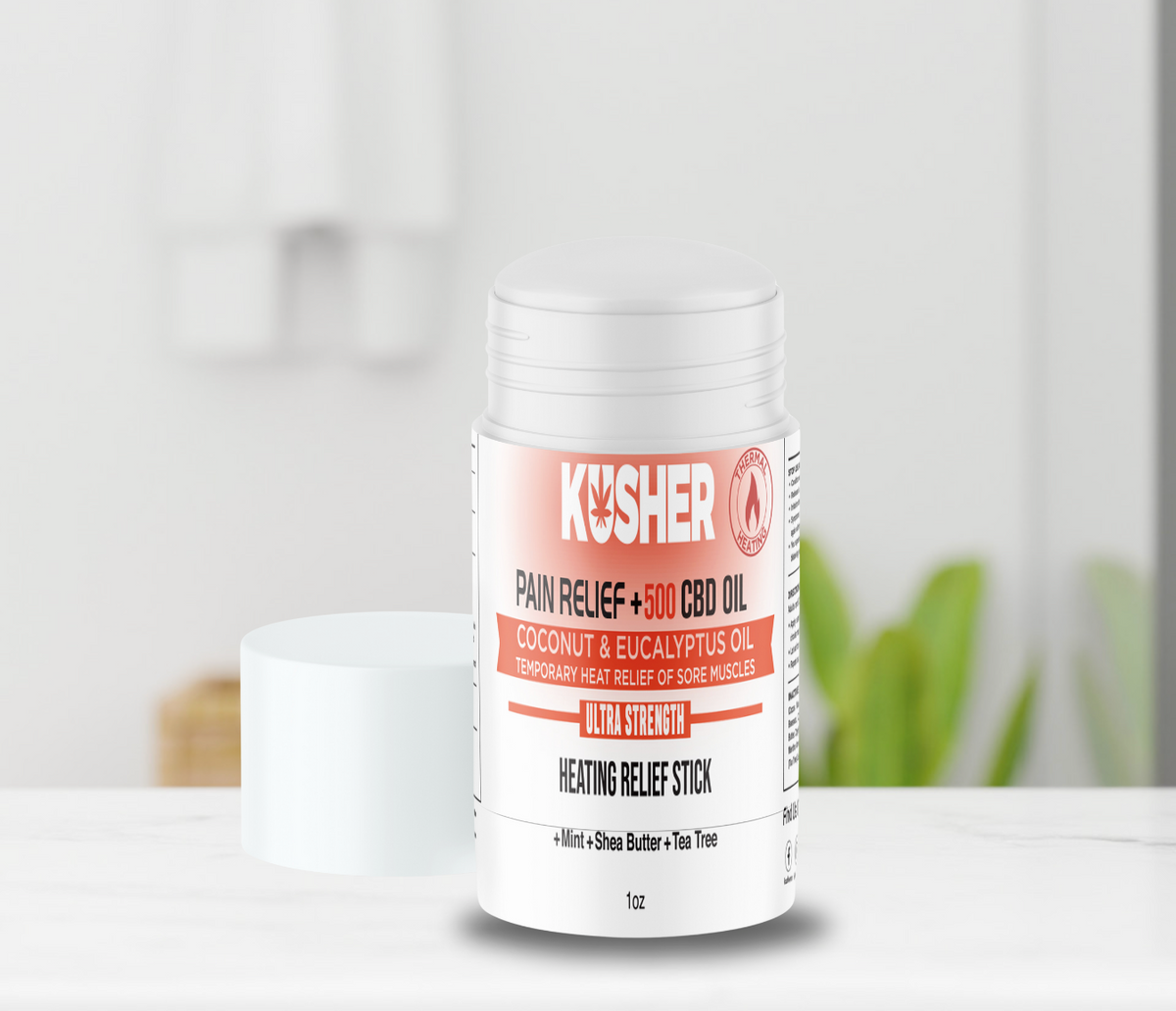
Coconut oil and shea butter are in the Heating Relief Stick because without them there is no stick. They are not a wellness flourish added to make an ingredient list look natural. They are the structural part of the product, the reason a solid block behaves like a solid block at room temperature and turns into a spreadable film the moment it meets skin, and swapping them out would mean designing a different product from scratch.
This gets misread constantly. Shoppers scan a label, find the CBD figure, treat everything under it as filler, and then compare two products on milligrams alone. In a topical that logic falls apart, because what carries the active ingredients decides where they end up, how long they stay put, and whether the thing is pleasant enough to keep using. The Heating Relief Stick is $20.00 and carries 500mg of CBD, coconut oil and shea butter, mint, eucalyptus, tea tree, and a warming character. The base is doing at least as much work as anything else on that list.
What a base actually is
Every topical has one. It is the material that holds everything else and delivers it onto skin, and it is chosen before almost anything else in formulation, because it determines the physical form the product can take.
Pick water and thickeners and you get a gel. Pick oils and butters and you get a balm or a stick. Pick a thin alcohol carrier and you get something that flashes off in seconds. Those are not decorative choices. Each one produces a different object with different behavior in the hand, on the skin, and in a bag on a hot day.
So when the ingredient list of our Heating Relief Stick opens with coconut oil and shea butter, that is the formulation telling you what kind of object you are buying. Everything else in the product is being carried by those two.
Why a stick has to be solid and soft at the same time
A stick has a demanding job description. It has to hold its shape in a drawer, survive being carried around, stay firm enough to twist up out of a tube without crumbling, and then soften into a spreadable film under nothing more than the pressure and warmth of skin contact.
That is a narrow window. Too hard and the product drags across the skin, deposits almost nothing, and feels like rubbing a candle on your leg. Too soft and it slumps in the tube, goes everywhere on a warm day, and turns the first application into a mess.
Coconut oil sits close to that window naturally. It is firm at ordinary room temperature and it gives way at skin temperature, which is exactly the behavior a stick format needs. It is one of the few widely available materials that does this without a lot of engineering around it.
Coconut oil, and what it does at body heat
The property that matters here is the melting behavior. Coconut oil is solid when it is cool and liquid when it is warm, and the transition happens right around the temperature of a hand or a shoulder.
That is why the stick spreads under pressure rather than by scraping. You press, the surface layer softens, and a thin film transfers. You are not shaving material off a block. You are melting the outermost fraction of it against your own skin, which is a far more even way to deliver something.
It also explains why the stick feels different on a cold morning than it does after sitting in a warm car. Give it a few seconds of contact before you expect it to move, and the first pass gets easier. That is the base doing its job, not the product being inconsistent.
Shea butter, and what it adds that coconut oil does not
If coconut oil were enough on its own, we would use it on its own. It is not, because a coconut oil only stick is brittle and it disappears too quickly once it has melted.
Shea butter is a heavier, more plastic material. It gives the stick body, it keeps the block from cracking, and once it is on the skin it stays there. It has a cushioned quality under the fingers that thin oils do not have. Together the two act as a pair, with coconut oil handling the melt and shea butter handling the stay.
Shea butter is also what makes the film feel conditioning rather than slick. On a spot you go back to repeatedly, that matters, because repeated application of anything drying to the same patch of skin gets uncomfortable long before you have finished the tube.
Spreads under pressure, then stays put
Those two behaviors are in tension, and reconciling them is most of the design work in a stick.
Spreading needs a material that gives way easily. Staying put needs a material that resists moving. A formulation with only the first property lays down beautifully and is gone in two minutes. One with only the second sits on the surface as a stubborn patch that never covers the ground you wanted.
The coconut and shea combination gets both because the two behave differently at the same temperature. One is already liquid at skin heat while the other is still soft solid, so the film that ends up on your arm is part fluid and part body. That is why a stick application still feels present a while after you put it down.
Contrast this with a thin gel
Our Cooling Pain Relief Gel at $25.00 is built the other way around, and comparing the two is the fastest way to understand what a base decides.
A gel goes on wet, spreads across a wide area with almost no pressure, and then flashes off. Within a few minutes there is very little left sitting on the surface. That is not a flaw. It is the entire reason to reach for a gel, because you can cover a whole calf in one pass and get dressed straight afterward without anything transferring to your clothes.
The stick trades that away deliberately. It is slower over a large area, it wants direct contact and a bit of pressure, and it leaves a film you can feel. In exchange it goes exactly where you put it, it does not run, and it conditions rather than dries. Neither behavior is better in the abstract. They answer different questions.
Why the carrier matters for the CBD too
There is a chemistry reason the base of a CBD topical tends to be oils and butters rather than water alone.
CBD is not water soluble. It disperses readily in fats and oils, and a formulation built on them can carry it evenly through the product rather than letting it separate or clump. Coconut oil and shea butter are both fats, so they hold the CBD in suspension throughout the stick from the first twist to the last.
That is a formulation fact rather than a performance promise. We are not going to tell you a particular base makes CBD do something it otherwise would not, because that is exactly the sort of confident unsupported claim this category is full of. What we can say plainly is that an oil based carrier is the sensible way to distribute an oil soluble ingredient evenly, and evenly is what you want.
Conditioning the skin you keep returning to
The unglamorous benefit of a rich base is what it does to the skin over weeks rather than what it does in the first thirty seconds.
People who buy a topical rarely use it once. They use it on the same shoulder or the same knee repeatedly, sometimes daily. Whatever you apply is in contact with that patch of skin far more often than anything else you own touches it.
Shea butter and coconut oil are both used as skin conditioners in their own right, and that is quietly the reason repeated use of the stick stays comfortable. A formulation that leaves skin tight or flaky gets abandoned regardless of what else is in it, and an abandoned product is a wasted purchase no matter how good the ingredient list looked.
Why the warming version leans on its base even harder
The Heating Relief Stick and the Cooling Relief Stick share the same base, and both are $20.00 with 500mg. The warming one asks slightly more of it.
A warming sensation builds rather than arriving all at once, and it rewards a product that stays exactly where it was placed while that happens. A carrier that ran or migrated would spread the sensation into territory you never meant to include, and warming in an unintended place is more noticeable than cooling in one.
The stay put quality of shea butter is what keeps the application defined. That is also why we would steer anybody trying a warming topical for the first time toward a small area and a light pass, then a wait, rather than a generous first application.
Reading an ingredient list without being fooled
The habit worth breaking is treating the CBD number as the product and everything else as packaging.
A topical is a whole formulation. The base decides the format, the format decides where you can use it and how much lands on your skin, and the botanicals decide how it feels and smells. Two products with identical CBD figures can be completely different objects with different uses, which is exactly the case with our stick at $20.00 and our gel at $25.00, both carrying 500mg.
Here is the short version of what each part of the Heating Relief Stick is doing:
- Coconut oil sets the melting behavior, so the stick is firm in a drawer and spreadable on skin.
- Shea butter gives the block body and keeps the film on the skin after application.
- Mint and eucalyptus set the aromatic character.
- Tea tree is the shared botanical across most of our topical range.
- CBD is the reason the product exists, carried evenly by the fats around it.
What the base costs you
Every design choice has a bill attached and we would rather hand you ours up front.
An oil and butter base leaves a film. That film can transfer to clothing if you dress immediately, it is not the right thing to put on before a shirt you care about, and it takes longer to feel fully settled than a gel does. The stick is also slower over large areas, because you are working a solid across skin rather than spreading a fluid.
If those costs bother you more than the benefits appeal to you, buy the gel instead. That is a legitimate answer and we sell it. What we do not want is somebody buying a stick expecting gel behavior and concluding the product is wrong when it is doing precisely what a stick is supposed to do.
How to use the stick so the base can work
Most disappointing first experiences with a stick come down to technique rather than formulation.
Twist up only a small amount of product, less than feels right. Hold the stick against the skin for a couple of seconds before you start moving it, which lets the surface soften. Then use short passes with light pressure rather than long hard strokes, and stop while the film still looks thin.
On cold skin or a cold day, expect the first pass to take a moment longer. Warm the tip against your hand if you are impatient. Cap it and keep it out of direct heat, because a stick left on a dashboard will not be the same shape when you come back to it.
The certification covers the base as well
Kosher certification applies to the whole formulation, not to the headline ingredient. The coconut oil and the shea butter are inside that boundary along with everything else.
That is worth saying out loud because it is the part of certification people assume is loose. It is not. Supervision covers what goes in and where it comes from, checked by somebody who does not work for us, and that constrains our sourcing on ordinary base materials just as much as on the interesting ones.
In a category where almost nobody carries this certification, keeping it across every product rather than on a token line is the harder path. It is also the whole reason a good number of our customers found the store at all.
Bottom line
Coconut oil and shea butter are load bearing. They are why the Heating Relief Stick is a stick, why it spreads under pressure without dragging, why the film stays where you put it instead of running somewhere you did not want warmth, and why going back to the same spot day after day stays comfortable. Judge a topical by its base first and its milligram figure second, because the base decides what the product can physically do. If you want maximum coverage with nothing left on the skin, our gel is the honest recommendation. If you want a defined application that stays put and conditions as it goes, that is the stick, and the two ingredients people dismiss as marketing are the reason it works that way.
Frequently Asked Questions
Are coconut oil and shea butter just cheap filler?
No. They are the structural part of the product. Coconut oil is firm at room temperature and gives way at skin temperature, which is what lets a solid stick spread under light pressure instead of dragging. Shea butter gives the block body so it does not crumble, and it keeps the film on the skin after application. Take those two out and you do not have a cheaper stick, you have no stick at all, because nothing is holding the format together.
Why does the stick feel harder on a cold day?
Because the base is doing exactly what it is designed to do. Coconut oil is solid when cool and softens at skin temperature, so on cold skin the first pass takes a moment longer while the surface warms up. Hold the tip against the area for a couple of seconds before you start moving it, then use short light passes. If you push hard on a cold stick you will drag rather than spread and deposit very little.
How is the stick different from the Cooling Pain Relief Gel?
They are built on opposite bases and they behave accordingly. The gel is $25.00, goes on wet, covers a large area in one pass and flashes off within a few minutes, leaving very little on the surface. The stick is $20.00, wants direct contact and light pressure, is slower over a big area, and leaves a film that stays where you put it. Neither is better in the abstract. They answer different questions about coverage and staying power.
Why do CBD topicals use oils and butters rather than water?
CBD is not water soluble. It disperses evenly through fats and oils, so an oil based carrier keeps it distributed through the product from the first twist of the tube to the last. That is a formulation fact rather than a performance promise. We are not claiming a particular base makes CBD do anything extra, only that distributing an oil soluble ingredient in an oil based carrier is the sensible way to get it evenly spread.
Will the stick mark my clothes?
It can if you dress immediately. An oil and butter base leaves a film by design, and that film has to settle before fabric goes over it. Give the area a minute, use less product than feels right on the first pass, and do not apply it under something you care about. If transfer is a deal breaker for your situation, the gel is the better format, since it dries down fast and leaves much less behind.
Is the base covered by the kosher certification?
Yes. Certification applies to the whole formulation, so the coconut oil and shea butter sit inside the same boundary as everything else. Supervision covers sourcing and what is permitted into the product, verified by somebody outside our company. Keeping that across every item rather than on one token line does constrain our supplier choices on ordinary base materials, which is the part people usually assume is loose.
Does the Cooling Relief Stick use the same base?
It does. Both sticks are $20.00 with 500mg and both are built on coconut oil and shea butter, which is why they handle almost identically in the hand. The difference between them is the character of the sensation rather than the structure of the product. If you have used one and liked how it applied, the other will apply the same way, and your choice comes down to whether you want cooling or warming.