News · 18 August 2026
How to Pick the Right CBD Tincture Strength: 250mg Through 3000mg Explained
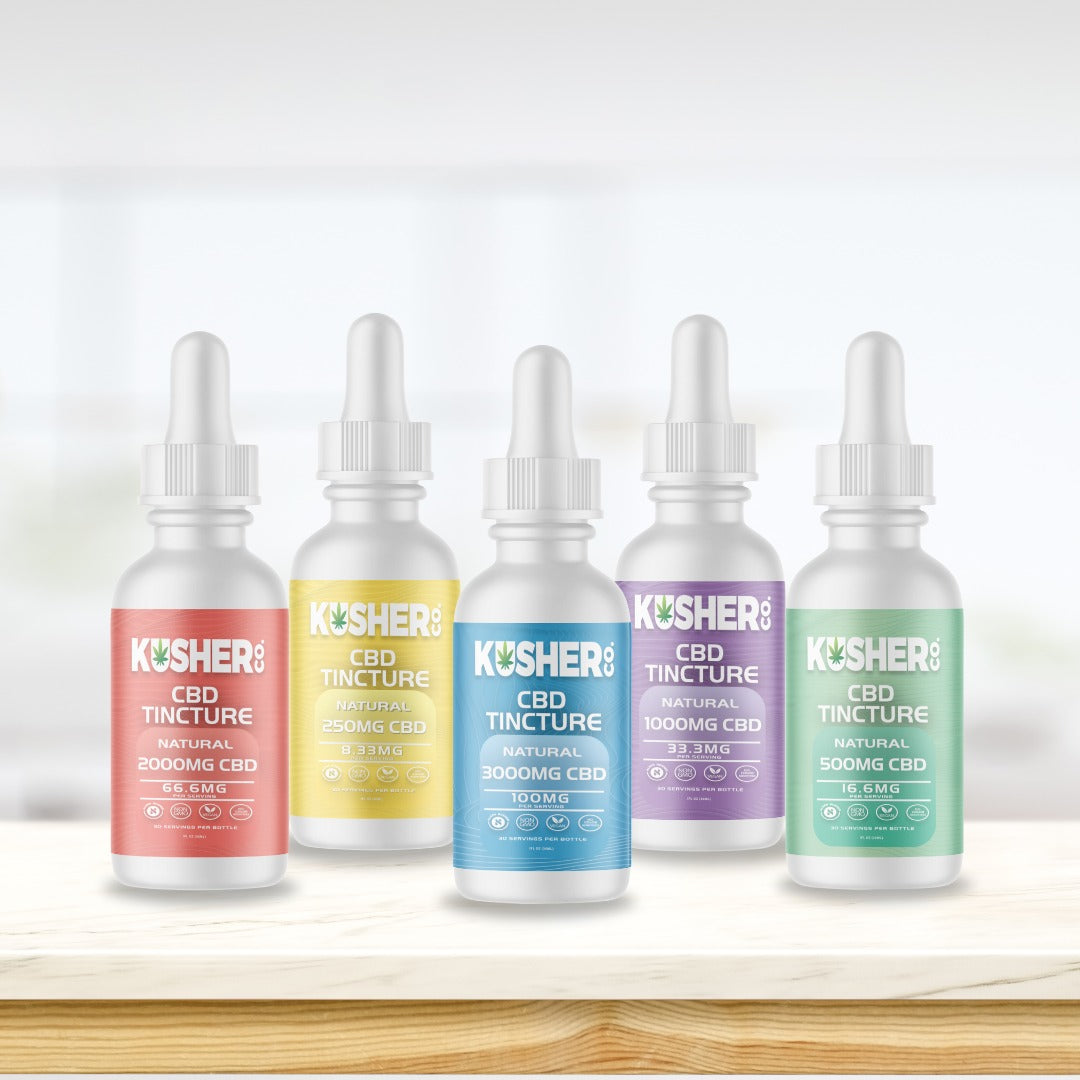
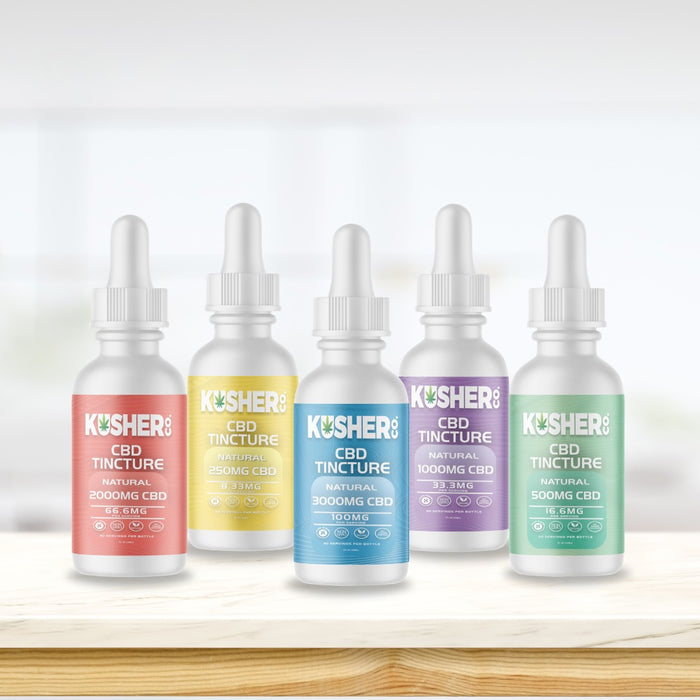
The right tincture strength is the one that lets you take a comfortable amount of oil and hit the milligrams you want, and for most people arriving new to this that is the 250mg bottle at $20.00 rather than anything larger. Our Full Spectrum Kosher Hemp Extract CBD Tincture comes in five strengths: 250mg at $20.00, 500mg at $25.00, 1000mg at $30.00, 2000mg at $35.00 and 3000mg at $40.00. Those numbers describe the total CBD in the bottle, not the amount in a serving, and that distinction is where most of the confusion in this category lives.
Below is how to think about the choice, what the price curve is actually telling you, and the reason the largest bottle is not automatically the smartest buy even when the math looks like it should be.
What the milligram number on the bottle means
A 1000mg bottle contains 1000mg of CBD spread through the whole bottle of oil. It does not mean each dropper delivers 1000mg, and it does not mean the oil is a thousand times anything.
To get from the bottle figure to a serving figure you need to know how many servings the bottle holds. Divide the total by the number of servings and you have the amount per serving. That arithmetic is simple and it is the single most useful thing you can do before buying, because it converts a marketing number into a number you can actually act on.
Here is the part that trips people up. Two bottles at different strengths hold the same volume of oil. A 3000mg bottle is not a bigger bottle. It is the same bottle carrying twelve times as much extract in the same amount of carrier oil. So moving up in strength does not give you more oil to take. It makes every drop denser.
That has a practical consequence people rarely think through. At high strengths, the amount of oil you actually put under your tongue gets small. Some people find that a benefit, because holding a small amount of an earthy tasting oil in the mouth is easier than holding a large one. Others find it harder to measure accurately, because a small difference in drop count becomes a large difference in milligrams. Which camp you fall into is worth knowing about yourself.
What the price curve is really telling you
Look at the spread again. Twelve times the CBD costs twice the money. From $20.00 to $40.00 you go from 250mg to 3000mg.
That is not a promotion and it is not a trick. It reflects how the cost of a bottle is actually made up. The glass bottle, the dropper assembly, the carrier oil, the label, the filling and the certification cost close to the same whether the bottle contains a little extract or a lot. Only the extract itself scales with strength. When most of your cost is fixed, adding more of the one variable ingredient barely moves the total.
So the cost per milligram falls steeply as you go up. The 250mg bottle is the worst value per milligram of anything we sell, and the 3000mg is by a wide margin the best. If value per milligram were the only consideration, everybody would buy the 3000mg and we would not stock the rest.
Value per milligram is not the only consideration, which is the whole point of the next two sections.
There is one more thing the curve tells you, and it is about the category rather than about us. When a seller prices strength close to linearly, so that twice the milligrams costs roughly twice the money, they are either carrying costs we are not or they are pricing on what the market will bear rather than on what the bottle costs to make. A steep fall in cost per milligram is what the underlying economics actually produce. It is worth knowing what a normal curve looks like before you judge anybody's pricing, including ours.
Why we still tell new buyers to start small
The 250mg bottle exists to answer one question cheaply. Can you live with taking a tincture at all?
A meaningful number of people cannot, and it has nothing to do with whether the product works. A full spectrum extract tastes green and earthy, because the aromatic compounds that make it full spectrum are still in it. Taking it properly means holding oil under the tongue for a while rather than swallowing it straight down. Some people find that entirely fine and forget about it within a week. Others quietly stop after four days and the bottle sits in a cupboard.
Finding out which of those you are for $20.00 is a good trade even though the per milligram cost is poor. Finding out for $40.00, with a bottle you will never finish, is a worse one. The cheapest bottle is not the best value per milligram and it is very often the best value overall for someone who has not done this before.
There is a second reason. You do not yet know what amount suits you, and a low strength bottle is more forgiving of that uncertainty. When each drop carries less, an error in counting costs you less. Learning on a dilute product and moving up once you know your number is the sane order to do things in.
The argument against simply buying the biggest bottle
Hemp extract is a plant oil and it degrades. The three things that degrade it are light, heat and oxygen, and the last of those is the one that matters for bottle size.
Every time you open the bottle, the oil meets air. Oxidation is cumulative rather than something that happens all at once, so a bottle opened daily over a long stretch has had a great deal more exposure by the end than at the beginning. If you buy the largest size and take a small amount each day, the last of that bottle may be considerably older than the first, and it will not be quite the same material.
This is not a reason to avoid the large sizes. It is a reason to match the size to how fast you will genuinely get through it. Someone taking a substantial amount daily will finish a 3000mg bottle in a sensible window and should absolutely buy it. Someone taking a small amount a few times a week is better served by a middle strength, even though the sticker math argues otherwise.
Buying more than you can use in a reasonable time is not a saving. It is paying less per milligram for milligrams that are slowly getting older.
Matching strength to how you actually intend to use it
Here is the honest mapping between our five sizes and the people who should buy them.
- 250mg at $20.00. A trial. Buy this if you have never taken a tincture, or never taken ours, and you want to find out whether the format and the taste work for you before committing to anything.
- 500mg at $25.00. The step after the trial. You know it suits you, you take it occasionally rather than daily, and you want a bottle you will finish while it is fresh.
- 1000mg at $30.00. The everyday middle, and where a lot of regular users settle. Enough concentration that the amount of oil stays small, enough total that a daily routine does not run the bottle down in a fortnight.
- 2000mg at $35.00. For an established daily routine at a higher amount per serving. The value per milligram is strong and the bottle still moves fast enough to stay fresh.
- 3000mg at $40.00. The best cost per milligram we sell. Buy this when you know your amount, you take it every day, and you will finish it in a reasonable time.
Notice that the recommendation is never simply the biggest. It is the largest bottle you will actually use up while it is still what you paid for.
Signs you bought the wrong strength
You will usually know within a fortnight, and the signals are unmistakable once you know to look for them.
If you are taking several full droppers to get where you want to be, the strength is too low. Beyond the cost, you are putting a large volume of oil in your mouth and holding it there, which is the part people give up on. Moving up one step solves this immediately and usually costs five dollars.
If a difference of one or two drops swings the result noticeably, the strength is too high for the amount you want. At high concentrations, small counting errors become large milligram differences, and consistency gets hard. Stepping down gives you back the resolution to make small adjustments.
If the bottle has been open for a long stretch and still looks half full, you bought more than you use. Nothing is wrong with the product. The next purchase should be smaller so you are always drinking from a bottle that is fresher rather than one slowly aging in a cupboard.
And if you cannot bring yourself to take it because of the taste or the routine, strength is not your problem and buying a different size will not fix it. That is a format question, and the answer for many people is a gummy instead, which asks nothing of you beyond chewing.
Why we do not print a recommended dose on the bottle
People ask, and the honest answer is that we are not in a position to tell you what amount is right for you, and neither is anybody else selling in this category.
The amount that suits one person does not transfer to another. Body size, what you have eaten, how often you take it and what you are hoping to notice all move the answer around. A number printed confidently on a label would be a guess dressed up as instruction, and it would carry the weight of a recommendation from the company that sold it to you.
What we can do is give you the information to work it out. The total in the bottle is on the label. The number of servings tells you the rest. Start at the low end of whatever that arithmetic gives you, hold everything else steady, and move in one direction slowly.
The category is full of confident dosing advice from people with no basis for it. We would rather hand you the arithmetic and be straight about the limits of what we know than print a number that looks authoritative and is not.
How to take it so the strength you chose matters
Choosing a strength is wasted effort if the way you take it throws away most of the material.
Hold the oil under the tongue for a while before swallowing. The tissue there absorbs some of it directly into circulation, which is both faster and less lossy than the route through digestion. Swallowing it straight away turns your tincture into a very small and rather expensive edible.
Take it with food that contains some fat. Cannabinoids are fat soluble rather than water soluble, so they are carried and absorbed considerably better in the presence of fat. An empty stomach is not dangerous, it is simply wasteful.
Be consistent about timing and conditions while you are working out your amount. Comparing a morning dose on an empty stomach against an evening dose after dinner tells you a great deal about the conditions and very little about the product. Hold the variables still, change one thing at a time, and you will learn something usable within a couple of weeks.
Bottom line
The bottle number is the total CBD in the bottle, not the amount per serving, and every bottle holds the same volume of oil regardless of strength. Twelve times the CBD costs twice the price because most of the cost of a bottle is fixed, which makes the 3000mg at $40.00 the best value per milligram by a wide margin. Buy it anyway only if you will finish it while it is fresh, because oxygen and time degrade plant oil and a slow bottle ends up older than it started. If you are new to this, buy the 250mg at $20.00, find out whether the taste and the routine suit you, then move up once you know your amount.
Frequently Asked Questions
Does a 3000mg bottle contain more oil than a 250mg bottle?
No. Both hold the same volume of oil. The 3000mg bottle carries twelve times as much extract dissolved in that same volume, which makes every drop denser rather than giving you more liquid. That is why moving up in strength shrinks the amount you actually put under your tongue rather than increasing it, and why very high strengths ask for more care in counting drops.
Which strength should I buy first?
The 250mg at $20.00, unless you already know tinctures suit you. It is the worst value per milligram we sell and usually the best value overall for a first purchase, because it answers the only question that matters at that stage cheaply. A full spectrum extract tastes green and earthy and asks you to hold oil under your tongue, and some people simply do not take to that. Find out for twenty dollars rather than forty.
Why is the biggest bottle only twice the price of the smallest?
Because most of what a bottle costs has nothing to do with how much extract is in it. The glass, the dropper, the carrier oil, the label, the filling and the certification cost about the same either way. Only the extract scales with strength, so adding more of it barely moves the total. That is why cost per milligram falls so sharply as you go up the range.
Is there any reason not to buy the 3000mg?
Yes, and it is about time rather than money. Hemp extract degrades with light, heat and oxygen, and every opening exposes the oil to air. If you take a small amount a few times a week, a 3000mg bottle will still be going months later and the last of it will not be the same material as the first. Buy the largest bottle you will genuinely finish while it is fresh, not the largest bottle on the list.
How do I work out the amount per serving?
Divide the total milligrams on the bottle by the number of servings the bottle holds. That converts a marketing number into one you can act on. Do it before you buy rather than after, because two bottles with very different headline numbers can deliver similar amounts per serving depending on how they are portioned, and the headline on its own tells you almost nothing useful.
Does taking it with food really matter?
It does. Cannabinoids are fat soluble rather than water soluble, so they are carried and absorbed noticeably better alongside food containing some fat. Taking a tincture on an empty stomach is not harmful, it simply wastes part of what you paid for. Holding the oil under your tongue before swallowing matters for the same reason, because that route reaches circulation more directly than digestion does.