News · 18 August 2026
Cooling Pain Relief Gel vs Joint and Muscle Roll On: Same Problem, Different Tools
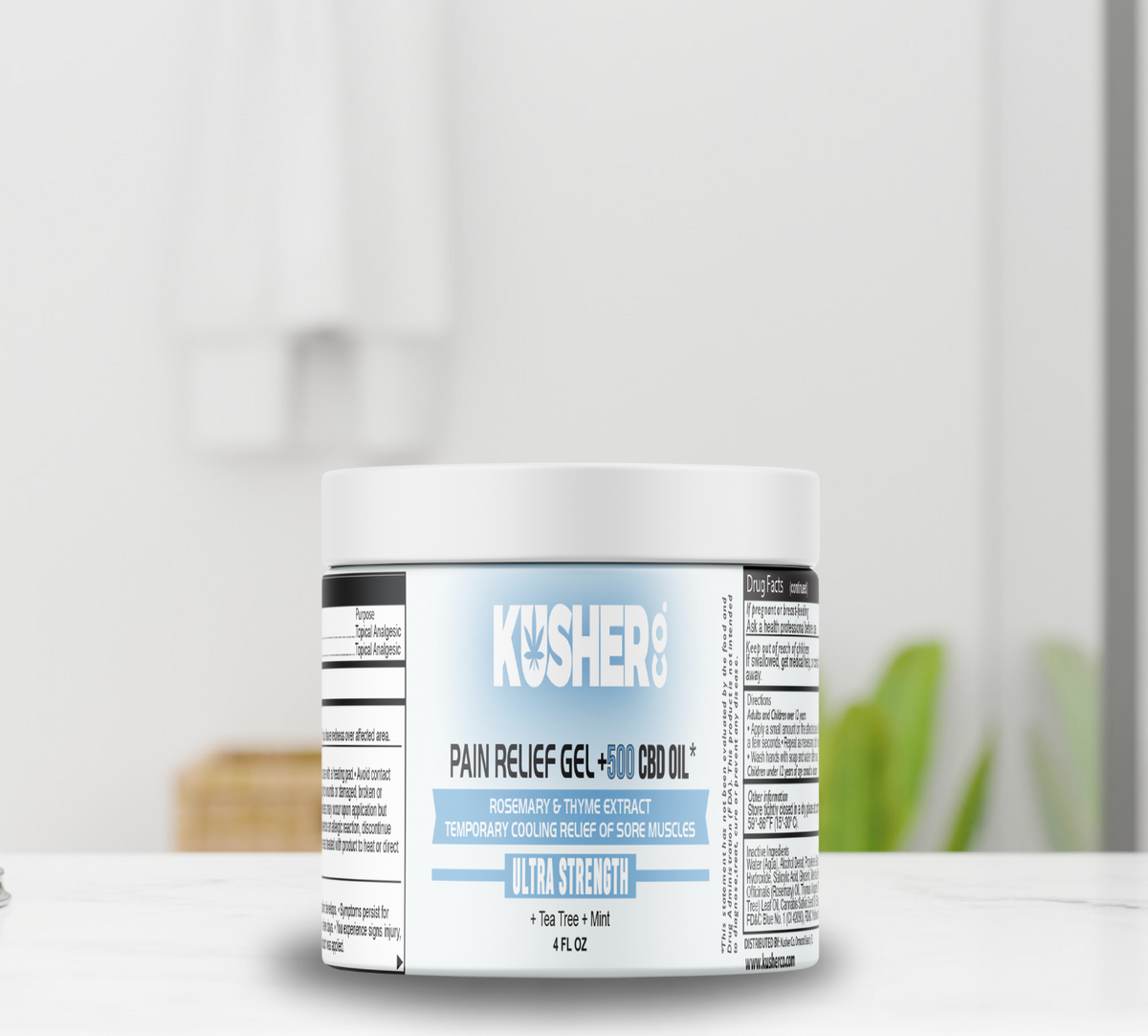
The Cooling Pain Relief Gel and the Joint and Muscle Roll on Relief are built for the same job and they go about it in two completely different ways. The gel is $25.00 and carries 500mg of CBD alongside rosemary and thyme extract, tea tree and mint. The roll on is $20.00 and carries 350mg alongside menthol, tea tree and aloe. What should decide between them is the shape of the area you are covering and where that area sits on your body, not the milligram figure printed on the front of the package.
These two get compared more than any other pair we sell, and the comparison goes wrong the same way almost every time. Someone lines up 500 against 350, concludes the gel is the stronger product, and buys it for a knee. A knee is precisely the case where the other one is the better tool. We would rather say that in public than keep selling the more expensive item to people who would have been happier with the cheaper one.
What those two numbers actually describe
Both figures describe the total amount of CBD in the whole container. Neither one describes what lands on your skin in a single application, and a single application is the only quantity that has ever mattered to anybody using a topical.
Think about what has to be true for a container number to be comparable across two products. The containers would have to hold the same volume, dispense at the same rate, and be used the same way. Ours do none of those three. A gel jar and a roll on are different objects with different mechanics, and the number on the label is measuring the object, not the dose.
The honest way to read 500 and 350 is as concentration information within a format. It is genuinely useful when you compare our two roll ons against each other, because they dispense identically. Across formats it tells you very little, and taken as a strength ranking it is actively misleading.
The dispensing rate is the part nobody accounts for
A roll on meters itself. The ball picks up a thin film from the reservoir and lays down a narrow track, and the amount that ends up on your skin is roughly the same whether you are being careful or rushing out the door. The applicator makes the decision for you.
A gel meters nothing at all. You decide how much to take, and in our experience almost everyone takes more than they need for the first week or two, because the visual cue of a decent scoop feels like the right amount when the pot is full. That settles down once people find their rhythm, but the early waste is real.
So the container holding less CBD in total puts less of it on your skin per application, and it does that consistently. Over the life of the two products the gap in cost per application is far narrower than the gap in headline milligrams. Depending on how heavy handed you are with a jar, it can run the other way entirely.
The gel is built for area
What the gel does that nothing else in our range can do is cover a lot of ground evenly and fast. You take some on your fingers and work it across a whole region in a continuous layer, and you can see and feel exactly where you have been.
A full shoulder including everything around it. The length of a calf. A broad section of lower back, assuming somebody else is doing the applying. Those are jobs where a narrow applicator track would take five minutes of patient work and still leave gaps, and where a palm covers the same ground in one pass.
The Cooling Pain Relief Gel is also the most ingredient rich thing we make. Rosemary and thyme extract appear here and nowhere else in the range, sitting alongside the tea tree and mint that give the gel its character. If the formulation itself is what draws you rather than the delivery, this is the one with the longest list on the back.
The roll on is built for a point
What a roll on does that a gel cannot is place product exactly where you aim it and nowhere else. That sounds like a small thing until you own a joint that needs attention twice a day.
A joint is a small, defined structure with a clear outline, and the tissue immediately around it is where you want the product to sit. A ball applicator traces that outline the way a marker traces a line. A palm full of gel covers the joint plus a generous margin of the limb on either side, most of which you never intended to cover.
The Joint and Muscle Roll on Relief carries menthol, which is the sharpest and most immediate of the cooling compounds we work with, plus tea tree and aloe. The aloe is specific to this product, and it conditions the surface it goes onto, which suits something designed to be applied to the same small patch of skin over and over.
Reach, which settles the question outright for some people
There is one situation where this is not a comparison at all, and it comes up more often than you would expect.
If the place you need to treat is on your own back, the roll on wins and the gel is barely in the conversation. The applicator has a handle, and that few inches of plastic is the difference between reaching a shoulder blade and not reaching it. Trying to spread a gel across your own upper back is a contortion routine that ends with product on your forearm and a stripe down your ribs.
The same logic covers anywhere awkward. Behind a knee, the back of a shoulder, anywhere along a spine. A tool with a handle gets to places a hand does not, and no amount of CBD in the jar changes the geometry of your own arms.
Hands, and whether you want product on them
The gel goes on with fingers. That is a genuine advantage for control and a genuine cost afterward, and the cost is the part people forget when they are standing in front of the two listings.
Cooling compounds on hands travel. They find eyes with a reliability that surprises everybody at least once, and they transfer to a phone, a steering wheel, a sandwich, a contact lens. Using the gel means washing properly afterward, every single time, with no exceptions for being in a hurry.
The roll on never touches your hands at all. Cap off, apply, cap on, carry on with whatever you were doing. For anyone applying something at work, in a gym, in a car, or anywhere a sink is not three steps away, that one difference decides the purchase before any other factor gets a vote.
Cooling character, which is not identical between them
Both products are cooling and they do not feel the same. This surprises people who assume cooling is one sensation with a volume knob.
Menthol leads the roll on. It is sharp, it arrives fast, and it is completely unmistakable within a short time of going on. Nobody has ever applied a menthol product and wondered whether anything happened.
The gel leads with mint and tea tree, with rosemary and thyme extract underneath, and the result is broader and rounder rather than a spike. Some people much prefer that and describe menthol as too aggressive to live with. Others want the spike specifically and find anything softer underwhelming. This is a preference, not a quality difference, and we are not going to pretend one of them is objectively better made.
What happens after application, on skin and on clothing
A gel has more water in its character and it flashes off faster. It goes on wet, it dries down, and within a few minutes there is not much sitting on the surface. That is convenient if you are getting dressed straight away.
The roll on leaves a thinner film to begin with, simply because the ball puts down less. It also dries down quickly, which is part of why it works as a bag product rather than a bathroom product.
Neither one is a heavy or greasy product, and neither is designed to sit on the skin the way a balm does. If you want something that stays put under pressure and conditions the skin as it goes, that is what our sticks are for, and it is a different conversation from this one.
Where each one gets used, in practice
Watching what people actually buy these for, a pattern shows up quickly, and it has more to do with logistics than with formulation.
The gel is a home product. It lives on a bathroom shelf or a bedside table, it gets used as part of a routine, usually in the evening, usually on a larger area, and usually with a sink within reach for afterward.
The roll on is a portable product. It lives in a bag, a desk drawer or a glove box, and it gets used opportunistically at the moment somebody notices something rather than at a set time of day. Knowing which of those two descriptions fits your life is worth more than any ingredient comparison, because a product that suits your circumstances gets finished and a product that requires arrangements sits unopened.
Cost over the life of the product rather than at checkout
The gel is $25.00 and the roll on is $20.00. That is a five dollar gap at the till and it is the smallest part of the real difference.
Over their working lives that gap widens, because the gel dispenses freely and empties faster. If you are treating one small area, buying the gel means paying more for a container that runs down quicker while giving you nothing extra for the job in front of you.
Run it the other way and the arithmetic flips. Covering a full calf with a roll on means a great many passes, an emptier reservoir every time, and a replacement sooner than you expected. Buying the cheaper item for the wrong job is still the more expensive decision.
How to apply either one without wasting it
The single most common mistake with both products is applying a large amount once rather than a moderate amount and then coming back later.
Neither product accumulates on the skin. Doubling what you put on gives you a stronger signal for a while, not a longer lasting one, and past a certain point stronger stops being pleasant and starts being distracting.
A few practical notes that apply to both:
- Start with less than you think, on clean dry skin, and add more only after you have felt what the first pass does.
- Keep both well away from eyes, and wash your hands after using the gel even if you think you were careful.
- Do not use either one on broken skin.
- Give the area a minute before pulling clothing over it.
- Patch test on a small spot the first time, since both carry botanical ingredients and skin varies.
Both are kosher certified, which is the part we will not compromise
Every product we make is kosher certified, and that includes both of these. It is the reason a lot of our customers found us in the first place, because the certification is rare in this category and searching for it narrows the field fast.
Certification is not a claim about how well something works. It is a claim about supervision, sourcing and what is permitted to go into the formula, verified by somebody outside our company. We keep it on everything rather than on a token product line, which does constrain our ingredient choices and occasionally our suppliers.
If the certification is why you are here, then this comparison is purely about format and you can pick on the practical grounds above without worrying that one of them is the compromise option.
If you can only buy one
Buy the roll on. That is not a hedge, it is what we would tell a friend.
The reasoning is coverage of situations rather than coverage of skin. A roll on handles a small area well, handles a medium area with patience, reaches your own back, travels, and never gets on your hands. A gel handles a large area beautifully and fails outright at three of those four other things.
The exception is if you already know your usual job is a big one, a whole shoulder or a full calf after training, and you are always at home when you do it. In that case the gel is not the luxury option, it is the correct tool and the roll on will frustrate you within a week.
Bottom line
Ignore the 500 against 350 comparison, because those numbers describe whole containers that dispense at completely different rates and tell you nothing about a single application. Buy the Cooling Pain Relief Gel at $25.00 when you have a large area to cover evenly, you are at home, and there is a sink for afterward. Buy the Joint and Muscle Roll on Relief at $20.00 when you have a specific joint or a small area, when the spot is somewhere awkward like your own back, or when the product needs to live in a bag and get used without ceremony. If menthol has always felt too sharp for you, the gel is the gentler of the two, and that is a preference worth respecting rather than pushing through.
Frequently Asked Questions
Is the 500mg gel stronger than the 350mg roll on?
Not in any way you would feel. Both figures describe the whole container, and the two dispense very differently. A roll on ball meters a thin track per pass, while a gel gives you whatever you scoop, which is usually more. The container with less CBD in it puts less on your skin per application, so the real difference across the life of the two products is much smaller than the headline numbers suggest and can run the other way depending on how heavy handed you are with a jar.
Which one should I buy for a knee?
The roll on. A joint is a small defined structure, and a ball applicator traces it precisely while a palm full of gel covers the joint plus a lot of the leg on either side that you never intended to cover. The aloe in the Joint and Muscle Roll on Relief also suits a product applied repeatedly to the same patch of skin, which is what a joint you keep coming back to tends to get.
Which one reaches my own back?
The roll on, and it is not close. The applicator has a handle, and that few inches is the difference between reaching a shoulder blade and not reaching it. Spreading a gel across your own upper back is awkward and it ends with product in places you did not aim for. For anything behind you, a tool with a handle is the answer, and no amount of CBD in a jar changes the geometry of your arms.
Do the two feel the same when applied?
No. The roll on leads with menthol, which is sharp and arrives fast and is unmistakable within a short time. The gel leads with mint and tea tree over rosemary and thyme extract, which reads broader and rounder rather than as a spike. If menthol has always felt too aggressive to you, the gel is the gentler of the two. That is a genuine preference rather than a quality difference, and we are not going to pretend otherwise.
Why is the gel more expensive if it empties faster?
It carries the widest ingredient list we make, including the rosemary and thyme extract that appears nowhere else in the range, and it covers large areas in a way nothing else we sell can. It also empties faster because you control how much comes out. If you are treating a small spot, the gel is the expensive way to do it. If you are covering a whole calf, it is the only sensible tool and the roll on will run down quickly.
Are both kosher certified?
Yes. Everything we make is kosher certified, and neither of these is an exception. The certification covers sourcing and what is permitted into the formula, verified by somebody outside our company, and it is rare enough in this category that it is how a lot of our customers found us. It is not a claim about how well a product performs, so if certification is why you are here, pick between these two purely on format.
Can I use both?
Plenty of people end up doing exactly that, split by body part rather than by day. The gel for large areas at home, the roll on for the one joint that always speaks up, kept wherever you happen to be when it does. Buy the one that matches your most common situation first and add the second when you notice the specific gap, rather than buying both before you know your own pattern.