News · 18 August 2026
What Makes a CBD Product Full Spectrum, and Is the Bigger Tincture Worth It
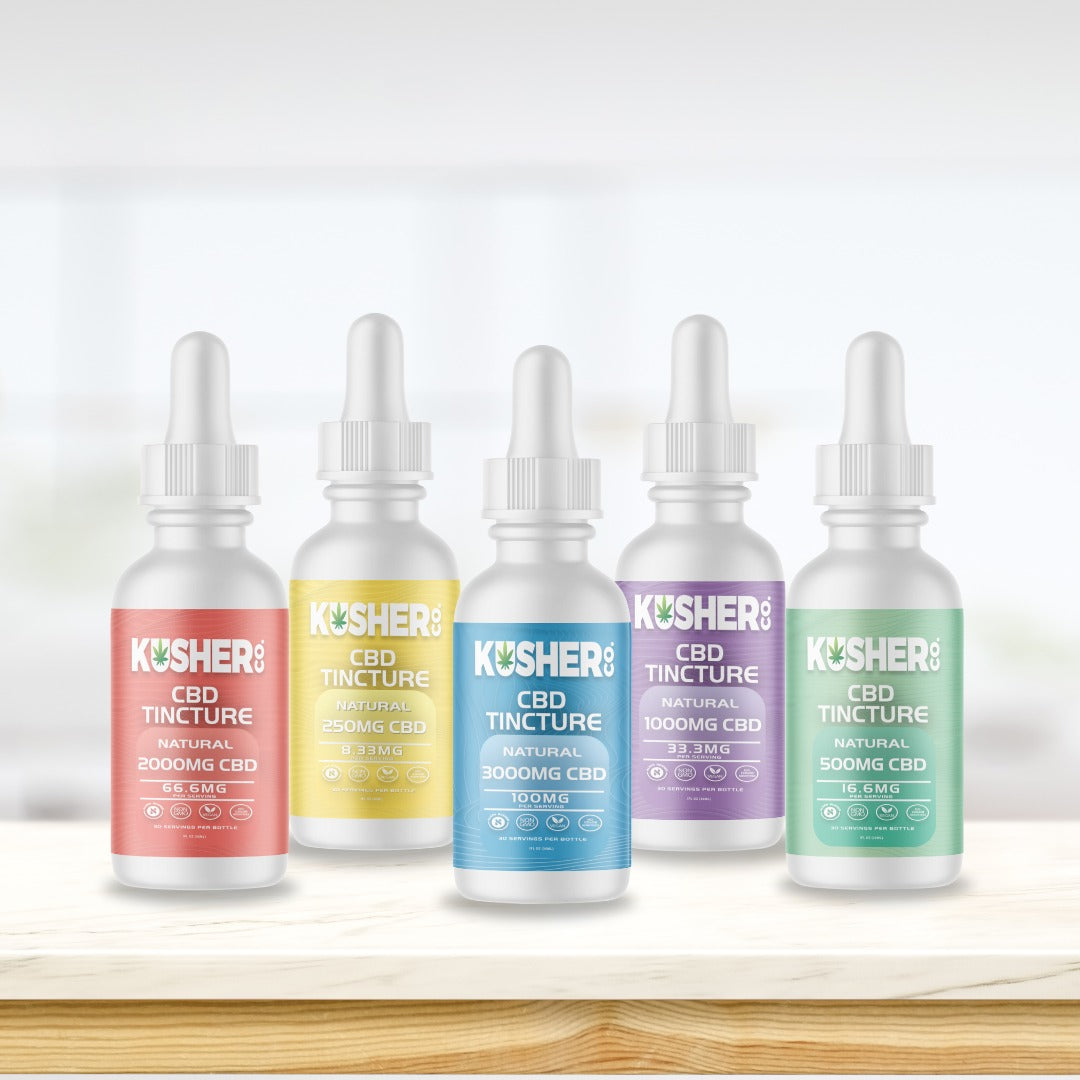
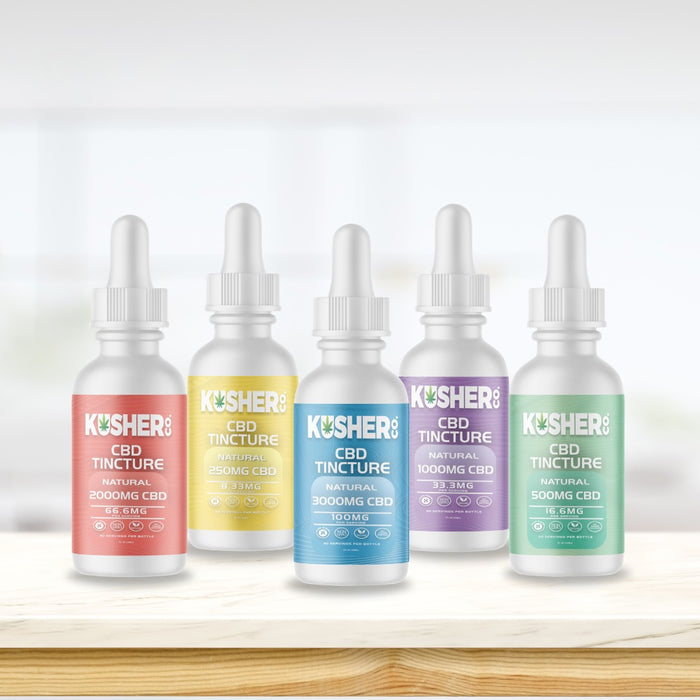
Full spectrum means the extract in the bottle still carries the rest of what the hemp plant made, instead of being stripped back to one isolated compound. Our Full Spectrum Kosher Hemp Extract CBD Tincture keeps the minor cannabinoids and the plant's own terpenes alongside the CBD, at hemp THC levels. That is a statement about how the extract was processed, not about how strong the bottle is.
Strength is the separate question, and it is the one people actually write to us about. The tincture comes in five sizes and the price barely moves across them. 250mg is $20.00. 3000mg is $40.00. Twelve times the extract for twice the money looks like a pricing error on the shelf. It is not an error, and the reason it works that way is the most useful thing we can tell you before you pick a size.
What the full spectrum label commits us to
The three extract types, full spectrum and broad spectrum and isolate, differ in what the processing removed. We have written about that comparison already and there is no point in us writing it twice, so this piece takes the term as read and goes after the part nobody covers.
What matters here is that full spectrum is a claim about the input, not the output. It tells you the extract was not fractionated down to a single molecule. It tells you nothing whatsoever about how much of that extract ended up in the bottle you are holding.
The milligram figure answers that second question, and the two get conflated constantly. A 250mg full spectrum bottle and a 3000mg full spectrum bottle contain the same kind of extract. One of them contains a great deal more of it.
The five prices, side by side
Here is the whole ladder, because the shape of it is the argument.
- 250mg at $20.00
- 500mg at $25.00
- 1000mg at $30.00
- 2000mg at $35.00
- 3000mg at $40.00
Every step up adds five dollars. The first step doubles what is in the bottle. The last step adds a thousand milligrams for the same five dollars that the first step added two hundred and fifty. The ladder is not linear and it was never meant to be.
Work it per milligram and the picture gets blunt. The 250mg bottle costs eight cents a milligram. The 3000mg bottle costs about one and a third cents. Same extract, same glass, same dropper, roughly six times the value per milligram of CBD.
Where the money in a bottle of tincture actually goes
This is the part the industry rarely says out loud, and it is the whole explanation.
Most of what you pay for in a tincture is not the hemp. It is the amber glass bottle, which costs what it costs whether it holds a little extract or a lot. It is the dropper assembly with its calibrated markings. It is the carrier oil that makes up the great majority of the liquid volume. It is the filling and capping and labeling run. It is the batch testing. It is the kosher supervision that gets our facility and our ingredient list inspected and signed off.
Add all of that up and you have a floor under every bottle we sell, and that floor does not care how concentrated the contents are. A 250mg bottle and a 3000mg bottle sit on identical fixed costs.
Only one line on the sheet scales with strength, and that is the extract itself. Hemp extract is a commodity input bought by weight. Putting twelve times more of it into the same bottle costs us more, but it does not cost twelve times more overall, because the extract was never the majority of the cost in the first place.
Why we price it that way instead of pocketing the difference
We could hold the per milligram price flat across the range and charge $240 for the 3000mg bottle. Plenty of categories do exactly that and call the top of the range premium.
We would rather people buy a size that lasts them. A customer who buys the smallest bottle every few weeks pays us more in total and gets less for the money, and after a few rounds of that they usually conclude the product is expensive rather than that they bought it in a bad format.
Pricing that reflects our real cost structure is also just easier to defend. When someone asks why the big bottle is cheap, the answer is that the glass and the dropper and the certification were always the expensive part, and we can say that without inventing a story.
The argument against buying the biggest bottle
Here is the honest counterweight, and we would rather you hear it from us.
Hemp extract does not sit still. Light breaks it down, heat speeds that up, and oxygen works on it every time you open the bottle. Cannabinoids are chemically active compounds and the shelf is not a neutral place for them. A tincture is at its best on the day it was filled and it is gradually less like itself from then on.
Which means a bottle bought for value and then used slowly ends up in an awkward place. The extract that made it good value is sitting in a bottle getting older, and the last quarter of it is not the same material as the first quarter was.
That is not a reason to buy the smallest bottle. It is a reason to buy the biggest bottle you will get through while it is still fresh, which is a different calculation and a more personal one.
How to work out what you will actually finish
Nobody can do this arithmetic for you because it depends entirely on how you use the product and how often.
The method is simple though. Take how much you use in a typical week, whatever that is for you, and count how many weeks the bottle in front of you would cover. If the answer runs past several months, you are buying storage rather than value.
People are consistently bad at this in one direction. Almost everyone overestimates how fast they will get through a bottle, especially when they have just bought it and are enthusiastic about it. Use is rarely as regular as intent.
If you have never bought a tincture before, you do not have the data to answer the question at all, and the 250mg bottle at $20.00 exists precisely so that finding out costs twenty dollars rather than forty.
The amber glass is doing a real job
The bottle color is not a design decision and it is worth knowing why.
Amber glass filters a good deal of the light that would otherwise reach the extract. Clear glass would look better on a shelf and would let through exactly the wavelengths that cause the most trouble. That is why almost every serious extract on the market ships in dark glass, and why we do not ship the tincture in anything else.
The dark bottle buys you time. It does not stop the clock. Leaving an amber bottle on a sunny windowsill still puts light and heat on the contents, and the glass only ever mitigates.
Storage, which is the cheapest thing you can do about any of this
If you are going to buy a large bottle, the storage question stops being optional.
Cool, dark and closed. A cupboard rather than a counter. Away from the stove, away from the window, away from anywhere that swings between warm and cold across the day. A bathroom cabinet sounds sensible and is one of the worse places in a house, because a bathroom heats and cools and steams several times a day.
Close the cap properly every time. The dropper going in and out is your main source of fresh air, and a cap left loose overnight is a small amount of ongoing exposure repeated across the life of the bottle.
None of this costs anything. It is the difference between a 3000mg bottle that is still good at the end and one that quietly was not worth buying.
The tincture format compared with our gummies
Every gummy we make is fixed at manufacture. Each piece carries what it carries, and that consistency is exactly the appeal for a lot of people.
The tincture is the opposite kind of product. The dropper lets you take a different amount on a different day, and the same bottle can suit two people in one household who would need two different gummy products.
That flexibility is the reason the strength ladder matters more here than anywhere else in our range. Our gummies come at one strength per product at $29.99. The tincture asks you to choose, and the choice has a six to one spread in value per milligram sitting behind it.
What full spectrum costs us that isolate would not
Since the piece is about value, it would be dishonest to skip the fact that our own choice of extract type is not the cheapest one available.
A full spectrum extract carries a wider set of compounds, which means more to test for, tighter limits to hold, and a batch process with more that can go out of specification. Isolate is a simpler input to buy and a simpler thing to certify.
We use full spectrum anyway because the whole plant extract is the product people are actually asking for when they buy a hemp tincture. The cost of that choice is real and it is baked into every price on the ladder, including the twenty dollar bottle.
Why we stop at 3000mg
If the per milligram value keeps improving as the bottle gets stronger, the obvious question is why the ladder ends where it does.
The freshness problem is most of the answer. A bottle strong enough to last one household a year is a bottle whose last portion has been sitting through a year of cap openings and temperature swings, and at some point the value on the receipt stops being value in the glass. We would rather cap the range than sell somebody a bottle that outlives its own quality.
There is a formulation limit as well. A tincture is extract carried in oil, and the carrier is not optional. Past a certain concentration you are changing the character of the liquid itself, how it pours, how it sits on the dropper, how it tastes. Pushing the number higher would mean making a different product rather than a stronger version of this one.
So the ladder ends at a point we can stand behind rather than at the highest number we could print. That is a deliberate choice and it costs us the sale of a bigger bottle now and then.
Two small bottles or one large one
A reasonable person reading the freshness argument lands on a middle option, which is buying smaller and buying more often.
The arithmetic works against that harder than most people expect. Two 500mg bottles come to $50.00 for 1000mg of extract. One 1000mg bottle is $30.00 for the same amount. You paid twenty dollars extra for a second set of glass, a second dropper and a second filling run, which is exactly the fixed cost problem this whole piece is about.
Where buying smaller does make sense is when the alternative is a bottle you will not finish. Paying the fixed cost twice is a real waste. Paying it once on a bottle that goes stale halfway through is also a waste, and it is the larger of the two when the bottle is big enough.
The honest answer is that neither pattern is right in general. Match the bottle to your own rate of use, and the value takes care of itself.
Which size suits which buyer
Sorting our own range honestly, the sizes fall into three groups rather than five.
- 250mg at $20.00 is the trial bottle. Buy this if you have never used a tincture, or if you are testing whether the format suits you at all.
- 500mg and 1000mg, at $25.00 and $30.00, are the middle of the range. These suit occasional use, or a household where the bottle gets picked up now and then rather than daily.
- 2000mg and 3000mg, at $35.00 and $40.00, are for someone who already knows their pattern and knows they will get through it. This is where the value is, and it is only value if the bottle empties.
The mistake we see most often is a first time buyer going straight to 3000mg because the per milligram math is obviously better. The math is better. It is also irrelevant if the bottle turns out not to suit them, at which point they paid forty dollars to find out something twenty dollars would have told them.
What the kosher certification does and does not tell you here
Our tinctures are kosher certified, which is unusual in this category and is the reason a lot of our customers found us in the first place.
What that certification covers is ingredients and process. An outside agency looks at what goes into the product and how it is made, and signs off on it, and can withdraw that sign off.
What it does not do is tell you anything about strength, freshness or which bottle size is right for you. Those are separate questions and a certification mark is not an answer to them. We would rather say that plainly than let a good certification carry weight it was never meant to carry.
Bottom line
Buy the largest bottle you will genuinely finish while it is fresh, and no larger. For most people who have already used a tincture and know their own pattern, that is the 2000mg at $35.00 or the 3000mg at $40.00, and the value gap against the small bottle is wide enough that there is no real argument. For anyone buying their first one, it is the 250mg at $20.00, and the better per milligram price on the big bottle is not worth the risk of finding out you do not like the format. The ladder is priced the way it is because glass and droppers and certification cost the same at every strength. The one thing that does not scale in your favor is time, so store it properly and use it.
Frequently Asked Questions
Why is the 3000mg tincture only twice the price of the 250mg?
Because most of what a bottle costs has nothing to do with how much extract is in it. The amber glass, the dropper assembly, the carrier oil that makes up most of the volume, the filling run, the batch testing and the kosher supervision all cost the same whether the bottle holds 250mg or 3000mg. Only the extract itself scales with strength, and extract was never the majority of the cost. So twelve times the CBD adds real cost, but nowhere near twelve times the total. Pricing the ladder any other way would mean charging you for fixed costs twice.
Does full spectrum mean the tincture contains THC?
Full spectrum means the extract kept the other compounds the hemp plant produced rather than being stripped down to isolated CBD, and that includes hemp levels of THC. This is a description of how the extract was processed, not a description of strength. The same full spectrum extract goes into every size on the ladder, from the 250mg bottle at $20.00 to the 3000mg bottle at $40.00. If you want the detail on how full spectrum differs from broad spectrum and from isolate, we have covered that comparison separately rather than repeating it here.
How long does a tincture stay good once I open it?
There is no single number we can honestly give you, because it depends on how the bottle is stored and how often it is opened. What we can tell you is the mechanism. Light, heat and oxygen all work on hemp extract, and every time the dropper comes out the contents meet fresh air. A bottle kept cool, dark and properly closed holds up far better than one on a kitchen counter or a bathroom shelf. That is why we suggest buying the largest bottle you will actually finish rather than the largest bottle available.
Should I buy the 3000mg bottle for my first tincture?
We would suggest the 250mg at $20.00 instead. The per milligram value on the 3000mg bottle is roughly six times better, which is a genuinely strong argument once you know the format suits you. Before you know that, it is an argument for spending forty dollars to learn something twenty dollars can teach you. Tinctures are not for everyone, the dropper format takes some getting used to, and the small bottle exists so that finding out is cheap. Move up the ladder once you know your own pattern of use.
Why is the tincture in a dark bottle instead of clear glass?
Amber glass filters out a good part of the light that breaks down hemp extract. Clear glass would look better on a shelf and would let through exactly the wavelengths that cause the most degradation, which is why serious extracts ship in dark bottles across the whole category. The glass buys time rather than stopping the clock, so an amber bottle left in direct sun still takes on light and heat. Treat the dark glass as one layer of protection and storage as the other, and keep the bottle in a cupboard.
Is the kosher certification connected to the strength or quality of the extract?
No, and we try to be careful about that. Kosher certification is an outside agency inspecting our ingredients and our process and signing off on them, with the standing ability to withdraw that sign off. It is a real structure with real oversight behind it, which is why it is unusual in the hemp category. What it does not do is speak to potency, freshness or which bottle size suits you. Those are separate questions with separate answers, and stretching a certification to cover them would be exactly the kind of marketing we try not to do.