News · 18 August 2026
How to Read a Hemp Product Label: What Kusher Co Puts on Theirs and What It Means
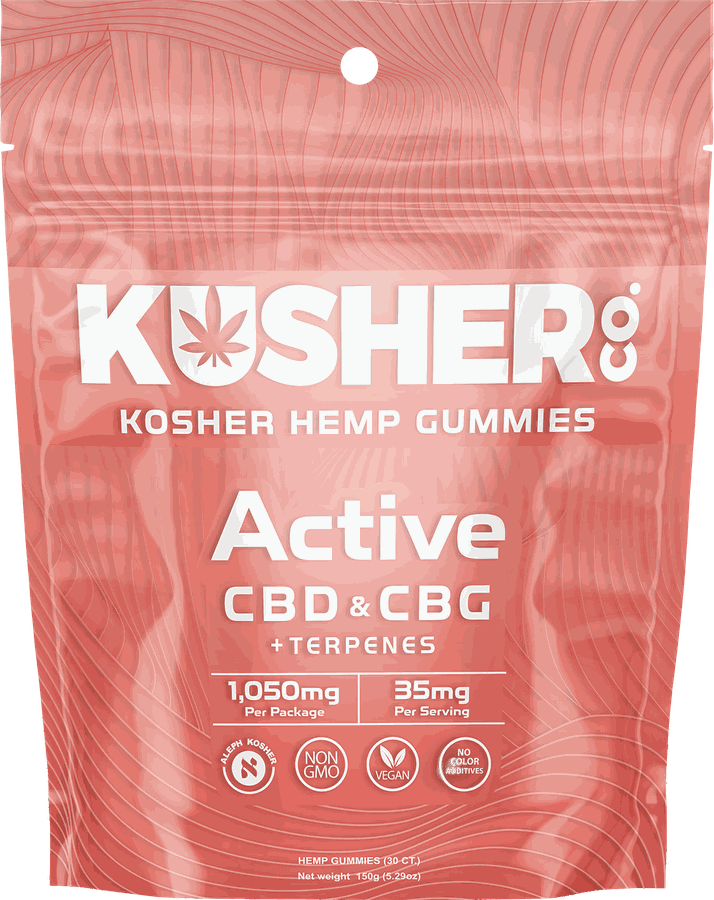
The number on the front of a hemp package is usually a total for the container, and the number that actually describes what you are taking is the per serving figure printed somewhere smaller on the back. Confusing those two is the most common label mistake in this category, and everything else on a hemp label is easier to read once that distinction is fixed in your head. A percentage is a third thing again, and it is not a dose at all.
We put a lot of thought into what goes on our packaging, so this is a walk through our own labels, what each element means and what it does not establish. Some of what follows is an argument for why our labels look the way they do. All of it applies just as well to a label we did not write.
Total milligrams and per serving milligrams are different numbers
A total tells you how much active material is in the container. A per serving figure tells you how much is in the amount you actually take. They answer different questions and only one of them is about you.
A large total on the front of a package looks impressive and is easy to compare against a rival package on a shelf, which is precisely why it is the number that gets the biggest type. It is not a lie. It is simply not the figure you need in order to decide anything.
The arithmetic that converts one into the other is trivial and almost nobody does it. Divide the container total by the number of servings in the container. That gives you the number that governs your evening. If a package makes that division difficult, or does not tell you how many servings it holds, treat the omission as a finding rather than an oversight.
Serving size is where the two numbers meet
Serving size is the quiet field that makes the whole label coherent. On a gummy it is a count of pieces. On our tincture it is a volume drawn with the dropper.
Two products carrying identical totals can put very different amounts into a single serving, purely because they divided the container differently. That is not a trick, it is a formulation decision, and it means a total by itself cannot rank two products against each other in any way that matters.
When you compare hemp products, compare per serving figures. When you compare value, compare totals against price. Those are two separate exercises and mixing them produces a conclusion that is wrong in both directions.
A percentage is a concentration, not a dose
This is the one people misread most confidently. A percentage describes what fraction of the product's weight is a given compound. It says nothing on its own about how much of that compound you are taking, because that depends entirely on how much of the product you consume.
A large product at a low percentage can carry more total material than a small product at a higher one. That is not a paradox or a loophole, it is just what a ratio is. A percentage is a property of the material. A dose is a property of the material multiplied by the amount you took.
So when you see a percentage on a hemp label, the correct next question is always the same. A percentage of what quantity? Until you have that, the figure is describing the substance rather than describing your serving.
What total THC under 0.3 percent actually governs
Our Happy Hour Kosher Hemp Gummies carry the line total THC under 0.3 percent, and that number is doing specific legal work rather than sitting there as reassurance.
Hemp is separated from other cannabis by THC concentration measured on a dry weight basis, with 0.3 percent as the dividing line. That threshold is what makes a plant, and the material derived from it, hemp in the first place. It is a definitional boundary about what the product is.
What it is not is a statement about how much THC you will consume. It is a concentration, subject to everything in the section above. A buyer who reads 0.3 percent as a small dose has misread a category definition as a serving size. The two are unrelated, and Happy Hour also contains Delta-8 and Delta-9 with live resin, which is information the percentage does not carry at all.
Hemp extract and CBD are two different claims
These get used interchangeably in marketing copy and they are not the same statement. CBD names one specific compound. Hemp extract names the material that came out of the plant, which contains that compound alongside others.
A label that says hemp extract and gives a milligram figure is telling you about the weight of extract. A label that says CBD and gives a milligram figure is telling you about the weight of one compound within it. Those numbers can differ substantially for the same physical product, and a package that reports the larger one without saying which it is has told you something technically accurate and practically useless.
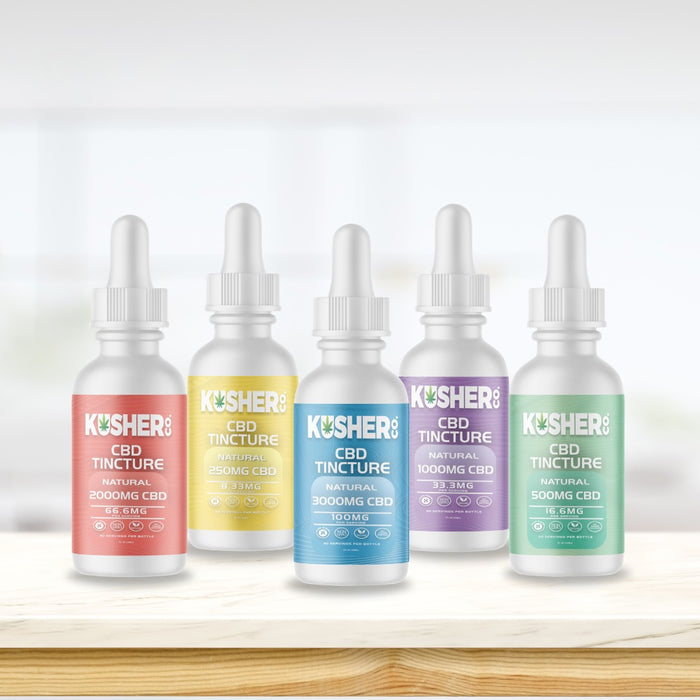
Our tincture is a Full Spectrum Kosher Hemp Extract CBD Tincture, and the strength ladder runs 250mg, 500mg, 1000mg, 2000mg and 3000mg from $20.00 to $40.00. The naming is deliberately long because each part of it is a separate fact about the product rather than a stack of adjectives.
Full spectrum is a word about what was kept
Full spectrum describes an extraction that retained the wider set of cannabinoids and the terpene fraction the plant produced, rather than stripping the material down to a single isolated compound.
It is a claim about a process and about what survived that process. It is not a claim about strength and it is not automatically a claim about quality. A well made isolate and a well made full spectrum extract are both legitimate products, and they are legitimately different things.
The practical consequence of full spectrum shows up in taste, because a fuller extract carries more of the plant's own character. If a product describes itself as full spectrum and tastes of nothing at all, that is worth a second thought.
The cannabinoid list tells you what a formula was designed around
On our gummies the ingredient list is the clearest signal of intent on the whole package, more so than any name or any color on the bag.
- Wellness Kosher Hemp Gummies at $29.99 list CBD and terpenes. One cannabinoid, plus the aromatic fraction.
- Active Kosher Hemp Gummies at $29.99 bring CBG in alongside the CBD, with terpenes.
- Night Time Kosher Hemp Gummies at $29.99 combine CBD with CBN and melatonin, and melatonin is not a cannabinoid at all.
- Happy Hour Kosher Hemp Gummies at $29.99 are Delta-8 and Delta-9 with live resin, at total THC under 0.3 percent.
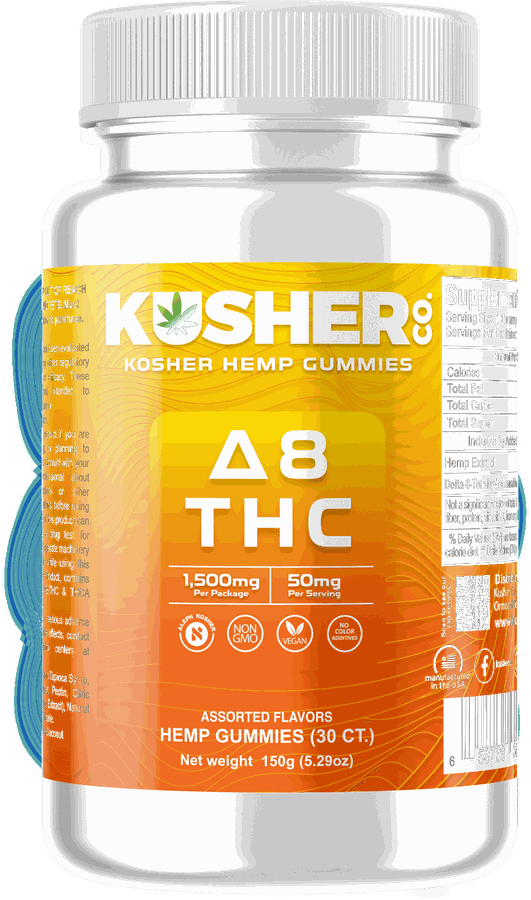
- D8 Kosher Hemp Gummies at $39.99 come in a jar and are built on Delta-8.
Read those lists and you can see the design decisions without reading a word of marketing copy. A product that treats every cannabinoid as interchangeable, or that lists a proprietary blend without saying what is in it, has withheld the only part of the label that carries real information.
What a milligram figure on a topical means
Our Cooling Pain Relief Gel at $25.00 carries 500mg of CBD. So do our Cooling Relief Stick and Heating Relief Stick, both at $20.00. Our Joint and Muscle Roll on Relief and our Pain Relief Gel Roll On, also $20.00, carry 350mg.
Every one of those figures is a total for the container. It is not a per application number, and a topical has no serving size in the way an edible does, because how much you apply at once is entirely up to you and varies by the size of the area you are covering.
That makes a topical milligram figure genuinely harder to reason about than an edible one. What it usefully tells you is concentration relative to the size of the container, which is why the 500mg gel and the 350mg roll ons are different products rather than different sizes of the same product.
The rest of the ingredient list is not decoration
Topical labels carry a longer ingredient list than edibles and those ingredients are doing real work in the formulation. Our Cooling Pain Relief Gel contains rosemary and thyme extract along with tea tree and mint. The Cooling Relief Stick uses eucalyptus and mint in a base of coconut oil and shea butter, with tea tree. The Heating Relief Stick shares that base and mint, eucalyptus and tea tree, and is formulated as a warming product rather than a cooling one. Our Joint and Muscle Roll on Relief lists menthol, tea tree and aloe.
Those choices explain the difference between products that would otherwise look identical on a spreadsheet. The base determines how the product spreads and how it feels going on. Menthol and mint are why a cooling product reads as cooling.
If you have a sensitivity to any botanical, the topical shelf is where the label matters most, because that is where the ingredient count is highest.
What a self declared label can and cannot establish
Almost everything discussed so far is asserted by the company selling the product. The milligrams, the percentages, the extraction description. All of it is the manufacturer's own statement about its own goods.
That does not make any of it false. It does mean that a shopper holding the package has no independent way to check a single figure on it. You cannot look at a gummy and see how much CBD it contains, and you cannot look at an extract and see whether the process matched the description.
Careful language on a package is a signal of a company that has thought about its labels. It is not evidence about the contents. Those are different things and the category regularly encourages buyers to treat them as the same.
What an outside certification adds
Every product we sell is kosher certified, which is unusual in hemp and is the reason many of our customers found us. The value of it for a buyer, including a buyer with no interest in kosher requirements as such, is structural.
A certification means a body outside the company examined the ingredients and the processing and put its own name to the result. That body has no stake in whether you buy anything, which is exactly what makes its statement worth more than ours. It is the difference between a company describing its own care and an independent party with the standing to inspect confirming what it found.
In a category where the manufacturing is invisible to the shopper and the finished product looks the same regardless of how carefully it was made, an outside reviewer is one of the few things on a package that a buyer cannot simply be told.
What no label can tell you
A label cannot tell you what a product will do for you, and any label that claims to is telling you something nobody in this industry is in a position to know about an individual. We do not print that sort of language and we are wary of packages that do.
A label also cannot tell you whether a formula suits your situation, whether it interacts with medication you take, or what amount is appropriate for your body. Those are questions for a doctor who knows your circumstances, not for a package.
What a label can do is describe the contents accurately, state the totals and the servings plainly, name the actual ingredients rather than a blend, and point at an outside party who checked. That is the honest ceiling of what packaging can achieve, and it is a lot more than most of this category attempts.
Bottom line
Find the per serving figure and ignore the big number on the front until you have it. Treat every percentage as a concentration and ask what quantity it applies to before you draw any conclusion from it. Read the cannabinoid list as a statement of what the formula was designed around, because it tells you more than the product name does. Then notice how much of what you have just read is the seller talking about itself, and give real weight to the one element on the package that is not, which is an outside certification from a body with nothing to gain from your purchase.
Frequently Asked Questions
What is the difference between total and per serving milligrams?
A total tells you how much active material is in the whole container. A per serving figure tells you how much is in the amount you actually take. Only the second one describes your evening. The total usually gets the biggest type on the front because it is impressive and easy to compare on a shelf, which is exactly why it is the wrong number to decide on. Divide the container total by the number of servings to get the figure that matters. If a package makes that division hard, treat the omission as a finding rather than an accident.
Is a percentage the same as a dose?
No. A percentage describes what fraction of the product's weight is a given compound, which is a property of the material rather than of your serving. How much you actually take depends on how much of the product you consume. A large product at a low percentage can carry more total material than a small one at a higher percentage, which is simply what a ratio is. Whenever you see a percentage on a hemp label, the next question is always a percentage of what quantity. Until you have that, the number is not about you.
What does total THC under 0.3 percent mean on your Happy Hour gummies?
It is a category definition rather than a serving size. Hemp is separated from other cannabis by THC concentration measured on a dry weight basis, with 0.3 percent as the dividing line, and that threshold is what makes a plant and the material derived from it hemp. It governs what the product legally is. It does not tell you how much THC you will consume, because it is a concentration and concentration alone never yields a dose. Happy Hour also contains Delta-8 and Delta-9 with live resin, which the percentage does not describe at all.
Are hemp extract and CBD the same thing on a label?
No, and they get used interchangeably in marketing copy where they should not be. CBD names one specific compound. Hemp extract names the material that came out of the plant, which contains that compound alongside others. A milligram figure attached to hemp extract is describing the weight of extract, while the same figure attached to CBD describes the weight of one compound within it. Those numbers can differ substantially for the same physical product, so a package that reports the larger one without saying which it is has told you very little.
What does full spectrum actually mean?
It describes what the extraction kept rather than what was added. A full spectrum extract retains the wider set of cannabinoids and the terpene fraction the plant produced, instead of being stripped down to a single isolated compound. It is a claim about a process and about what survived it. It is not a claim about strength and it is not automatically a claim about quality, since a well made isolate is a legitimate product too. The practical consequence shows up in taste, because a fuller extract carries more of the plant's own character with it.
What does the milligram number on your topicals refer to?
The total in the container, not a per application amount. Our Cooling Pain Relief Gel at $25.00 carries 500mg of CBD, as do the Cooling Relief Stick and Heating Relief Stick at $20.00 each. The Joint and Muscle Roll on Relief and the Pain Relief Gel Roll On carry 350mg. A topical has no serving size in the way an edible does, because how much you apply depends on the area you are covering. What the figure usefully conveys is concentration relative to container size, which is why the 500mg and 350mg products are genuinely different formulations.
Why does a kosher certification matter if I am not buying for kosher reasons?
Because of what it establishes structurally. Almost everything on a hemp label is the manufacturer's own statement about its own goods, and a shopper holding the package has no independent way to check any figure on it. A certification means an outside body examined the ingredients and the processing and put its own name to the result, and that body has no stake in whether you buy. In a category where manufacturing is invisible and the finished product looks identical regardless of how carefully it was made, that independence is worth real money.
What can a label never tell me?
What the product will do for you. Any package that claims to know that is asserting something nobody in this industry is in a position to know about an individual, and we do not print that sort of language. A label also cannot tell you whether a formula suits your circumstances, whether it interacts with medication you take, or what amount is appropriate for your body. Those belong to a doctor who knows your situation. What a label can honestly do is state the contents, the totals and the servings accurately and point at an outside party who checked.